Young Goodman Brown, by Nathaniel Hawthorne (1835)

I first read Young Goodman Brown in high school and recall being puzzled by it. Hawthorne’s prose was perhaps a bit too dense for me, as I suspect it was for most of my ninth grade English class. But there was something unsettling about it, and I returned to it again and again through the years. Eventually, Hawthorne became one of my favorite writers, but it was an acquired taste.

We’re in the Puritan village of Salem; the tale was written in 1835 but Hawthorne is reaching back to the witch trials of 1692-93. The story seems straightforward. Young Goodman Brown leaves his wife, Faith, to go out on some ‘evil purpose,’ against her wishes. He travels past the town meeting house in Salem Village, and Hawthorne sets a foreboding tone:

“It was all as lonely as could be; and there is this peculiarity in such a solitude, that the traveller knows not who may be concealed by the innumerable trunks and the thick boughs overhead; so that, with lonely footsteps, he may yet be passing through an unseen multitude.”

“What if the devil himself should be at my very elbow!” Brown remarks, as he continues on his way. He meets others from the village on his path, including a man who is older than him, around age fifty, but who looks just like him, and remarks in a very matter of fact way that he had done terrible things with Young Goodman Brown’s grandfather:

“I helped your grandfather, the constable, when he lashed the Quaker woman so smartly through the streets of Salem. And it was I that brought your father a pitch-pine knot, kindled at my own hearth, to set fire to an Indian village, in King Philip’s War. They were my good friends, both; and many a pleasant walk have we had along this path, and returned merrily after midnight. I would fain be friends with you, for their sake.” The stranger goes on to say that he is acquainted will the deacon, the governor, and other elders of the town. This shakes Brown’s understanding of his own family and village, leaving him quite unsettled.

This stunning section ramps up the tension until Brown hears the voice of his wife, Faith, and is distraught that she is in the woods. He arrives at a clearing where all the village is assembled; he and Faith are to be initiated in a ceremony, binding them to the devil. He calls out to Faith that she must resist and “look up to heaven,” at which point the villagers disappear.

Brown is unsure whether the entire story was a dream, but it bewilders him to the point that “A stern, a sad, a darkly meditative, a distrustful, if not a desperate man, did he become, from the night of that fearful dream.” Hawthorne’s final sentence is: “And when he had lived long, and was borne to his grave, a hoary corpse, followed by Faith, an aged woman, and children and grand-children, a goodly procession, besides neighbors, not a few, they carved no hopeful verse upon his tombstone; for his dying hour was gloom.”

It may not be entirely fashionable today to believe in good and evil or supernatural powers, but this story still leaves me unsettled. The idea that your friends and neighbors, or your entire conception of the world, may be totally wrong, is something no one wants to admit. But the devil is right there in the story, cheerfully informing Brown that his father committed atrocities, that his grandfather enthusiastically persecuted his neighbors, and that Brown himself is on friendly terms with evil. Everyone in Salem is implicated; the story takes place during the Witch trials, at which Hawthorne’s own grandfather was a judge, making this tale even more grim.

There are no easy interpretations or answers in this tale. Brown lives the rest of his days haunted by his knowledge. There’s no redemption for him from God, or from anyone else, even his beloved Faith.

Hawthorne wrote plenty more in this vein: A Scarlet Letter, The House of Seven Gables, and numerous stories, and all of them leave me with this same feeling of helplessness in the face of evil. They’re also incredible to read, with the stylized, romantic prose adding to the sense of gloom and mystery.

I am not sure of Hawthorne is still taught in high schools, but he ought to be. This is one of the best short stories you’ll ever read, one that has stayed with me in the three and a half decades since I first encountered it.

The October Country, by Ray Bradbury (1955)

We start the month with one of the finest collections of seasonal stories ever, by the great Ray Bradbury. Released in 1955, its significance in the genre can’t really be overstated, nor can Ray’s role in shaping Halloween as we know it today. Just leafing through this one is enough to give you a warm feeling of nostalgia and creepiness, to know that autumn is at hand. You start reading and immediately know you’re in the hands of a master.

I first encountered this one many years ago, and I make a point to re-read it nearly every October. The beautiful cover by Joseph Mugniani (with whom Bradbury often collaborated) sets the tone, and it keeps getting better as you read each tale. There are so many memorable stories here that it’s a bit like listening to the Beatles’ greatest hits: The Small Assassin, The Dwarf, Jack in the Box, on and on they go, each one weirder and more wonderful than the last. I love The Dwarf, the tale of a short man who visits a carnival fun house each night to see himself taller and more handsome, only to be cruelly abused by the fun house proprietor. For me, the centerpiece here is “The Homecoming,” which along with “Uncle Einar” are the strangest and most jaw-dropping of these stories. They’re so good that later in his career they became the backbone of another collection, ‘From the Dust Returned,’ which explores the Elliott family in all their glory.

Bradbury wrote so much over his long and storied career that it’s hard to pick just one novel or collection of his, but I think this one is most emblematic of all his best elements. Good-hearted, small-town people meet fantastic beings. Helpless loners and outsiders are treated cruelly by life but keep their souls intact through art and kindness. The wonder and mystery and imagination of the dark side of the world, all told with Bradbury’s poetic prose, heartfelt emotion, and wild imagination. It just doesn’t get any better than The October Country. We were so lucky to have had Ray.

Bradbury often wrote of the importance of feeding one’s imagination. Zen and the Art of Writing is a wonderful book for any writer, with lots of great observations on how to work at your craft. Mostly, he wants writers to stop thinking and just write. The ideas poured forth from his mind when he did this. One oft quoted passage from the book is: “If you did not write every day, the poisons would accumulate and you would begin to die, or act crazy, or both. You must stay drunk on writing so reality cannot destroy you.”

I think there’s a real lesson in this. Overanalyzing things, thinking too much, and soaking up too much information, which is very easy to do in our hyper-connected world, is the enemy of good writing. In my view, Bradbury’s method works. He was drunk on life and ideas and let them spill out in beautiful ways that have resonated with millions of readers for generations. May he keep finding new audiences forever. Thanks for all the stories, Ray.

Short Story, ‘Chess Match’

A new story of mine, Chess Match, was just published in the October issue of Black Sheep: Unique Tales of Terror and Wonder. It’s a tale of an ancient being living in our world, who must face down an old adversary. Check it out, and let me know what you think.

31 Tales of Halloween

‘The Halloween Tree,’ by Ray Bradbury, 1964

October has long been my favorite month. I love Christmas, too, as well as every other holiday that affords me time to spend with my children. But there’s always been something special about October 31. As a child, I knew Halloween was a night devoted to kids, where magical things happened, where you had a bit of independence to go out with friends and have a grand time. The costumes, the folklore, the changing of the seasons, all add warmth and wonder to this grand day. My own children have enabled me to experience these feelings again. It is so fun enjoying the fall with them: decorating the house, creating costumes, getting ready. The anticipation of it, the colors and sounds and stories, are almost better than the day itself.

The stories are the things that really animate it for me. The list of writers I admire in this season is almost endless, but it begins somewhere around Shakespeare and continues into the present. Shelley, Poe, Hawthorne, Stoker, Lovecraft, Jackson, Bradbury—my list goes on and on. The only thing that stops me from reading all these authors constantly is lack of time.

This October, time permitting, I intend to have a project on this blog, where I write some thoughts about some of my very favorite tales in the genre. I can’t promise I’ll do so every day, though that is the goal. Certainly, I’ll do a post weekly, or every couple of days. These posts aren’t meant to be comprehensive, scholarly, or to offer some kind of profound critique. It’s mostly just for me, to write up thoughts and impressions and appreciation of these tales that affected me: why I like them so much, how they work, why I have such affection for them, in that vein. Hopefully I’ll add to the catalog throughout the year, with other seasonal tales. Maybe some readers out there feel the same way about some of these stories. My hope is to document some of my very favorite books and stories, and perhaps turn some readers out there onto some tales they may have overlooked, or never heard of. There are a great number of unappreciated stories out there that ought to have more attention, in my view.

So, I’ll see how it goes. If you’re a like minded reader, I hope you join in the fun by commenting or offering your own thoughts.

I’ll probably begin early, before October 1, with some other seasonal type stories to get started. I’ll throw in some children’s stories that I’ve been reading with my family as well.

I’ll post more soon. I hope those reading this enjoy the season. I plan to be outside as much as possible in the next six weeks, to enjoy the beauty of fall, before it gets too cold and the leaves are gone.

Happy Autumnal equinox. Enjoy your fall!

Meta’s Theft and AI

Over the past few years, there’s been no shortage of folks breathlessly telling us that AI is our new tech to be worshiped, that it is a wonderful and amazing tool that we all must rush to use. It will make life better, and everything will be easier and more effortless. Besides, there is the whole inevitability thing, an argument which tech bros love to shove down our throats, the same way they do with every other technology on which their fortunes depend.

I’d like to offer a different view. AI is a soulless source of junk information, bad writing, and bad ideas. On a personal note, the creators of Meta’s AI program stole my novel, without asking, to ‘train’ their stupid tool. They’ve illegally done this with millions of works, but when called out on this lawless behavior, the companies merely shrug and inform us that there would be no way to train their tools if they had to deal with pesky copyright laws. Authors are powerless in the face of these tech forces, it seems. It’s all inevitable: the bright, shiny future.

Forgive me for a moment if I seem emotional here. My humble novel, The Osprey Man, was a labor of love. I spent years writing it, and years beyond that marketing it, and it finally found a home at a tiny, independent publisher. I made very little money from it, but of course, as any decent writer will tell you, that was never the point. I had a story I wanted and needed to get out there. It may not have sold many copies, but I didn’t care.

My story of publication isn’t unique. There are plenty of writers out there who have done and continue to do the same, despite the odds. Zuckerberg and his lackeys, no matter how rich and powerful, have no right to churn up our work like it’s fertilizer. Yet that’s exactly how Meta and every other purveyor of AI treat the copyrighted works of millions of writers. It’s revolting, undemocratic, downright vile behavior, yet it’s exactly the sort of thing we’ve come to expect from our tech overlords, and no one even bats an eye. In fact, the story barely seemed to make news and disappeared rather quickly.

Aside from the outrageous way Meta has treated authors, there is a much larger issue with AI, and how it’s bound to affect us all. In 1985, Neil Postman, in his seminal work Amusing Ourselves to Death, argued convincingly about the death of our reading culture, and how television had dumbed us down so much that it had reduced our once coherent public debate to mere sound-byte and spectacle. In Postman’s view, things had gotten so bad that Americans elected a nincompoop in Ronald Reagan. I’m sure he’d not be the least bit surprised by America in 2025, where, after a generation of hyper-connectivity and bad information, there seem to be few who believe in facts at all anymore, and we elected a far more ignorant, dangerous man than Reagan as president.

Give AI some time, and we will no doubt have an even dumber public life, one in which no one is able to read or understand anything more complicated than a meme. Where no one knows what reality is, and no one really cares anyway, since it’s AI’s job to figure out the issues and tell us what to think.

The King of Dogwood Street, Chapter Three

In the last installment of The King of Dogwood Street, (a comedy of good, evil, and home improvement), Billy Joe had a day of reckoning when the police showed up to put an end to his drunken property destruction.

In chapter three, he and his dimwitted buddy, Travis, are in the town lockup trying to figure out where it all went wrong. Will they escape? What charges might they face? Will they drive their arresting officer crazy? And will Billy ever overcome his hangover? Read on to find out!

If you missed previous installments, you can find them below:

Storytelling Panel in Poughkeepsie

If you are in the Poughkeepsie area, stop by the Unitarian Universalist Fellowship this Sunday, where I’ll be part of a panel on storytelling. It’ll be a fun time, and there will be books for sale from the authors on the panel. https://www.uupok.org/welcome/upcoming-events

Happy New Year!

Kafka and Belle da Costa Greene at The Morgan Library and Museum

I was at the Morgan Library and Museum this week and wanted to give a brief reflection on their current exhibits, and how much I enjoyed them. We are lucky to have this museum in New York, and I can’t recommend a visit highly enough. Originally, it was J.P. Morgan’s personal library, and later became a public institution. There are always different exhibitions there; over the years, I’ve seen things ranging from Blake engravings, to Mary Shelley and Frankenstein, to Tolkien, to Dickens, among others. If you live in or near New York, by all means go for a visit. They also have lectures and concerts regularly, and every Friday evening is free admission from 5-8. Educators and students also receive a discount.

Franz Kafka

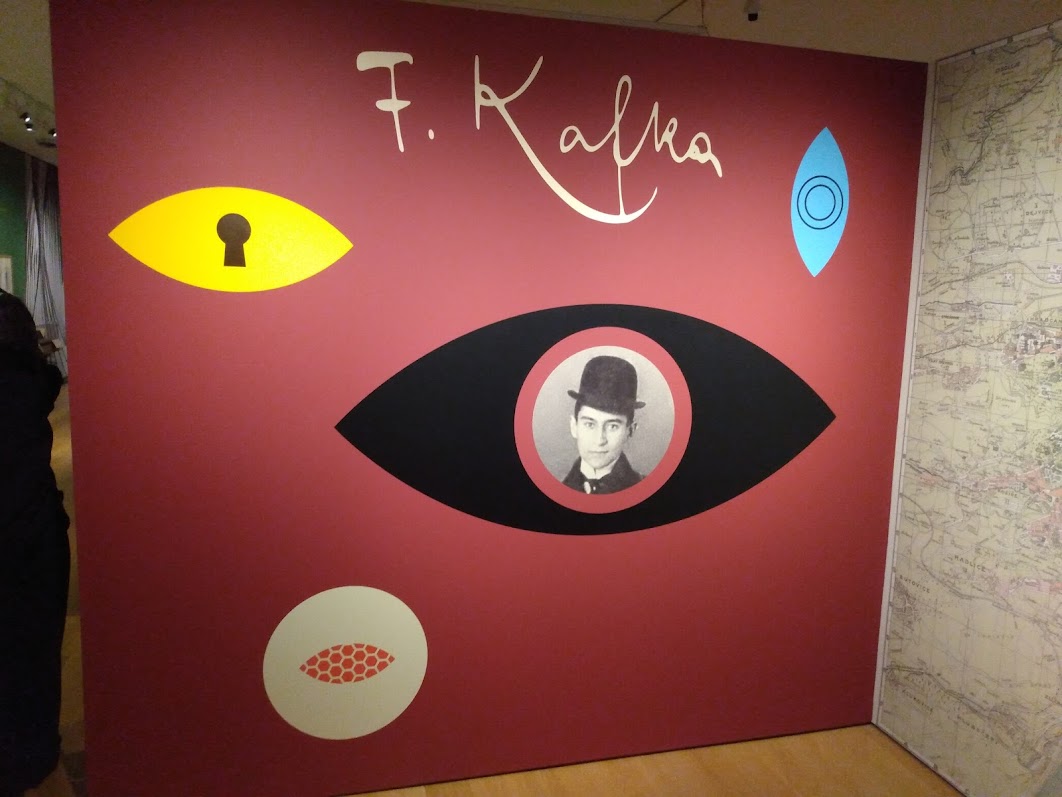
I made this recent trip for the Franz Kafka exhibition, which was every bit as wonderful as I’d hoped. There were many of his handwritten manuscripts, journals, letters, photographs, and other personal effects on display. Anyone with an interest in him and his work should definitely go. It gave me a more intimate look into his life and work, and I found something quite haunting about it. Such a tragedy that he died so young, and it made me wonder what else he might have accomplished had he lived longer.

Kafka’s work has meant quite a lot to me, especially when I was a young man, and so I was very pleased to see him celebrated at the library. I still recall the chills I got reading The Metamorphosis as an undergraduate, and the feeling of urgency I had in finding the rest of his stories and books and reading those, too. I was so inspired that at one point I wrote my own little comical story about a superintelligent, powerful cockroach, which won an award from my college’s literary magazine. I am sure it was embarrassingly bad, but I had so much fun writing it.

I particularly enjoyed the handwritten copy of the Metamorphosis that was on display, and which was accompanied by contemporary textbooks of insect larvae and roaches. I had not thought of the Darwinian connection before seeing it laid out in this way, but as the display suggested, these were somewhat new fields of study at the time, with which Kafka would have been acquainted, and may have inspired him to write the story. Kafka is, of course, a towering figure in modern literature and his influence on contemporary fiction and culture is hard to overstate. This exhibit did a lot to help me appreciate him more as a human being and an artist. Photos of him and his fiancee, as well as details of his ill health, lent a very personal touch to a writer who sometimes can seem very remote and cryptic.

Belle da Costa Greene

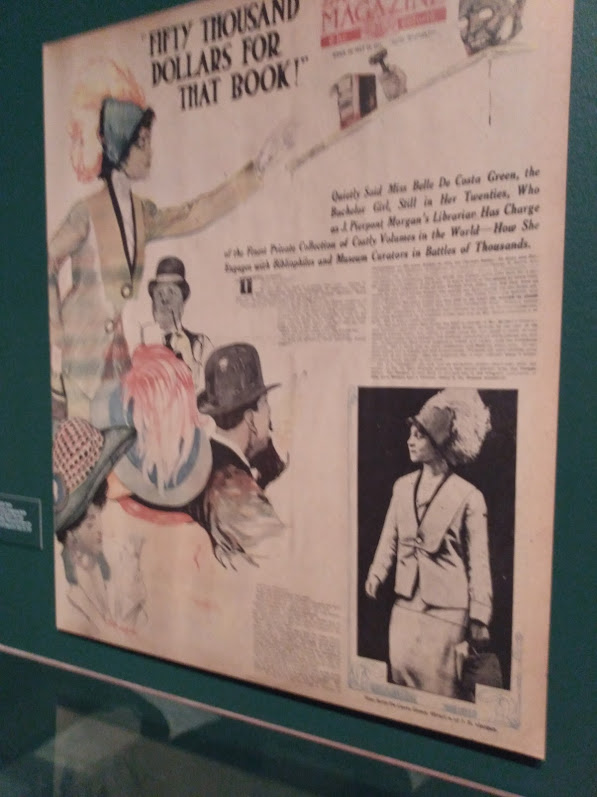
After having seen the effective, thought provoking Kafka exhibit, I moved back to the first floor to see the other exhibition, about which I knew nothing. But what an experience visitors will have in learning about the life of Belle da Costa Greene, the first director of the Morgan. She was an amazing person who built the Morgan’s collection of rare books and manuscripts, and was a well known authority on these treasures. In the process of creating the library, she traveled the world to make acquisitions, and shaped it into a world class institution.

Belle’s father was the first black graduate of Harvard, and Belle and her family passed as white in segregated America. Much of the exhibit explores this part of her life, and it’s a breathtaking biography.  She was a brilliant scholar and a cultural force at the Morgan, but a lot of her life was tinged with tragedy. The details about her her nephew were quite moving; he was a soldier in World War II who committed suicide when his fiancée learned he was not white and broke off their engagement. The exhibit gave other harrowing examples of stories like this, of ‘passing’ blacks in a segregated country.

I appreciated the display of Belle’s own collection of books and cultural treasures. She had exquisite tastes and collected illuminated manuscripts, paintings, sculpture, and other artifacts. It was an interesting window into her personal life.

This exhibit also included many examples of illuminated manuscripts, for which Belle had a passion and much expertise. It’s a bit overwhelming seeing all of these ancient books laid out for perusal, and it’s best to take your time and look at the intricate detail of things like the Crusader’s Bible, among other medieval treasures.

I also learned that the NYPL used to have a library school, and at one point there was a course in rare books taught at the Morgan, using their resources. There was a syllabus on display that was a really fascinating look at library education from the 1920s. I’d love to take a course like this, incidentally. (I took a couple of rare books courses while doing my MLS and loved them, but to do it at a library like the Morgan would be a lifelong dream for any bibliophile.)

Belle’s life seems quite ripe for a film or a biography. And her life’s story should cause anyone to reflect on this country’s shameful past. These pernicious evils–racial segregation, passing, and other injustices–were not so long ago, and we have a long way to go to become a world that treats everyone equally. Belle’s remarkable life is a testament to what an exceptional person and scholar she was, and I was happy to see so many people learning about her. I can’t recommend the exhibit highly enough. Everyone should go.

I hope Belle would be pleased by the legacy she left at the Morgan. Her hard work and dedication live on through the collections and the stories they tell us about our culture and history.

Welcome to Freak Show II

I’d been hesitant to post anything since election day. What can anyone say about this situation that hasn’t already been said? In my opinion, all you need to do is look at the decline of reading and critical thinking skills to understand the second rise of the sexual assaulting felon. When an entire electorate stares at screens 80 hours a week, don’t or can’t read anything challenging, and believe all kinds of disinformation and nonsense, guess what happens?

During his last term, I read more American history than is usual for me, hoping to see some similarities to our current times in our past. We have seen much worse days than this, and survived as a nation. In some of our most tumultuous eras, it was never certain that we would make it through, but somehow, we did.

I don’t know what the next few years will bring, exactly, but I will be surprised if the great dictator doesn’t try to suspend elections. He’s already talked about doing that, as well as rounding up millions of immigrants. His proposed cabinet members are a farce and a disgrace, unqualified people who hate the government agencies they’ll be running, just like last time. His voters wanted this, and we’re all about to get it.

One thing I heard a lot of from 2016-2020 are variations of ‘this is not who we are—we’re better than this.” No, we aren’t. This is exactly who America is and what we want. We can take a little solace in the millions who voted against him, but that’s cold comfort. A man as mendacious and vile as this should have been thoroughly repudiated.

My job is to just try and make sure my children are safe and happy. There is little else we can do. Locally, you can try and make your community better. You can volunteer and try and make your corner of the world a little more humane. Make your voice heard to your elected representatives. Beyond that, we can just hope for the best.

My wife and I don’t talk politics around our children, since that would be a crazy thing to do, and we want to let them enjoy their childhoods. We did look at an electoral map together, and they are aware who won. My nine-year-old daughter, who is a brilliant artist and incredibly smart and perceptive in ways that I was not at her age, summed things up perfectly afterward. “Bruh—it was a girl’s turn after all this time. And that guy is so dumb, and such a mean bully. Just look at him.”

Children intuitively understand things, no matter what adults might say. She knows a lying creep when she sees one. I have never seen a picture of this man where he is smiling and it looks natural, because he is a deeply miserable human being who hates himself and continues to take it out on the entire world. As soon as he starts talking, this is self-evident.

The religious people who voted for him could be the topic for an entire book. All I can say about them is that they ought to be deeply ashamed of themselves, but I’m sure they are not. He’s an imperfect vessel on a mission from Jesus, after all.

And that’s enough about elections. I refuse to follow news cycles for years on end. I’m turning it all off. It will be hard to miss the worst of what he’ll do, but there is little point in following it week after week with every new outrage.

In other news, I have a few writing projects I’m working on, and a deadline I have to meet in a few weeks. I’ll have plenty to keep me busy through the end of the year and the start of next.

One day at a time, as the saying goes.

The King of Dogwood Street, Chapter Two

As promised, here is chapter two of my novel, The King of Dogwood Street, a neighborly comedy of good, evil, and home improvement.

When we last saw our heroes, they were in conflict with a drunken neighbor Billy Joe, who was challenged by Rex, a strange newcomer. Enraged by his defeat, Billy sought vengeance in the form of petty vandalism.

In Chapter two, the police arrive to the scene of the crime, and Billy must fight both his own stupidity and his hangover to avoid charges. The rest of he neighborhood happily watches the drama unfold. Read on!

If you missed the first chapter, it’s also uploaded on the blog for your reading enjoyment– please see the links below. If you enjoy it please share and let me and others know what you think.

https://christuthill.wordpress.com/2024/06/19/new-project/