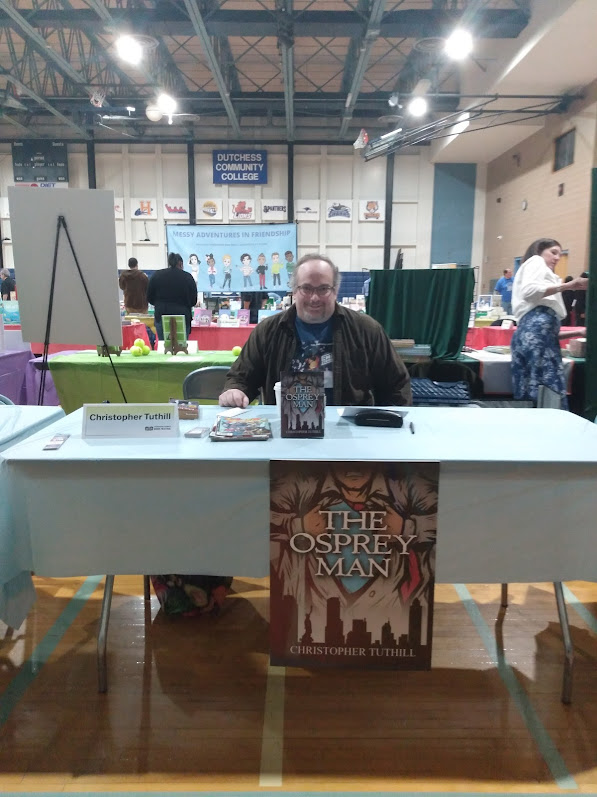
The 2025 Poughkeepsie Children’s Book Festival was a huge success. Many thanks to both the Merritt Bookstore and the Poughkeepsie Public Library, who worked tirelessly to put on a great event. It was really heartening to see so many enthusiastic children and young adults. They’re the next generation of readers and the future of our world, and they need our support.
Many thanks to all the people I met, and to those who bought books from me and the more than 100 authors who were there. My children had a great time, met some authors, and came home with lots of great stuff to read. I hope by next year’s event I’ll have another book to bring with me.
Over the past few years, there’s been no shortage of folks breathlessly telling us that AI is our new tech to be worshiped, that it is a wonderful and amazing tool that we all must rush to use. It will make life better, and everything will be easier and more effortless. Besides, there is the whole inevitability thing, an argument which tech bros love to shove down our throats, the same way they do with every other technology on which their fortunes depend.
I’d like to offer a different view. AI is a soulless source of junk information, bad writing, and bad ideas. On a personal note, the creators of Meta’s AI program stole my novel, without asking, to ‘train’ their stupid tool. They’ve illegally done this with millions of works, but when called out on this lawless behavior, the companies merely shrug and inform us that there would be no way to train their tools if they had to deal with pesky copyright laws. Authors are powerless in the face of these tech forces, it seems. It’s all inevitable: the bright, shiny future.
Forgive me for a moment if I seem emotional here. My humble novel, The Osprey Man, was a labor of love. I spent years writing it, and years beyond that marketing it, and it finally found a home at a tiny, independent publisher. I made very little money from it, but of course, as any decent writer will tell you, that was never the point. I had a story I wanted and needed to get out there. It may not have sold many copies, but I didn’t care.
My story of publication isn’t unique. There are plenty of writers out there who have done and continue to do the same, despite the odds. Zuckerberg and his lackeys, no matter how rich and powerful, have no right to churn up our work like it’s fertilizer. Yet that’s exactly how Meta and every other purveyor of AI treat the copyrighted works of millions of writers. It’s revolting, undemocratic, downright vile behavior, yet it’s exactly the sort of thing we’ve come to expect from our tech overlords, and no one even bats an eye. In fact, the story barely seemed to make news and disappeared rather quickly.
Aside from the outrageous way Meta has treated authors, there is a much larger issue with AI, and how it’s bound to affect us all. In 1985, Neil Postman, in his seminal work Amusing Ourselves to Death, argued convincingly about the death of our reading culture, and how television had dumbed us down so much that it had reduced our once coherent public debate to mere sound-byte and spectacle. In Postman’s view, things had gotten so bad that Americans elected a nincompoop in Ronald Reagan. I’m sure he’d not be the least bit surprised by America in 2025, where, after a generation of hyper-connectivity and bad information, there seem to be few who believe in facts at all anymore, and we elected a far more ignorant, dangerous man than Reagan as president.
Give AI some time, and we will no doubt have an even dumber public life, one in which no one is able to read or understand anything more complicated than a meme. Where no one knows what reality is, and no one really cares anyway, since it’s AI’s job to figure out the issues and tell us what to think.
On the occasion of my birthday, my four year old son brought me a package he’d wrapped himself, and proudly announced: “You got books, dad. They’re your favorite thing.” He dutifully unwrapped them, commenting on how nice they were, and handed them to me one by one. Even better, he gave me a card he’d written himself, his eyes shining with pride, grinning from ear to ear. He wants to read them with me and play the boardgame I got, too. He’s a keeper.
On Saturday, March 29, I’ll be at the Poughkeepsie book festival with copies of my novel The Osprey Man. Every child gets a voucher for a free book, and there are activities for the whole family. Hope to see you there! https://poklib.org/bookfestival/
In the last installment of The King of Dogwood Street, (a comedy of good, evil, and home improvement), Billy Joe had a day of reckoning when the police showed up to put an end to his drunken property destruction.
In chapter three, he and his dimwitted buddy, Travis, are in the town lockup trying to figure out where it all went wrong. Will they escape? What charges might they face? Will they drive their arresting officer crazy? And will Billy ever overcome his hangover? Read on to find out!
I was at the Morgan Library and Museum this week and wanted to give a brief reflection on their current exhibits, and how much I enjoyed them. We are lucky to have this museum in New York, and I can’t recommend a visit highly enough. Originally, it was J.P. Morgan’s personal library, and later became a public institution. There are always different exhibitions there; over the years, I’ve seen things ranging from Blake engravings, to Mary Shelley and Frankenstein, to Tolkien, to Dickens, among others. If you live in or near New York, by all means go for a visit. They also have lectures and concerts regularly, and every Friday evening is free admission from 5-8. Educators and students also receive a discount.
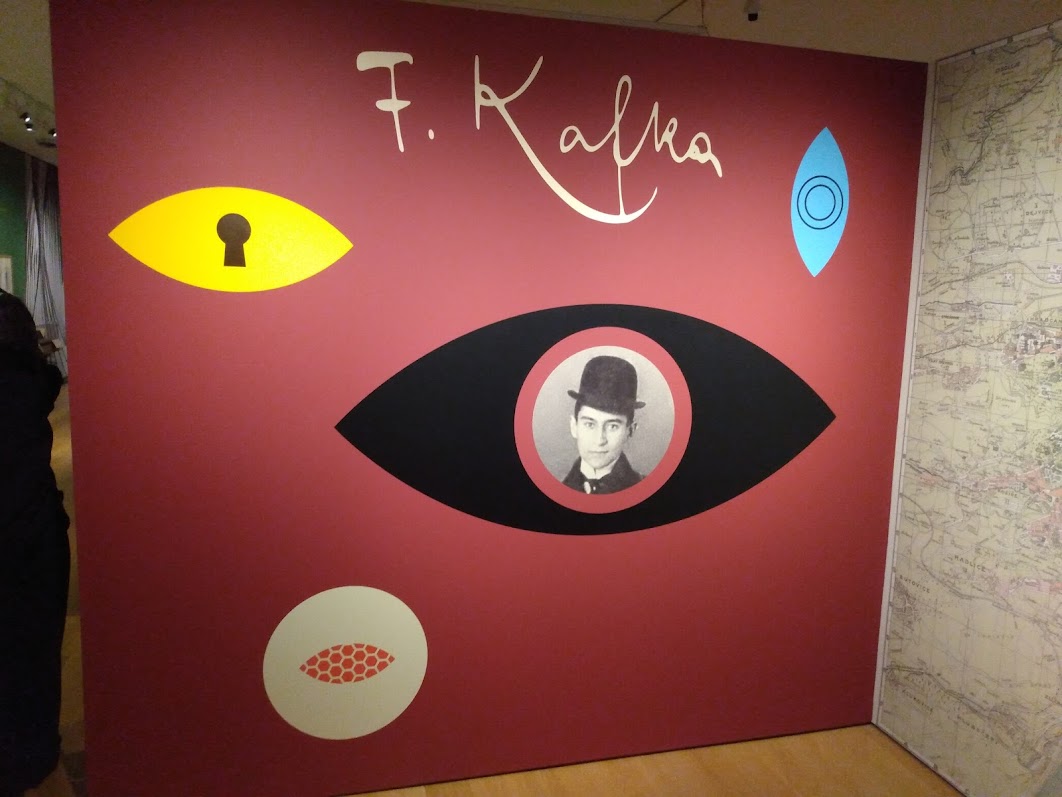
Franz Kafka
I made this recent trip for the Franz Kafka exhibition, which was every bit as wonderful as I’d hoped. There were many of his handwritten manuscripts, journals, letters, photographs, and other personal effects on display. Anyone with an interest in him and his work should definitely go. It gave me a more intimate look into his life and work, and I found something quite haunting about it. Such a tragedy that he died so young, and it made me wonder what else he might have accomplished had he lived longer.
Kafka’s work has meant quite a lot to me, especially when I was a young man, and so I was very pleased to see him celebrated at the library. I still recall the chills I got reading The Metamorphosis as an undergraduate, and the feeling of urgency I had in finding the rest of his stories and books and reading those, too. I was so inspired that at one point I wrote my own little comical story about a superintelligent, powerful cockroach, which won an award from my college’s literary magazine. I am sure it was embarrassingly bad, but I had so much fun writing it.
I particularly enjoyed the handwritten copy of the Metamorphosis that was on display, and which was accompanied by contemporary textbooks of insect larvae and roaches. I had not thought of the Darwinian connection before seeing it laid out in this way, but as the display suggested, these were somewhat new fields of study at the time, with which Kafka would have been acquainted, and may have inspired him to write the story. Kafka is, of course, a towering figure in modern literature and his influence on contemporary fiction and culture is hard to overstate. This exhibit did a lot to help me appreciate him more as a human being and an artist. Photos of him and his fiancee, as well as details of his ill health, lent a very personal touch to a writer who sometimes can seem very remote and cryptic.
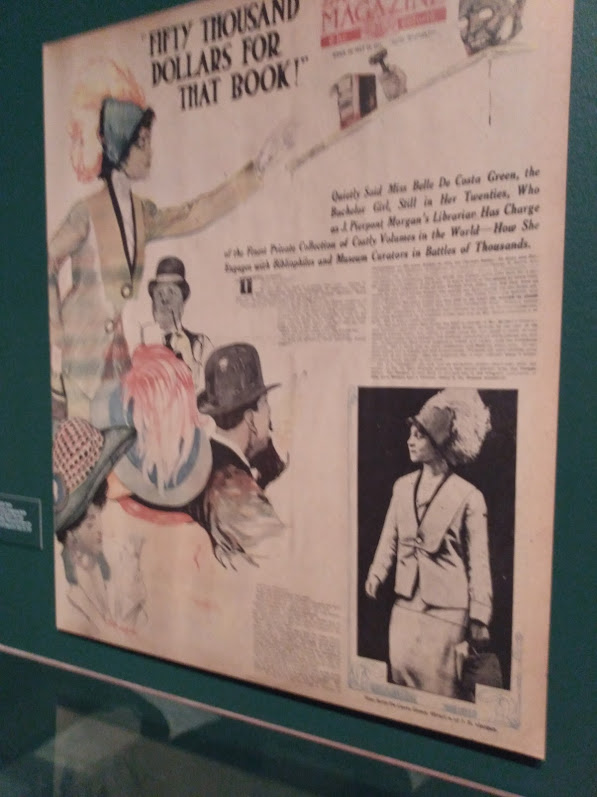
Belle da Costa Greene
After having seen the effective, thought provoking Kafka exhibit, I moved back to the first floor to see the other exhibition, about which I knew nothing. But what an experience visitors will have in learning about the life of Belle da Costa Greene, the first director of the Morgan. She was an amazing person who built the Morgan’s collection of rare books and manuscripts, and was a well known authority on these treasures. In the process of creating the library, she traveled the world to make acquisitions, and shaped it into a world class institution.
Belle’s father was the first black graduate of Harvard, and Belle and her family passed as white in segregated America. Much of the exhibit explores this part of her life, and it’s a breathtaking biography. She was a brilliant scholar and a cultural force at the Morgan, but a lot of her life was tinged with tragedy. The details about her her nephew were quite moving; he was a soldier in World War II who committed suicide when his fiancée learned he was not white and broke off their engagement. The exhibit gave other harrowing examples of stories like this, of ‘passing’ blacks in a segregated country.
I appreciated the display of Belle’s own collection of books and cultural treasures. She had exquisite tastes and collected illuminated manuscripts, paintings, sculpture, and other artifacts. It was an interesting window into her personal life.
This exhibit also included many examples of illuminated manuscripts, for which Belle had a passion and much expertise. It’s a bit overwhelming seeing all of these ancient books laid out for perusal, and it’s best to take your time and look at the intricate detail of things like the Crusader’s Bible, among other medieval treasures.
I also learned that the NYPL used to have a library school, and at one point there was a course in rare books taught at the Morgan, using their resources. There was a syllabus on display that was a really fascinating look at library education from the 1920s. I’d love to take a course like this, incidentally. (I took a couple of rare books courses while doing my MLS and loved them, but to do it at a library like the Morgan would be a lifelong dream for any bibliophile.)
Belle’s life seems quite ripe for a film or a biography. And her life’s story should cause anyone to reflect on this country’s shameful past. These pernicious evils–racial segregation, passing, and other injustices–were not so long ago, and we have a long way to go to become a world that treats everyone equally. Belle’s remarkable life is a testament to what an exceptional person and scholar she was, and I was happy to see so many people learning about her. I can’t recommend the exhibit highly enough. Everyone should go.
I hope Belle would be pleased by the legacy she left at the Morgan. Her hard work and dedication live on through the collections and the stories they tell us about our culture and history.
Yesterday I saw an ad for a company that promises to publish eight thousand (yes, you read that right) books next year using the power of AI. I won’t link to their page because if you’re reading this, you have probably seen it, or something about it, and if you have not I don’t wish to give the tech bros behind it any more traffic, slight as it may be from this unseen corner of the internet. Even so, I feel I must write something about this, because it enraged me so much to see it.
This company promises to cut down production times for a book from the usual 12-18 months to a few weeks. How? You might ask. I’ll tell you: they will do a horrible job of it and flood the market with unreadable trash. What truly sets these guys apart is the way they’ll steal from aspiring authors and turn out a lousy product, while happily saying they’re ‘tech disruptors’ without a shred of self-awareness or irony. They’re immensely proud of themselves and their predatory business model.
This brings me to the larger problem of AI in general, which we are constantly told is a wondrous new tool, an inevitability, a technology that will transform everything.
Why is this tech inevitable? Well, our tech overlords say so. They are never wrong, of course, and all their innovations have done nothing but improve our lives. Just look around—isn’t everything great? We have access to more information than at any point in human history, and the world is a veritable paradise, with only the wisest, kindest, most learned people in charge everywhere.
In my view, AI writing tools produce junk. If you want to use it to produce your own special brand of garbage, have at it. “But it’s a tool!” you protest. “Same as a wrench or a bicycle! It will make everything better.” Yes, everything will improve, except your ability to write and think clearly, your ability to read and understand information. It will not help this at all. In fact, it will likely do immense harm to these skills. It’s a plagiarism machine, trained unethically to churn out generic awfulness. But hey, it does it very quickly, and with minimal effort. Just dump in a few prompts, and call it a day.
Right now, higher education is in a race to see who can adapt to these AI machines quickest. Never mind the effect it may have on learning, they’ll just use it. We’re about to turn universities over to tech companies. And why shouldn’t we? What does it matter if people are educated and humane, so long as profits are healthy?
And in another generation, some other whiz bang tech developer will come along peddling some other kind of junk, and once again every education administrator in the land will get in the marching band and beat the drum for it, no matter what it may be.
Who cares what students are learning, anyway, except a few oddball humanities people who still actually read books, which are obsolete, dusty artifacts that any machine can produce in just a few minutes.
There has been so much written on Hamilton that I can’t add a whole lot here, except to say that I would not delay on reading Ron Chernow’s masterful biography of the man. Just a brilliant book, combining voluminous research with engaging, lively writing. Hamilton’s life story lends itself to such an epic scope, and I can see why it has captivated so many. It’s not often someone rises from absolutely nothing to the highest levels of fame and power.
Whatever your thoughts on Hamilton, whatever you already know about him, I would give my highest recommendation to Chernow’s book. A few years back I read his Grant biography, which was a similar tour-de-force, and kept me so eager to read more, despite its massive size.
I’m looking for other summer things to read, and am eyeing Chernow’s Washington, which won the Pultizer in 2011. I may have to dive into that next. Such a fine writer, really doing a great public service by helping us better understand these early years of our country.
My summer reading list is large and always too ambitious. I have a few other big ones I might read, will have to see what strikes my fancy. But I was considering Pynchon’s Against the Day, which I’ve never read, as well as some other history books (I recently got Bruce Catton’s civil war trilogy) and a few fantasy novels. As always, there are so many great things to read, and so little time!
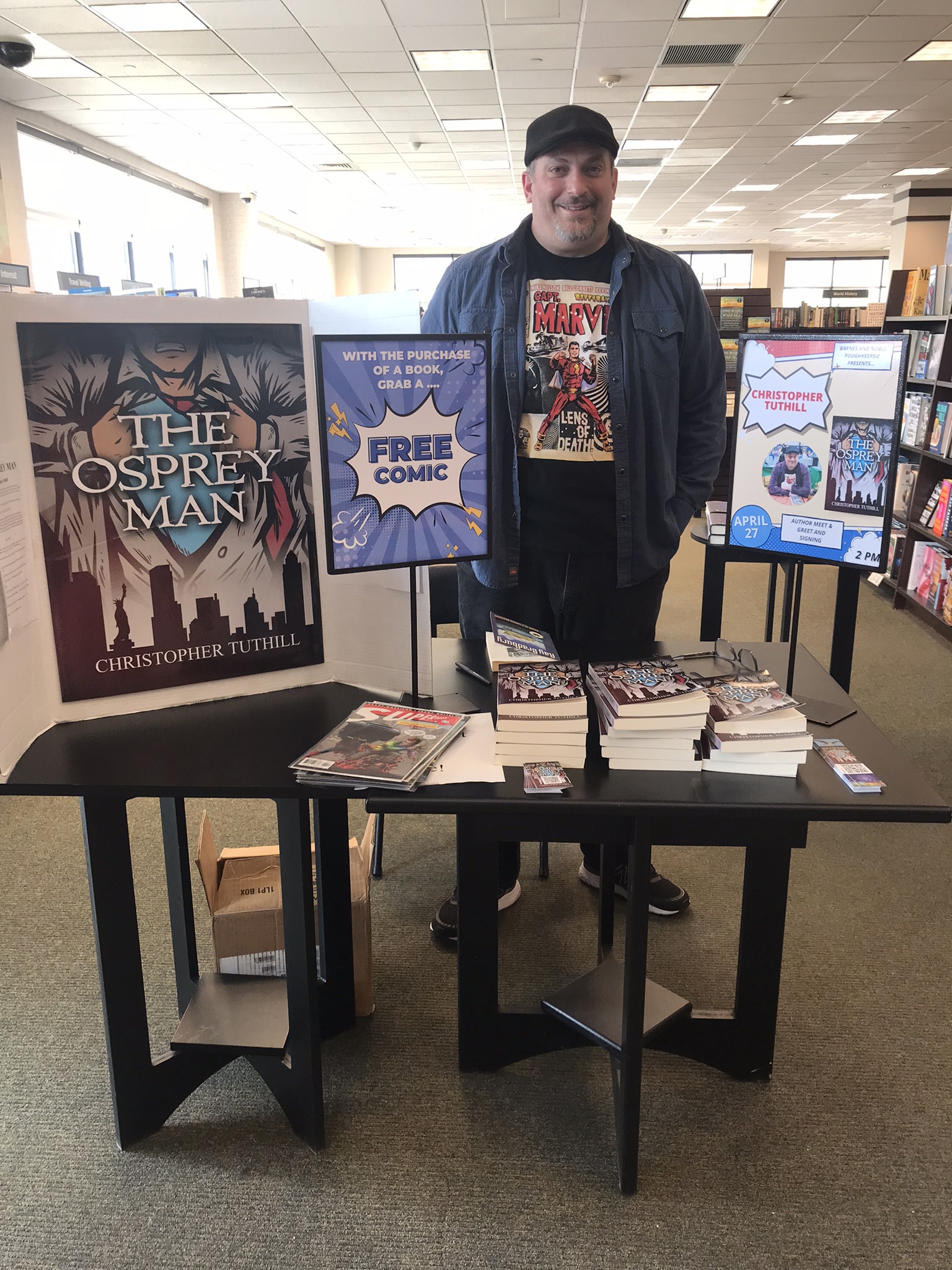
Here’s a photo of yours truly at the Barnes and Noble. I met a number of readers and signed some books, it was a great day. Hoping to do more events like this when the next book is released.



 Christopher Tuthill