Jethro Tull: Curious Ruminant

My opinion of the new Jethro Tull album doesn’t make much difference, but here it is anyway: it’s a total joy to even have one. Since I was a teenager, this has been my favorite band, and there will come a day that I won’t get any more new ones, so I’m enjoying the hell out of it.

We’ve been lucky enough to have three new Jethro Tull albums since 2022, and all of them have been fantastic. The Zealot Gene was a tour-de-force of biblical proportions, mingling sacred text and modern life, while 2023’s RokFlote was an epic exploration of Norse myths. Curious Ruminant is perhaps more down to earth, more contemplative, but no less searching–it’s a truly impressive artistic journey that gets better with repeated listenings.

The album should be listened to straight through, in one sitting, if you can manage it. As with all of Ian Anderson’s best records, this one ebbs and flows and gives the listener the feeling they’re looking at a giant canvas, revealed bit by bit, or reading a complex book and learning more in each chapter.

The opening song is the high-energy ‘Puppet and Puppet-Master,’ a reflection on the songster and his audience. We know we’re in capable hands as the band shows its chops with some fine electric guitar, organ and flute solos as Anderson delivers his tongue in cheek dramatization of what it’s like to get up there every night and play. “Holding court on a black box stage, dangling from the strings, I twirl and face the music,” he sings; the subject matter reminds me of ‘A Raft of Penguins,’ from his excellent 2003 album, Rupi’s Dance, which was a song about his nervousness in playing with an orchestra.

“Dunsinane Hill” is a real treat if you’re a Tull fanatic who also loves Shakespeare, like me. Having grown up in Scotland, one can only imagine how much MacBeth must have inspired Ian over the years. I absolutely love this song and it’s conceit: intrigue between two politicians discussing betrayal. Here the flute plays a merry folk tune even as the narrator says “I look over my shoulder/To see my brother warrior, damned spot to wash away.” I give this reimagining of the bard ten out of ten stars.

“Stygian Hand” is a sort of companion to Dunsinane thematically. Have you ever been nervous walking down a dark street alone? Here’s a song to help you. Bring a symbol of faith to ward off the devil and hope for the best. The accordian features prominently on this one. It’s a fun song and gives bit of levity to the otherwise fairly serious proceedings on this album.

“The Tipu House” is another up-tempo number, and here Anderson is singing of ‘All God’s children’; the subject is a tenement Anderson saw in Barcelona, and the residents, including young kids playing in less than ideal conditions. The flute is as manic as on any Tull track, the melody will leave you humming. It’s neat trick, to get an audience feeling empathy for their fellow man even while tapping their feet and singing along.

Other songs in this collection continue to encourage us to recognize our shared humanity, including the nearly 17 minute “Drink from the Same Well,” a fantastic piece of music that’s a meditation on differences that drive people apart. It seems a plea to remember that we’re all human and are worthy of respect, much as Aqualung was. The music is eastern-influenced, and Anderson said the bulk of the instrumental work dates from 2007, which explains why it would not sound out of place on his albums of that era.

“Over Jerusalem” is a song of lament for Israel that sounds like it could have been the twin of ‘Swing it Far’ from Thick as a Brick 2. You get the sense that Anderson, who has played in Israel many times over the years, donating all the money to charity, is as deeply saddened by the current situation as anyone.

“Savannah of Paddington Green” is a song about ecology, a subject Anderson has written of before, most famously in “Skating Away,” way back in 1973. “Threatening species, we turned on ourselves, like others before us, now left on the shelves,” he sings, wondering what the future may hold for our planet.

The final track on this one is a sort of goodbye, called “Interim Sleep,” a meditation on one’s final act. Most of us don’t want to think of the end, but I suppose Mr. A feels the weight of time.

“When interim sleep takes me

I want you close beside

No tears, no sad goodbye

I am calm and still as a fallen autumn leaf”

This is really quite sweet, and moving, as well as very unlike most Jethro Tull songs in that it’s personal and straightforward. Anderson has always preferred things that are more abstract, but that isn’t to say he lacks emotion. After all, his most famous song is a searing heavy rock number about a homeless vagrant, featuring a face melting guitar solo that Jimmy Page himself approved of as it was played. The best Tull songs are like this, melding high and low, profane and holy, mundane and beautiful.

The title track has the classic sound of this band–heavy guitar, flute, coupled with philosophical lyrics. Anderson is pondering life, ‘asking why am I here, answering, why am I anywhere,’ and ending with ‘cogito ergo sum.’ At 77, he’s as much a seeker as he ever was. I’m glad he’s taken us all along for the ride, and I sure hope it doesn’t end anytime soon.

Book Festival

On Saturday, March 29, I’ll be at the Poughkeepsie book festival with copies of my novel The Osprey Man. Every child gets a voucher for a free book, and there are activities for the whole family. Hope to see you there!  https://poklib.org/bookfestival/

The King of Dogwood Street, Chapter Three

In the last installment of The King of Dogwood Street, (a comedy of good, evil, and home improvement), Billy Joe had a day of reckoning when the police showed up to put an end to his drunken property destruction.

In chapter three, he and his dimwitted buddy, Travis, are in the town lockup trying to figure out where it all went wrong. Will they escape? What charges might they face? Will they drive their arresting officer crazy? And will Billy ever overcome his hangover? Read on to find out!

If you missed previous installments, you can find them below:

Storytelling Panel in Poughkeepsie

If you are in the Poughkeepsie area, stop by the Unitarian Universalist Fellowship this Sunday, where I’ll be part of a panel on storytelling. It’ll be a fun time, and there will be books for sale from the authors on the panel. https://www.uupok.org/welcome/upcoming-events

Happy New Year!

War of the Rohirrim

My twelve year old son, who loves Tolkien, said, “It’s like they took one line and made an anime movie about it.” Indeed, my boy. This grim, humorless trek through Middle-earth had a few fun moments, but not nearly enough of them to justify its two plus hour running time. Miranda Otto and Brian Cox are pretty good. This film’s entire raison d’etre appears to be that WB was about to lose the license to make more cash-generating adventures in Tolkien’s world. I give it a B-. For all its flaws, it’s still much better than the awful slop amazon keeps pushing at me. I hope Andy Serkis’ return in 2026 is more fun than this was.

Kafka and Belle da Costa Greene at The Morgan Library and Museum

I was at the Morgan Library and Museum this week and wanted to give a brief reflection on their current exhibits, and how much I enjoyed them. We are lucky to have this museum in New York, and I can’t recommend a visit highly enough. Originally, it was J.P. Morgan’s personal library, and later became a public institution. There are always different exhibitions there; over the years, I’ve seen things ranging from Blake engravings, to Mary Shelley and Frankenstein, to Tolkien, to Dickens, among others. If you live in or near New York, by all means go for a visit. They also have lectures and concerts regularly, and every Friday evening is free admission from 5-8. Educators and students also receive a discount.

Franz Kafka

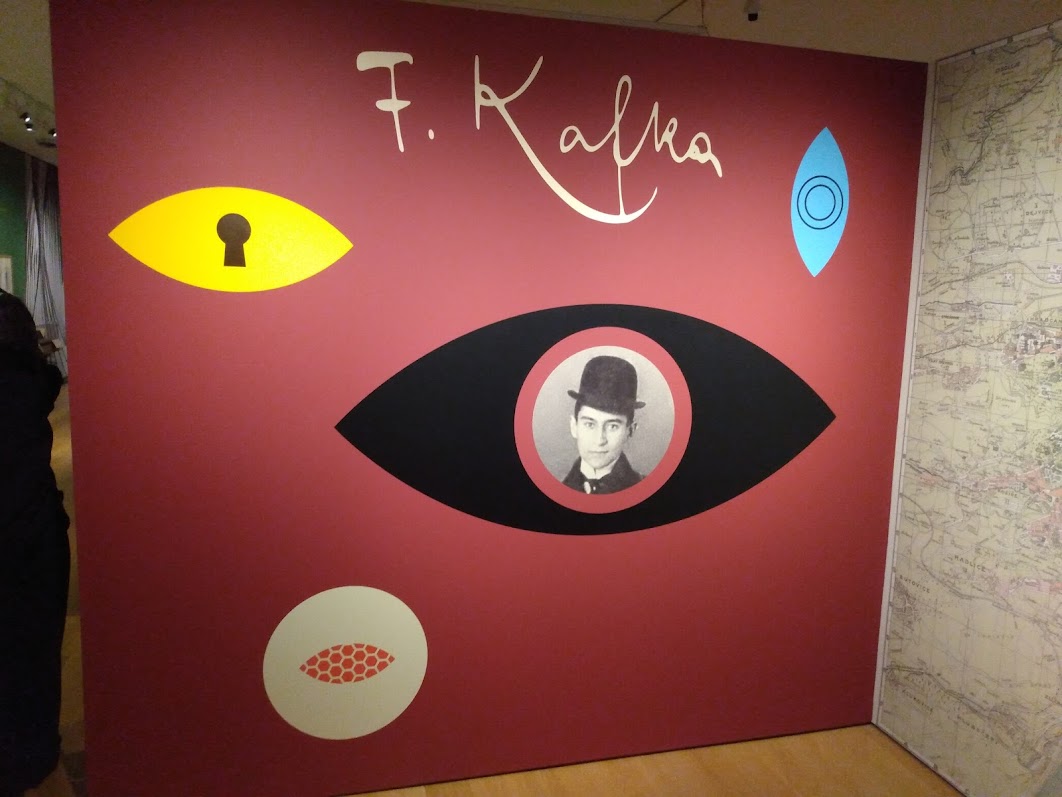
I made this recent trip for the Franz Kafka exhibition, which was every bit as wonderful as I’d hoped. There were many of his handwritten manuscripts, journals, letters, photographs, and other personal effects on display. Anyone with an interest in him and his work should definitely go. It gave me a more intimate look into his life and work, and I found something quite haunting about it. Such a tragedy that he died so young, and it made me wonder what else he might have accomplished had he lived longer.

Kafka’s work has meant quite a lot to me, especially when I was a young man, and so I was very pleased to see him celebrated at the library. I still recall the chills I got reading The Metamorphosis as an undergraduate, and the feeling of urgency I had in finding the rest of his stories and books and reading those, too. I was so inspired that at one point I wrote my own little comical story about a superintelligent, powerful cockroach, which won an award from my college’s literary magazine. I am sure it was embarrassingly bad, but I had so much fun writing it.

I particularly enjoyed the handwritten copy of the Metamorphosis that was on display, and which was accompanied by contemporary textbooks of insect larvae and roaches. I had not thought of the Darwinian connection before seeing it laid out in this way, but as the display suggested, these were somewhat new fields of study at the time, with which Kafka would have been acquainted, and may have inspired him to write the story. Kafka is, of course, a towering figure in modern literature and his influence on contemporary fiction and culture is hard to overstate. This exhibit did a lot to help me appreciate him more as a human being and an artist. Photos of him and his fiancee, as well as details of his ill health, lent a very personal touch to a writer who sometimes can seem very remote and cryptic.

Belle da Costa Greene

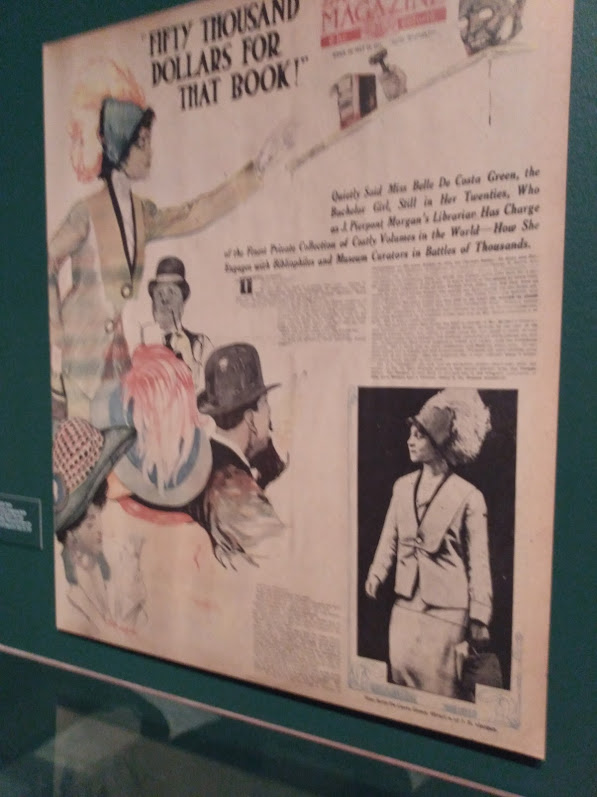
After having seen the effective, thought provoking Kafka exhibit, I moved back to the first floor to see the other exhibition, about which I knew nothing. But what an experience visitors will have in learning about the life of Belle da Costa Greene, the first director of the Morgan. She was an amazing person who built the Morgan’s collection of rare books and manuscripts, and was a well known authority on these treasures. In the process of creating the library, she traveled the world to make acquisitions, and shaped it into a world class institution.

Belle’s father was the first black graduate of Harvard, and Belle and her family passed as white in segregated America. Much of the exhibit explores this part of her life, and it’s a breathtaking biography.  She was a brilliant scholar and a cultural force at the Morgan, but a lot of her life was tinged with tragedy. The details about her her nephew were quite moving; he was a soldier in World War II who committed suicide when his fiancée learned he was not white and broke off their engagement. The exhibit gave other harrowing examples of stories like this, of ‘passing’ blacks in a segregated country.

I appreciated the display of Belle’s own collection of books and cultural treasures. She had exquisite tastes and collected illuminated manuscripts, paintings, sculpture, and other artifacts. It was an interesting window into her personal life.

This exhibit also included many examples of illuminated manuscripts, for which Belle had a passion and much expertise. It’s a bit overwhelming seeing all of these ancient books laid out for perusal, and it’s best to take your time and look at the intricate detail of things like the Crusader’s Bible, among other medieval treasures.

I also learned that the NYPL used to have a library school, and at one point there was a course in rare books taught at the Morgan, using their resources. There was a syllabus on display that was a really fascinating look at library education from the 1920s. I’d love to take a course like this, incidentally. (I took a couple of rare books courses while doing my MLS and loved them, but to do it at a library like the Morgan would be a lifelong dream for any bibliophile.)

Belle’s life seems quite ripe for a film or a biography. And her life’s story should cause anyone to reflect on this country’s shameful past. These pernicious evils–racial segregation, passing, and other injustices–were not so long ago, and we have a long way to go to become a world that treats everyone equally. Belle’s remarkable life is a testament to what an exceptional person and scholar she was, and I was happy to see so many people learning about her. I can’t recommend the exhibit highly enough. Everyone should go.

I hope Belle would be pleased by the legacy she left at the Morgan. Her hard work and dedication live on through the collections and the stories they tell us about our culture and history.

Technology is Using Us

            Yesterday I saw an ad for a company that promises to publish eight thousand (yes, you read that right) books next year using the power of AI. I won’t link to their page because if you’re reading this, you have probably seen it, or something about it, and if you have not I don’t wish to give the tech bros behind it any more traffic, slight as it may be from this unseen corner of the internet. Even so, I feel I must write something about this, because it enraged me so much to see it.

            This company promises to cut down production times for a book from the usual 12-18 months to a few weeks. How? You might ask. I’ll tell you: they will do a horrible job of it and flood the market with unreadable trash. What truly sets these guys apart is the way they’ll steal from aspiring authors and turn out a lousy product, while happily saying they’re ‘tech disruptors’ without a shred of self-awareness or irony. They’re immensely proud of themselves and their predatory business model.

            This brings me to the larger problem of AI in general, which we are constantly told is a wondrous new tool, an inevitability, a technology that will transform everything.

            Why is this tech inevitable? Well, our tech overlords say so. They are never wrong, of course, and all their innovations have done nothing but improve our lives. Just look around—isn’t everything great? We have access to more information than at any point in human history, and the world is a veritable paradise, with only the wisest, kindest, most learned people in charge everywhere.

            In my view, AI writing tools produce junk. If you want to use it to produce your own special brand of garbage, have at it. “But it’s a tool!” you protest. “Same as a wrench or a bicycle! It will make everything better.” Yes, everything will improve, except your ability to write and think clearly, your ability to read and understand information. It will not help this at all. In fact, it will likely do immense harm to these skills. It’s a plagiarism machine, trained unethically to churn out generic awfulness. But hey, it does it very quickly, and with minimal effort. Just dump in a few prompts, and call it a day.

            Right now, higher education is in a race to see who can adapt to these AI machines quickest. Never mind the effect it may have on learning, they’ll just use it. We’re about to turn universities over to tech companies. And why shouldn’t we? What does it matter if people are educated and humane, so long as profits are healthy?

            And in another generation, some other whiz bang tech developer will come along peddling some other kind of junk, and once again every education administrator in the land will get in the marching band and beat the drum for it, no matter what it may be.

            Who cares what students are learning, anyway, except a few oddball humanities people who still actually read books, which are obsolete, dusty artifacts that any machine can produce in just a few minutes.

Welcome to Freak Show II

I’d been hesitant to post anything since election day. What can anyone say about this situation that hasn’t already been said? In my opinion, all you need to do is look at the decline of reading and critical thinking skills to understand the second rise of the sexual assaulting felon. When an entire electorate stares at screens 80 hours a week, don’t or can’t read anything challenging, and believe all kinds of disinformation and nonsense, guess what happens?

During his last term, I read more American history than is usual for me, hoping to see some similarities to our current times in our past. We have seen much worse days than this, and survived as a nation. In some of our most tumultuous eras, it was never certain that we would make it through, but somehow, we did.

I don’t know what the next few years will bring, exactly, but I will be surprised if the great dictator doesn’t try to suspend elections. He’s already talked about doing that, as well as rounding up millions of immigrants. His proposed cabinet members are a farce and a disgrace, unqualified people who hate the government agencies they’ll be running, just like last time. His voters wanted this, and we’re all about to get it.

One thing I heard a lot of from 2016-2020 are variations of ‘this is not who we are—we’re better than this.” No, we aren’t. This is exactly who America is and what we want. We can take a little solace in the millions who voted against him, but that’s cold comfort. A man as mendacious and vile as this should have been thoroughly repudiated.

My job is to just try and make sure my children are safe and happy. There is little else we can do. Locally, you can try and make your community better. You can volunteer and try and make your corner of the world a little more humane. Make your voice heard to your elected representatives. Beyond that, we can just hope for the best.

My wife and I don’t talk politics around our children, since that would be a crazy thing to do, and we want to let them enjoy their childhoods. We did look at an electoral map together, and they are aware who won. My nine-year-old daughter, who is a brilliant artist and incredibly smart and perceptive in ways that I was not at her age, summed things up perfectly afterward. “Bruh—it was a girl’s turn after all this time. And that guy is so dumb, and such a mean bully. Just look at him.”

Children intuitively understand things, no matter what adults might say. She knows a lying creep when she sees one. I have never seen a picture of this man where he is smiling and it looks natural, because he is a deeply miserable human being who hates himself and continues to take it out on the entire world. As soon as he starts talking, this is self-evident.

The religious people who voted for him could be the topic for an entire book. All I can say about them is that they ought to be deeply ashamed of themselves, but I’m sure they are not. He’s an imperfect vessel on a mission from Jesus, after all.

And that’s enough about elections. I refuse to follow news cycles for years on end. I’m turning it all off. It will be hard to miss the worst of what he’ll do, but there is little point in following it week after week with every new outrage.

In other news, I have a few writing projects I’m working on, and a deadline I have to meet in a few weeks. I’ll have plenty to keep me busy through the end of the year and the start of next.

One day at a time, as the saying goes.

Rings and Other Things

 In the past few years, whenever a sci fi, comic book, or fantasy media property comes out with something new, and someone has the incredible nerve to criticize it, whether it’s Martin Scorcese saying they’re not cinema, or some obscure blogger like me saying “hey I thought that was not good,” I’ve heard some version of “Be quiet and let people enjoy things” in defense of such media offerings. To which I say an emphatic, “fair enough!” since everyone is free to enjoy whatever they wish, no matter how vapid.

What’s unusual about some of the superfan accounts that social media algorithms have been pushing at me lately are the accusations of racism, ‘toxic fandom’ or other charges levied at people who have valid criticisms of these movies and shows. The last time I checked, film and media criticism have long provided a valuable service. Nothing is above criticism or interpretation, as any good writer knows.

 You can criticize something you’ve grown up with and enjoyed for decades without being ‘toxic’ or racist about it. I understand there are some white nationalists around who hated the new star wars and rings of power simply because they hate the diverse casts. Any normal person disavows this stuff.

But when I see constant fawning praise for fairly lame, mediocre offerings from gigantic, multinational, multibillion-dollar entities, and constant defense of such middling fare, and cries of outrage aimed at anyone who dares to say they don’t like it, I don’t understand. Are we not allowed to say we think Rings of Power is lousy? Because, let me tell you my friends, it is a total slog, a huge disappointment, despite the great cast and expensive effects and everything else. I disliked it and gave up after 3 episodes. I don’t read Tolkien to watch a dwarf scream at Elrond for missing his wedding, an exchange which I found to be unintentionally hilarious. Nor do I read his works to see Steven Seagal type characters beating people senseless, breaking arms and legs and uttering lame, action movie kinds of one-liners in a brutal fistfight. No thanks, amazon. Have fun, those of you who enjoy such things. People can enjoy whatever they wish, it makes no difference to me.

Don’t get me wrong, I like plenty of junk. Bad TV and film have an illustrious history. One of my favorite things to watch is Rifftrax, a hilarious program that takes special delight in poking fun at bad movies and television. However, I don’t make lengthy videos breaking down each Rifftrax episode and telling people how great it is and insisting that people who don’t see the value in it are toxic, because that would be an incredible waste of my time. It’s enough that I enjoy it. But then, I’m not seeking to have millions of fans following me for new Rifftrax content. Nor do I  wish to be a Rifftrax influencer or to monetize my enjoyment of Rifftrax. I just want to laugh and have a good time. But that’s just me, and to each their own.

Now, a group of fans riffing Rings of Power? That I would watch and enjoy, along with a big bowl of popcorn.

The King of Dogwood Street, Chapter Two

As promised, here is chapter two of my novel, The King of Dogwood Street, a neighborly comedy of good, evil, and home improvement.

When we last saw our heroes, they were in conflict with a drunken neighbor Billy Joe, who was challenged by Rex, a strange newcomer. Enraged by his defeat, Billy sought vengeance in the form of petty vandalism.

In Chapter two, the police arrive to the scene of the crime, and Billy must fight both his own stupidity and his hangover to avoid charges. The rest of he neighborhood happily watches the drama unfold. Read on!

If you missed the first chapter, it’s also uploaded on the blog for your reading enjoyment– please see the links below. If you enjoy it please share and let me and others know what you think.

https://christuthill.wordpress.com/2024/06/19/new-project/