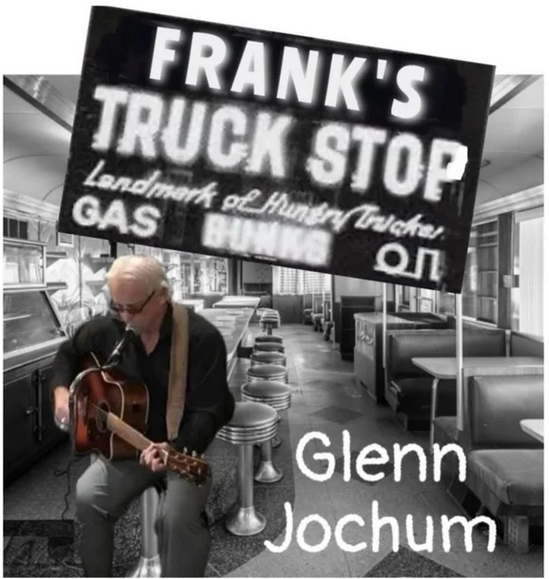
Frank’s Truck Stop, by Glenn Jochum (2025)

Glenn Jochum’s latest album, Frank’s Truck Stop, is a joy to listen to. Fans of roots and country rock will find so much to enjoy in this collection of songs. Jochum has a soulful, sincere voice that really engages you, and the playing of Don Cerce Jr. complements it perfectly. Cerce is an amazing player and an inductee of the New York State Country Music Hall of Fame who brings his talents to this record. His emotive playing is a fine counterpoint to Jochum’s singing and lyrics—they’re quite a dynamic duo.
“Rose in her Hair” starts off the fun—Glenn gives us a bluesy vision of better days here, singing “Come share the vision that life on the land brings/Come see the world with an innocent face” advice that all of us can take to heart in these hyper-connected, tumultuous days. You have to like his optimism here– it’s infectious.

The title song is a jaunty, fun tune that evokes a place where ‘We’re down-home folks, who like telling jokes, where food tastes like the frying pan.’ It’s a song that reminded me of listening to country music with my dad when I was growing up in the 80s, and would feel right at home in your collection of Glen Campbell or Johnny Cash albums. It’s a neat trick to tell a story and evoke a little world out of time in just three minutes, but Glenn accomplishes that here, has you tapping your feet along with the song, and he makes it sound easy.

No collection of country tunes would be complete without a heartbreaking tale of loss, and Glenn doesn’t disappoint, with “Smithereens,” among other tunes. “I can see the misty mountains…but I’ll never see this place again, cause I sabotaged my dreams…I smashed it all to smithereens,” he croons, and you can hear the regret and sadness in his voice. It’s not the cheeriest thought, but sung with such conviction and sureness that you can’t feel too sad about it. Like the best blues and country songs, it leaves you wanting more. Reflections is another song that speaks to loss and love, a brooding, sad tale of a broken relationship.

Copyright Blues is my favorite song on this collection. It has the kind of humor that I love in music, and Glenn is great at this sort of song. “Everybody told me about you, they all said that you would leave me blue, but I didn’t mind, my love for you was blind,” he sings, and you can almost see him grinning through the blues. “They might steal your copyright and walk away from you,” he says, concluding that he’s going to confiscate pictures of his lover and toss them in the sea to exorcise his loss. If you’re heartbroken and need to see the humor in it, this is the song for you. I was laughing at the image. It’s excellent advice for the broken-hearted. “What if?” is another great song in this vein, where he’s musing on the uncertainties of life and songwriting.

The other songs on this album are just as good as the ones I’ve highlighted. It’s been on rotation in my collection since I bought it, and I hope it will be in yours, too. Glenn is a poet, a fine songwriter, and if you enjoy your country and blues with a dash of humor, you’ll be happy you got this record.

Coheed and Cambria

I’m an old RUSH fan super excited by their recent reunion announcement, and so I’m the perfect audience for a band like Coheed and Cambria. A friend of mine has been raving about them for years, but it was only a couple of months ago that I finally took the plunge and started listening. I’ve bought two albums and will eventually get them all. It is so cool to see a progressive band like this doing so well.

I have very limited time, and so I usually stick to my favorite bands from earlier eras, (Jethro Tull, RUSH, YES, Led Zeppelin, The Who, ELP, King Crimson, Dylan and Tom Petty and The Kinks and so on) with a few newer ones sprinkled in here and there. Sometime around the birth of my children, and having the demands of family and my job, I kind of lost the ability to know much about new music, but these guys are so good. The epic science fiction story of The Amory Wars, (for the uninitiated, every album is set in this universe) the amazing riffs and energy of these albums, it’s fantastic. I feel like there should be some kind of rare band act passed by congress to protect these guys. They’re so great. I’m glad younger people have a modern day Rush they can follow. My kids are already singing along in the minivan.

I’ve read a couple of the omnibus comics and am getting into the story a bit, as well. I love how the comic books enhance the whole experience; it’s incredibly ambitious and also such a cool thing for fans to get into. As a teen, one of my favorite things to do was to get a new album by RUSH or some other progressive rock band and spend hours listening, reading the lyrics, looking at the artwork, all of that. I still do that when Jethro Tull or some other favorite band of mine releases a new album, or re-re-releases old ones with dozens of unearthed tracks. It’s more than just listening to songs; it’s an entire experience, and Coheed and Cambria is carrying on this glorious tradition.

I may not have been able to get Rush tickets, but I’ll be sure and try to see these guys the next time they’re touring near me.

Jethro Tull: Curious Ruminant

My opinion of the new Jethro Tull album doesn’t make much difference, but here it is anyway: it’s a total joy to even have one. Since I was a teenager, this has been my favorite band, and there will come a day that I won’t get any more new ones, so I’m enjoying the hell out of it.

We’ve been lucky enough to have three new Jethro Tull albums since 2022, and all of them have been fantastic. The Zealot Gene was a tour-de-force of biblical proportions, mingling sacred text and modern life, while 2023’s RokFlote was an epic exploration of Norse myths. Curious Ruminant is perhaps more down to earth, more contemplative, but no less searching–it’s a truly impressive artistic journey that gets better with repeated listenings.

The album should be listened to straight through, in one sitting, if you can manage it. As with all of Ian Anderson’s best records, this one ebbs and flows and gives the listener the feeling they’re looking at a giant canvas, revealed bit by bit, or reading a complex book and learning more in each chapter.

The opening song is the high-energy ‘Puppet and Puppet-Master,’ a reflection on the songster and his audience. We know we’re in capable hands as the band shows its chops with some fine electric guitar, organ and flute solos as Anderson delivers his tongue in cheek dramatization of what it’s like to get up there every night and play. “Holding court on a black box stage, dangling from the strings, I twirl and face the music,” he sings; the subject matter reminds me of ‘A Raft of Penguins,’ from his excellent 2003 album, Rupi’s Dance, which was a song about his nervousness in playing with an orchestra.

“Dunsinane Hill” is a real treat if you’re a Tull fanatic who also loves Shakespeare, like me. Having grown up in Scotland, one can only imagine how much MacBeth must have inspired Ian over the years. I absolutely love this song and it’s conceit: intrigue between two politicians discussing betrayal. Here the flute plays a merry folk tune even as the narrator says “I look over my shoulder/To see my brother warrior, damned spot to wash away.” I give this reimagining of the bard ten out of ten stars.

“Stygian Hand” is a sort of companion to Dunsinane thematically. Have you ever been nervous walking down a dark street alone? Here’s a song to help you. Bring a symbol of faith to ward off the devil and hope for the best. The accordian features prominently on this one. It’s a fun song and gives bit of levity to the otherwise fairly serious proceedings on this album.

“The Tipu House” is another up-tempo number, and here Anderson is singing of ‘All God’s children’; the subject is a tenement Anderson saw in Barcelona, and the residents, including young kids playing in less than ideal conditions. The flute is as manic as on any Tull track, the melody will leave you humming. It’s neat trick, to get an audience feeling empathy for their fellow man even while tapping their feet and singing along.

Other songs in this collection continue to encourage us to recognize our shared humanity, including the nearly 17 minute “Drink from the Same Well,” a fantastic piece of music that’s a meditation on differences that drive people apart. It seems a plea to remember that we’re all human and are worthy of respect, much as Aqualung was. The music is eastern-influenced, and Anderson said the bulk of the instrumental work dates from 2007, which explains why it would not sound out of place on his albums of that era.

“Over Jerusalem” is a song of lament for Israel that sounds like it could have been the twin of ‘Swing it Far’ from Thick as a Brick 2. You get the sense that Anderson, who has played in Israel many times over the years, donating all the money to charity, is as deeply saddened by the current situation as anyone.

“Savannah of Paddington Green” is a song about ecology, a subject Anderson has written of before, most famously in “Skating Away,” way back in 1973. “Threatening species, we turned on ourselves, like others before us, now left on the shelves,” he sings, wondering what the future may hold for our planet.

The final track on this one is a sort of goodbye, called “Interim Sleep,” a meditation on one’s final act. Most of us don’t want to think of the end, but I suppose Mr. A feels the weight of time.

“When interim sleep takes me

I want you close beside

No tears, no sad goodbye

I am calm and still as a fallen autumn leaf”

This is really quite sweet, and moving, as well as very unlike most Jethro Tull songs in that it’s personal and straightforward. Anderson has always preferred things that are more abstract, but that isn’t to say he lacks emotion. After all, his most famous song is a searing heavy rock number about a homeless vagrant, featuring a face melting guitar solo that Jimmy Page himself approved of as it was played. The best Tull songs are like this, melding high and low, profane and holy, mundane and beautiful.

The title track has the classic sound of this band–heavy guitar, flute, coupled with philosophical lyrics. Anderson is pondering life, ‘asking why am I here, answering, why am I anywhere,’ and ending with ‘cogito ergo sum.’ At 77, he’s as much a seeker as he ever was. I’m glad he’s taken us all along for the ride, and I sure hope it doesn’t end anytime soon.