One Roll Quest!

In our family travels this summer, I brought along some quick, portable games to play with my eight and ten year old. A couple of them were real hits with the kids that we will continue to play.

One Roll Quest plays just like it sounds. There’s a big clear die with 5 tiny colored die inside. You roll it, and that roll immediately determines whether you live or die, gain fame and fortune or experience points. The inner, colored dice determine some more specific consequences for your character–i.e. Everyone gains fame and fortune, except you–you die! It’s a very fast paced and funny game that my kids and I played numerous times. We also played One Roll Chronicles, which is a book with a brief story, in which you start out drinking in a tavern (like all good adventurers) and wind up, of course, looking for fame and glory. I’d rate this one 10 out of five stars for the number of laughs we had over it. It even includes some one off jokes like ‘One roll pizza,’ in which the die roll determines what pie you’ll order and which toppings. (we ended up with pepperoni and cheese, but my daughter cheated). 🙂

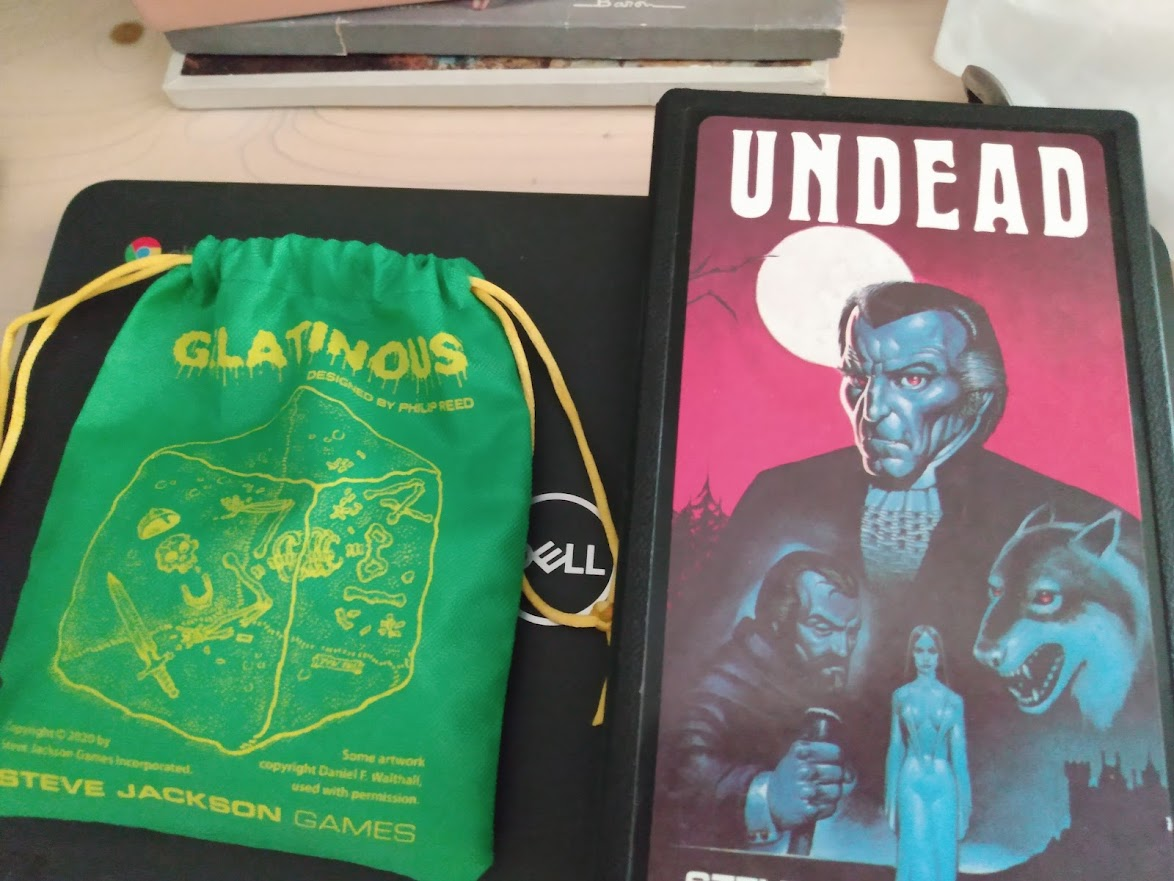
“Gelatinous” is another humorous dice game from Steve Jackson, in which each player gets 7 dice and tries to roll enough threes to create a gelatinous cube to win. Everyone can also lose and get eaten by a cube, which is a very amusing way to end this game. My kids found this one fun, as well.

We also played Catan dice, a shortened version of the game, in which all the dice have different resources on them, and you roll to create towns, cities, and roads. This was another fun and fast paced game, though it was less funny that the first two.

Finally, on a rainy day during our vacation, we played ‘Undead,’ a pocket box from Steve Jackson Games. This is a fun one, a bit more complicated than the others that will take an hour or two to complete. One player controls vampire hunters, the other is Dracula, and there is an option for a GM. It takes place in London in 1890, and is a hidden movement game that we found fun and thematically pleasing.

You can’t go wrong with any of these games. Steve Jackson Games has always done a great job with affordable, light games like these, and they keep creating great new ones all the time. I highly recommend supporting their kickstarters, or just checking out one of their many pocket or travel games if you’re looking for something to take with you on your vacation. They also make great diversions on game night with your friends.

Our trip was fun, as well. But games make everything better.

Kindred, by Octavia Butler

I found Kindred to be such an amazing achievement; wonderfully written, creating such a believable, harrowing world. I plan to read the rest of Butler’s novels in due course, but had to let my thoughts on this one simmer for awhile. This isn’t light beach reading or something you pick up to be distracted. It’s considered one of the monumental works of 20th century science fiction, deservedly so.

Dana, an African American writer, is transported back to the antebellum south, and this is where the horror begins. It is hard to do this book justice, but the day to day life of a slave in the American south is described in great and horrifying detail. Dana becomes the protector of young Rufus Weylin, the heir to a plantation, and she later learns that he is one of her ancestors. Dana travels back and forth between the 1820s and 1976, finding that while she has been in the past for several hours, days, or months, she has usually only been gone for comparatively short periods of time in the present.

Slaves on the Weylin plantation are brutalized, raped, and tortured, and yet Weylin’s father, Tom, their master, is considered by the slaves to be mild in comparison to other slave owners. Families are casually torn apart to pay debts, or in some cases just to prove a point. Dana’s account of these atrocities gives the reader an idea of what slave life was like, and the unimaginable horror of just surviving and enduring.

The book is set during the bicentennial, which is when it was written, and this setting is significant, given how much America was celebrating at that time. But this book is a clear reminder of our brutal, racist, genocidal past. It’s something we must reckon with, if we want to make this country more just and fair.

Kindred is a book everyone should read. It’s a landmark of American literature, a brilliantly written and researched novel and a powerful work of literature. The characters are very nuanced and have so much depth to them. The depiction of the slave community, and the brutality they were subjected to, are so moving and heartbreaking. They are faced with unthinkable choices for their survival, and Dana’s struggle to help them and eventually be liberated has echoes of historical slave narratives, as many critics have pointed out. Butler has said in interviews that she wanted “to make people feel history, and she succeeded brilliantly.

A Plague of Demons, by Keith Laumer

I’ve been reading authors who are new to me lately, in an effort to try to fill in some gaps in my knowledge. For my birthday, a good friend of mine with impeccable taste sent me a copy of a science fiction collection by Keith Laumer, A Plague of Demons. Laumer reached the height of his career before I was born, so I hadn’t known about him, but I knew it had to be great if my friend recommended it.

I was not disappointed. A Plague of Demons, the novel that leads off the collection, leaps off the page at you from the first sentences. A military thriller/action adventure/science fiction novel, it has a breakneck pace that never lets up, and is filled with surprises and wonders that will reward any reader. I had so much fun reading this and I can’t wait to read more Laumer. In fact, I was at a book sale today and picked up a couple more of his books.

In the near future, the hero, John Bravais, is sent on a secret mission to North Africa, where armies are fighting in a gentlemanly fashion, under the supervision of UN inspectors. Bravais soon learns, however, that demonic aliens are entering the fray, hiding themselves until they can clandestinely kill soldiers and–get this–steal their brains. Why are they doing this? Bravais decides to find out, and spends the rest of the book alternately chasing these demons down and being hunted by them. There is a secret society of humans who try to help him in his quest to thwart the aliens, but the task is almost impossible, since the aliens have far superior technology and are hiding everywhere on earth. They disguise themselves as soldiers and can strike whenever they wish.

I don’t want to reveal too much of the plot, but it turns out the aliens have been abducting soldiers from battles for their brains since at least as far back as the ancient Romans. They take the brains back to their homeworld, place them in giant robots, and use them to fight their wars.

Does this sound bonkers? Yes, but in the best sense of the word. The writing is so lively and the dialogue so sharp that I was laughing out loud. Laumer does a great job with setting up expectations and traps for the reader, and it all reaches a very fun and exciting conclusion. There is one hilarious and action packed scene in which dozens of human soldiers, trapped in their enormous, tank like roboskeletons, attack their oppressors. They are a ragtag bunch from every era of human warfare, yelling Old English and Viking and World War One and Napoleonic battle cries as they take up humanity’s fight against the aliens.

I’d rate this one five stars out of five. It has a bit of everything, and is so fun to read. I love this era of fantasy and science fiction, you never know what kind of story you’re about to get when you start. I’m adding Keith Laumer to my list and want to read more, as will every reader who encounters his work.

Time Bandits

One of the fun things about being a parent is showing your children things you enjoyed as a child. We read lots of different books and comics and watch movies together; most of the movies and TV my children watch is contemporary, but a good chunk of it consists of gems I enjoyed growing up. They mostly choose their own books but we read some of the cream of the crop together, as well.

Last night, we watched the 1981 classic, Time Bandits, Terry Gilliam’s family adventure film. I hadn’t seen this in decades, and wow, I was surprised how well it holds up. What a wonderful film. I recall watching the movie as a child, and the memories I have of it include John Cleese hilariously playing Robin Hood, Michael Palin as a lovelorn wimp, some great adventure scenes, witty, sharp dialogue, and a whole lot of fun. It’s a wonderful story of time traveling thieves, equipped with a magical map stolen from the Supreme Being. But seeing it as an adult made me view it differently–though all these wonderful comic elements are there, it’s a tale of a lonely child, the kind who is often seen in Roald Dahl novels.

The hero of this story is a young boy named Kevin, who is sympathetic from the opening scenes of the film. His parents are more interested in watching television and buying new gadgets than they are in their poor, lonely son, who escapes to his room to read and play with toy soldiers, only to be screamed at by his dad for making too much noise.

What dad doesn’t know is that the racket up in Kevin’s room was made by a knight on horseback who crashes through a wall, leaping over Kevin. But Kevin wonders if it were a dream, since the room quickly goes back to normal.

But Kevin does escape his mundane world when the Time Bandits break through the next night. By turns hilarious, greedy, selfish, and kind, Kevin’s diminutive companions are completely inept at what they do. They’re using the map to travel through space and time, only to steal valuables from guys like Napoleon and Agamemnon. Each time they make a leap through time, they fall from the sky and crash in a heap atop one another, sometimes smashing into innocent bystanders. It’s a hilarious and painful entrance every time. Yet all they do with this incredible ability to time travel is petty thieving. At one point, Kevin, having been taken from Agamemnon’s court, where he was to be the king’s heir, is despondent at this state of affairs, telling the leader of the Bandits, Randall, that the bandits have this amazing artifact, with which they can do anything, yet they choose to just go around stealing things. Kevin says, wistfully, of Agamemnon, “Money wasn’t important to him,” to which Randall replies, “He didn’t have anything to spend it on, did he?”

It’s a telling moment in the film; the young boy has perceived that even his new swashbuckling friends are barely better than his parents. They have the key to the universe, and what they want to use it for is to become rich.

Kevin does influence his group of pals, so that at the end they rescue him from Evil, who wants the map for himself. They risk themselves to save him, and it’s heartwarming to see Kevin’s kindness rub off on them.

But then God shows up, and everyone must leave, once Evil is destroyed. Kevin is in despair at this. He points out that God let dozens of people die, just to prove a point with his map and the Time Bandits. “Why does there have to be evil?” Kevin asks. “I think it’s something to do with free will,” the Supreme Being replies.

And Kevin is sent home. He awakens to his house burning down, and is saved by a fireman. His parents could not care less about his brush with death, and bicker on the lawn about their lost toaster, ignoring their son totally. They touch pieces of evil that Kevin has returned with, and immediately explode. Agamemnon, now a fireman, smiles at Kevin as he drives away in the fire truck. The movie ends with Kevin alone.

My son was on the verge of tears at this. I thought maybe he was upset at the dead parents, but that didn’t make sense, since Kevin’s parents were cruel and mean and shallow. No, my son explained that Kevin had had so much fun with his bandit pals, and now they were gone and the boy was alone.

Not exactly a comforting ending, but I guess Terry Gilliam’s movies are not there to comfort you.

This film is told with such good humor and wit and rapid fire jokes that it’s hard to take this too seriously as an adult, but my son was right. Maybe the best adults can do is save you and protect you, then wink and nod and send you on your way. The best strangers you meet will do that. And a lot of them, including God, are worth very little unless a kind-hearted child tells them they ought to behave.

The Guns of Avalon

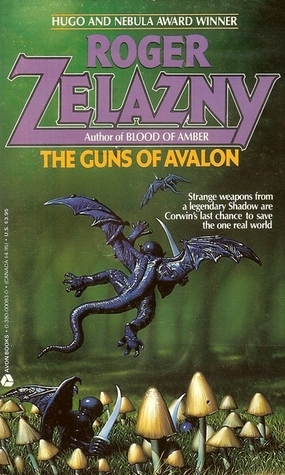
I had said that I’d take a break from Amber after reading the first book in this series, but I couldn’t resist and read The Guns of Avalon next. In this second installment, Corwin’s story gets stranger and his road into the shadow realm more circuitous. There’s plenty of action and intrigue and plot twists to keep readers engaged and guessing until the end.

The way Zelazny imbues the princes of Amber with both godlike and very petty, human characteristics is particularly interesting and satisfying for me. I’ve read plenty of epic fantasy where the heroes are noble and their cause righteous, so it’s fun to read an antihero whose motives are less pure. In this way, Corwin reminds me a bit of that other antihero, Elric. I guess by the 70s there was enough going on in science fiction and fantasy that we got some revolutionary kinds of stories like this that turned the heroic story on its head. Though, it should also be said that the selfish and sometimes cruel behavior of Corwin and his family is very much in line with plenty of Greek, Norse and other mythologies, where gods behave at their own whims, to the detriment of almost everyone around them.

You want Corwin to succeed in his return to Amber–mostly, anyway. Zelazny sets him up in circumstances so dire that it’s hard not to wish him success in his attempted revenge against his brother. But the cost of this revenge is disastrous indeed; the curse he utters threatens to destroy the world he claims to love above everything, so Corwin’s account of his exploits is more than a bit self-serving, in my view. But his story is engaging and worth the journey.

Of course, there are plenty of neat creatures in this book, monsters and concealed demons, treacherous family members and a land itself that is intent on destroying everyone. Zelazny’s use of trump cards that enable the royal family to communicate and teleport, as well as the idea of the pattern itself, that road on which those with royal blood may enhance their power and enter myriad worlds–are what really make this series unique, I think. These concepts, combined with Zelazny’s use of mythology, make the whole story feel like it has some psychic weight to it. I also continue to find his mix of the mythological and the everyday and modern a lot of fun.

This time I think I really may take a break before continuing the saga. There are so many great things to read, and so little time.

The Amazing Maurice and His Educated Rodents

My eight and ten year olds read this wonderful and hilarious Terry Pratchett novel with me, and yesterday we went and saw the new film based on it. They loved both the book and the movie. The incomparable Hugh Laurie voices Maurice, and did a fine job bringing the self-regarding feline to life.

The movie hit mostly all the right notes in bringing this book to the big screen. There are some things I truly love about the book. First off, it’s an irresistibly funny and mischievous idea to update the story of the Pied Piper of Hamelin, and of course Pratchett tweaks the tale so that the intelligent rats, in league with Maurice and a boy piper named Keith, scam town after town, infesting them and then pretending to be charmed by the piper, with whom they march away, before collecting their payday, splitting the cash, and moving on to the next victims.

I also love the idea that the rats at the center of the story became brilliant and self aware after eating magic potions from a dump filled with refuse from Unseen University. This is such an amusing idea that it seems like it could be the seeds of plenty of other books in Discworld. There is a lot of talk in both the book and the film about what it means to be intelligent, how the rats should best use their newfound intellect, and in what way they should live with humans. I daresay most people do not think philosophically like this about themselves and the purpose of their lives as much as these rats do; of course that’s part of the fun.

The rats’ names are a real hoot, too. When they became intelligent, they simply named themselves after things that they thought sounded cool in the dump, and the kitchens from which they pilfer food and widdle in the cheese. Hence they have names like Dangerous Beans, Hamnpork, Peaches, Big Savings, Darktan, Sardines, and so on. Great stuff that also never failed to make my kids chuckle.

Maurice, Keith, and the rats find themselves at odds with rival scheming ratcatchers, and then a Rat King who wants to control them and wage war on humans. The film diverges a bit from the book, but did an admirable job of bringing Pratchett’s wit and comedy to a new audience. My daughter had a great time at the movie and particularly enjoyed Death and his sidekick, a rat sized reaper.

Pratchett deftly handles some serious issues for kids in this book–death, for one, as well as bullying and tyranny and the need to defend oneself from such abuse. For a comic novel about magic rats, he covers a lot of ground and makes it seem effortless.

I highly recommend both the book and film to a wide audience. I think my kids and I will next read The Wee Free Men, another of Pratchett’s Discworld novels written for a young audience. Given how prolific Pratchett was, I don’t think we’ll be running out of Discworld books anytime soon.

Nine Princes in Amber

This isn’t exactly a review of Nine Prince in Amber. On my blog I talk about books I am reading, and that I love, and my personal experiences with these works. So what follows are my brief impressions of a weekend encounter with a book that I think is going to stay with me for a very long time.

Many years ago, when I was a college Freshman, a good friend told me of Roger Zelazny, and I dutifully picked up Nine Prince in Amber. At the time, I was looking for fantasy in the Tolkienian vein and somehow I couldn’t get into Corwin’s saga. It felt too strange for me, out of time and place, antiheroic, weird, and at that time, when I was still a teenager, I didn’t know what to make of it. I set it aside for more traditional heroic exploits like Robert Jordan’s Wheel of Time series, the kind of fantasy I understood better.

Thirty years later, I saw George RR Martin speaking reverently of his good friend and mentor, Roger Zelazny, and giving high praise to his work. If George loved his stuff so much, I figured I’d better listen.

So I picked up Nine Princes in Amber again a couple of days ago. Weird? Yes. Anti heroic? You bet. But I guess in the intervening decades I’d changed just a tad, read widely, and could appreciate this aesthetic. I still had a difficult time envisioning shadow earth, as well as the incredible longevity of prince Corwin, and the great city of cities, Amber, of which all other realities are mere reflections or shadows. This central theme of the ideal city, and its shadow realities, seems to me now the amazing charm of this book, part of its greatness. The idea of a kind of a Platonic ideal of a realm, nearly unattainable, but to which the hero is questing back to try and win for himself, really resonated with me on some subconscious level. The archetypal folks helping Corwin and hindering him along the way, his mythological, mischievous and murderous family, all of it was mixed together so expertly, in such a convincing way, that I felt it and enjoyed it very deeply. My criticisms of it aren’t criticisms, really, more matters of taste. As a person who loves mammoth fantasies and intricate detail in battles, I was a little chagrined by the very brief descriptions Zelazny used to describe massive, epic combat, or raising an army of a quarter million men and an armada of enormous size. But it works for this book, and if you want that kind of detail, plenty of other writers will provide it. Besides, there are nine more books in this story, so there is plenty more of Amber to explore.

I also loved the noirish feel to this, the mysterious story of this man who wakes from a coma not knowing who or what he is, but knowing he’s destined for something, that he better protect himself, he better get going and get some allies and start fighting before it’s too late. This guy is a godly prince, but he doesn’t know it yet. But this impetus to get on with it, to strive and fight for every inch, because nothing is guaranteed, this is the stuff of myth as well as noir. I loved the way Zelazny mixed high speech and low speech, high epic battles with lowly grimy hand to hand combat, old and new, mythological and familiar everyday things. What a perceptive, brilliant, erudite, gifted writer. Wonderful stuff, in my humble estimation. I guess I’d even say I loved this book.

I enjoyed it so much I read it in just a couple of sittings and was sad it was over, and I am eager to go back to Amber and walk the pattern again. I may need a break first though. This is heavy stuff, to me, not a typical fantasy realm of dragons and orcs, though I like those very much, as well.

So if my old pal out there is reading this, thanks good buddy for the recommendation. I’m also glad George RR Martin is out there promoting is friend’s work. It is so worth visiting, my friends. See you in Amber.

The Dying of the Light

I recently finished George RR Martin’s 1977 Science fiction novel, The Dying of the Light; I saw him speak last October and among other things, he was talking about his earlier career, so I was eager to track this one down. In the 70s, Martin wrote this novel and other stories in his “Thousand Worlds” science fiction setting. Since I’ve enjoyed so many of his other books, I wanted to give this one a try.

The novel is set on “Worlorn,” a dying planet that has recently hosted a worldwide festival. Dirk T’Larien, the hero of this tale, journeys to Worlorn after receiving a ‘whisperjewel,’ a token of love, from his former girlfriend Gwen, for whom he’s been lovesick. He arrives hoping to be reconciled, but instead is met with a strange set of circumstances and a love quadrangle that goes south very quickly.

Martin did a credible job in this novel of creating some alien cultures that are difficult to wrap one’s mind around. Gwen is now involved with a man named Jaan Vikary, who is from a brutal culture called Kavalar, in which women are treated as property. Another Kavalar man shares her in this revolting arrangement, and there is a lot of discussion of the harsh conditions that caused the Kavalar to become so regressive. They are descended from humans, but have taken human culture in a strange direction after centuries of living through plagues and nearly dying out. As a Star Trek fan, they reminded me a bit of Klingons, holding honor above all else and demanding combat when insulted.

Dirk is puzzled that Gwen, who seems surprised to see him, has no interest in rekindling their relationship; Dirk had figured that the whisperjewel was a cry for help from her desperate situation. Eventually, he learns that someone else sent it to him, to lure him to Worlorn. He is drawn into a conflict between Gwen’s lover and other Kavalar on the planet who want them dead. There are some fun action scenes throughout, and I think that fans of Martin’s other work will be pleased with this novel from earlier in his career.

For me, the setting of this book was really interesting. A dying world that hosts an armageddon-type festival and is then abandoned as it dies is a neat idea. Martin has a lot of interesting history of the Kavalar through the book, and at times it feels like this could be a sourcebook for a science fiction RPG. There are plenty of twists and turns in the plot, as in Martin’s more famous works. He would later masterfully develop these kinds of plot elements in A Song of Ice and Fire, and it’s really fascinating to see this early career effort from him. It’s got a lot of DNA that would turn up in Game of Thrones and is an enjoyable science fiction adventure, provided you don’t mind some grimness. If you’re a Martin fan, that is probably not an issue for you.

This was a fun book. I really enjoyed Martin’s other early works too. Armageddon Rag is a great read about a cursed rock band, and his vampire book, Fevre Dream, is another one that any Martin fan will enjoy. I’m working my way through his collection of short stories, and also have his novel with Lisa Tuttle, Windhaven, in my to be read pile.

One Bite at a Time

I very much enjoyed ‘One Bite at a Time,’ a book with the subtitle “a collection of paintings and two sentence horrors,” by N.M. Scuri, and illustrations by Byron Rempel. This book was enormous fun to look at and pore over, with some really chilling and darkly funny tales that I had a great time reading.

“Hell is a Library” was one tale that cracked me up. As a librarian and twilight zone aficianado, I loved this, which said simply “I’m the last man on Earth, and I can read all I want. Now where are my glasses?” The accompanying illustration is a man with his back to us, in a seemingly apocalyptic landscape. “A Dainty Dish” was another memorable entry, with a painting of a tentacled monstrosity beside the ominous words: “The Old One Cthulhu, baked in a pie.” And there are plenty of zombies here, too, of the human and animal variety, as in “Red Rover,” in which a canine pal keeps on killing even after he’s been dead a month.

Many of these stories sound like they could be the opening of a great short story or novel, the seeds are here for some fun stuff. Scuri has some precise, tightly controlled language to set the atmosphere for the really wonderful paintings, which reminded me of Ralph Steadman’s illustrations of Hunter Thompson’s books.

I highly recommend this engaging collection for fans of horror, comics, and poetic writing. It’s a unique book that is loads of fun. This was listed as “Volume One,” so hopefully there will be more installations to come.

In “Thirteen Stories and Paintings,” Scuri and Rempel take the idea a bit further. Here we have similar kinds of haunting illustrations, with flash fiction horror tales. “Hooked” is one such memorable story, about a night of scary storytelling that goes horribly wrong. “The Sad End of Perry Belmon” is a Joker-like tale of a lost soul, trying forever to win friends, yet always failing miserably. This is another fine, ghoulish collection of stories and art that I think would please horror fans, folks who like The Walking Dead, who enjoy Lovecraft and Poe and Stephen King and all the better things in life that make us uneasy.

Check these books out! They’re fun and engaging and I think you’ll like them as much as I did. You can find them on amazon.

An Interview

Here’s an interview I did with Bee Lindy at her site, Bookpleasures. It was a lot of fun to do, and you can learn a bit more about my novel THE OSPREY MAN there.

Today is also the last day you can enter to win a copy of the book, through Teddy Rose Book Reviews

http://www.bookpleasures.com/websitepublisher/articles/9743/1/In-Conversation-With-Christopher-Tuthill-Author-of-The-Osprey-Man/Page1.html

I’m lucky to have a ticket to see George RR Martin in conversation with Neil Gaiman at Symphony Space tonight, which should be a great event. I have seen Neil Gaiman give a talk before, several years back when his excellent novel The Ocean at the End of the Lane came out. But I’m a huge fan of George RR Martin’s work, and have never seen him in person, so I’m excited. I’ve been reading A Song of Ice and Fire since the early 2000s, when my brother in law gave me a copy of Game of Thrones one Christmas. I really hope I get to read Winds of Winter soon! I’ll be sure to report back on tonight’s event. I’ve thoroughly enjoyed House of the Dragon, which is a great show in its own right. I was concerned it might seem anticlimactic after Game of Thrones, but they’ve done a fantastic job bringing us back to Westeros.

When I finished Dance With Dragons, I was sorry that there were no more Westeros novels (though I happily read Fire and Blood when it arrived), so I set out to read the rest of Martin’s books. For those of you who haven’t read them, his other novels are enormous fun too. Tuf Voyaging is a wonderful collection of stories about space merchant Haviland Tuf. Fevre Dream is his vampire novel, and Armageddon Rag is another good one, about a rock journalist and a seemingly cursed band called the Nazgul (of course). And I recently got an early novel he wrote, Dying of the Light, that I’m eager to read. His story collections are also filled with great stuff.

I just finished Ray Russell’s Haunted Castles, a collection of his Gothic stories. I’d never read him before, but the book was so creepy and haunting that I immediately got his novel The Case Against Satan, which I’m halfway through. His stories are pretty grim, but I also find them great fun to read. Always so many good books to read, and not enough time.