“You can do one thing or you can do another, kill a man or take a tire off his car, because sooner or later you’re going to forget what it was you done and just be punished for it.”
One of the most anthologized and well-regarded short stories of the last century, A Good Man is Hard to Find, like some of the other stories on this list, deserves its towering reputation. O’Connor was a master of the short story, and this tale is one of the most shocking gothic stories I’ve ever read. I can still recall the palpable dread I felt as I first read it many years ago in a college class on the short story.
This tale involves a family that is out for a drive when unspeakable violence occurs, but there is plenty of foreshadowing, with the grandmother mentioning the ‘loss of values’ in the modern world; she also points out a graveyard filled with slaves from a bygone era. She remembers that there was a plantation in the area, and convinces her son, Bailey, to take a turn onto a deserted road, where the family has a sudden accident, flipping their car, and are met by the “Misfit,” a terrifying killer.
This tale is suffused with the south, and with notions of God and the possibilities of salvation and grace. The grandmother attempts to placate the Misfit, who clearly means the family harm, saying he is one of her ‘babies,’ and touches his shoulder. But there’s no salvation here for anyone, it seems.
I think it is best to read something like this, with such a well-known reputation, with an open mind. It’s better not to seek out or think too much about any of the criticism of it at first, just read it. It will probably leave you feeling desolate, as some of the very best horror stories tend to do.
Flannery O’Connor wrote two novels and thirty-one short stories and is considered one of the great American writers of the 20th century. Sadly, she was ill with Lupus and died at just 39. Who knows what she may have achieved had she lived longer; as it is, she left behind an amazing legacy.
“The summer had turned, the summer had gone; the autumn had dropped upon Bly and had blown out half our lights. The place, with its gray sky and withered garlands, its bared spaces and scattered dead leaves, was like a theater after the performance–all strewn with crumpled playbills.”
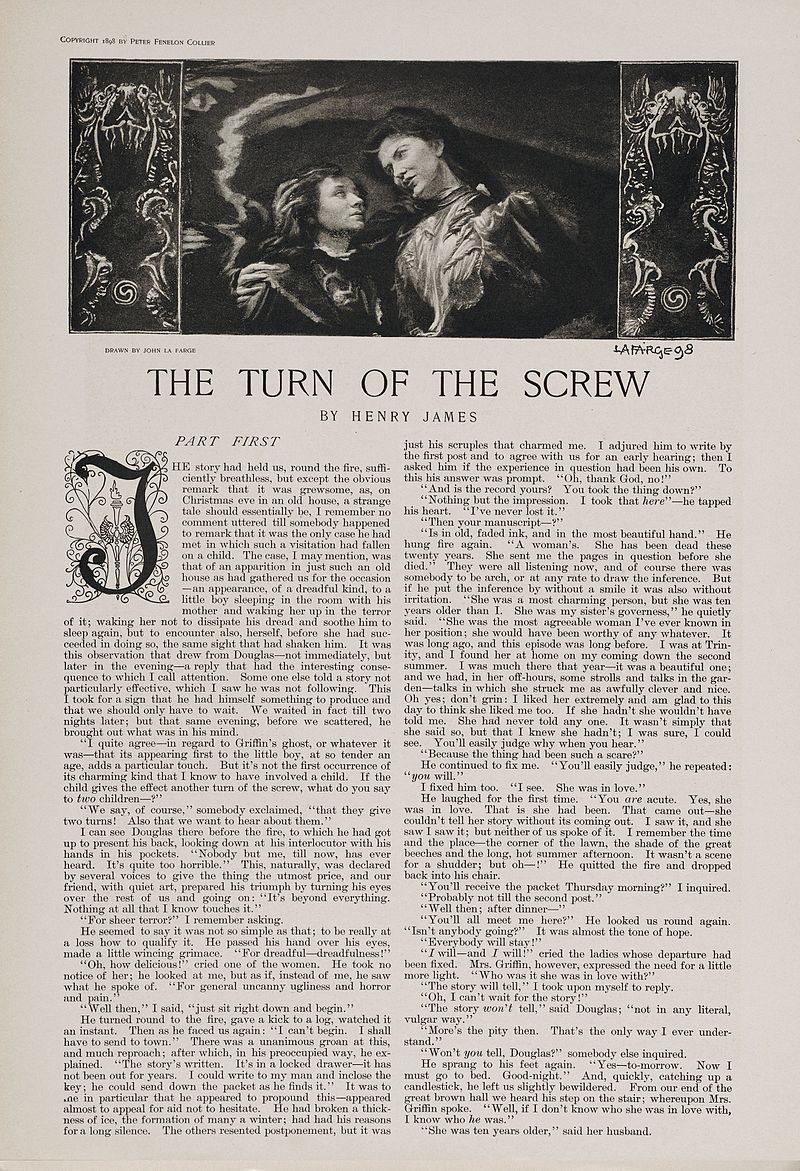
The Turn of the Screw is one of the most influential, classic horror tales ever written; everyone ought to read it. It’s a gothic story of a haunting at a British country estate, and the reader is never sure whether the ghosts are real or imagined. The story is told through a frame of a man reading a manuscript of a governess who believes that the children in her charge are being haunted by the ghosts of two former employees of the estate.
I find that the presence of children in fiction will usually increase the tension, and in a well written story like this one, you feel quite concerned for the children, worried that they are either being haunted, or being cared for by someone who is unstable and not up to the task. Either way, the sadness of these children, who are seemingly ignored by their parents, is something I couldn’t shake when I read this story. It was such a disturbing tale because of everything left to the reader’s imagination. In my opinion, this is usually the way to scare the reader far more than the usual genre tropes.
James was as prolific and famous as an author can be, and his reputation rests on a number of well known works, including Daisy Miller, Wings of the Dove, Portrait of a Lady, and The Golden Bowl, to name just a few. But it is Turn of the Screw that I always think of first, and I think this is likely true of other readers. It has been adapted no less than twenty-eight times, with numerous film versions, an opera by Benjamin Britten, various stage adaptations, and new adaptations still being made today. There’s something about this unsettling story that has deeply resonated with readers for more than a century.
‘Hateful day when I received life!’ I exclaimed in agony. ‘Accursed creator! Why did you form a monster so hideous that even you turned from me in disgust? God, in pity, made man beautiful and alluring, after his own image; but my form is a filthy type of yours, more horrid even from the very resemblance. Satan had his companions, fellow-devils, to admire and encourage him; but I am solitary and abhorred.’
The first ever horror and science fiction novel, first published in 1818, when Mary Shelley was just twenty years old, Frankenstein has a reputation that has been as long lasting as it is deserved. A beautifully written tale that began as a legendary writing contest between Shelley, her husband Percy, Byron, Dr. John Polidori, and others who were spending a summer together in Geneva, Frankenstein bears little resemblance to the monster most of us recognize from the many film adaptations that we’ve seen through the decades.
The monster is philosophical and brilliant, almost superhuman, and the real villains are those in the story who judge him by his ghastly appearance. There are as many interpretations of the work as there are film adaptations: a warning against humans playing God, the irresponsible Victor whose thirst for knowledge leads to catastrophe, the humans who judge the creature by how hideous he is. Several chapters in the book deal with a family of poor, blind people who treat Frankenstein with care and respect because they cannot see him. It’s written in a beautifully poetic style, was immediately successful, and still finds new and enthusiastic readers today.
There are a few different versions of the book, which Shelley revised in 1831, but most scholars prefer the earlier edition. Shelley had a very difficult early life, losing her famous mother when she was just a few weeks old. Her father, also a well-known intellectual, remarried a woman with whom Mary had a very difficult relationship. Under these circumstances it seems a miracle she was able to write such a classic. Her husband, the famous Romantic poet, also caused a scandal when he left his wife for Mary, and had numerous affairs.
I could write a lengthy essay about this book and its influence and various interpretations, but I’m by no means an expert on her; countless scholars have already done that better than I could, and the purpose of my blog this month is to offer a few thoughts on some of my favorite horror novels. This is an essential one that everyone ought to read. It’s one of the great novels in literary history, a book that will help you understand where the genre came from.
Richard Matheson’s I Am Legend is a book that may be overlooked by fans of vampires and zombies, but it’s one of the originals of the genre, inspiring three direct adaptations in addition to an entire industry dedicated to post-apocalyptic monster stories. Written in 1954, and set in 1976, it’s the story of Robert Neville, one of the last humans left alive after a pandemic that has killed most of the world population and turned the survivors (aside from him) into vampire-like creatures, complete with aversions to sunlight, garlic, and crucifixes. He becomes a vampire slayer, a legend to the remaining zombies, who are terrified of him. Eventually he learns more about the disease that has claimed so many lives, and befriends a woman whom he thinks may be immune to the disease, as he is.
Like some of the other books on this list, I Am Legend is a highly influential novel, and its stature has only increased with time. I read it after having seen Charlton Heston in the campy ‘Omega Man’ and Vincent Price’s excellent depiction of Neville in The Last Man on Earth. The most recent adaptation starred Will Smith, and of course there are dozens of other movies and television shows that have been inspired by Matheson.
Matheson’s other stories and novels are also well worth reading. I greatly enjoyed The Shrinking Man, a tale inspired by fears of radioactivity. Matheson had a long and successful career writing for TV and film, including some of the best-known episodes of The Twilight Zone and Star Trek, as well as screenplays for Roger Corman’s entertaining adaptations of Poe stories, which have delighted horror fans since the 1960s. Many of his works have been adapted for film as well. He had an incredible career and influenced a whole generation of writers, filmmakers and fans. If you’ve not yet read Matheson, don’t delay–start with I Am Legend.
“It’s hard and painful for you to talk about these things … and then people just look at you strangely. They haven’t understood what you’ve said at all, or why you almost cried while you were saying it. That’s the worst, I think. When the secret stays locked within not for want of a teller but for want of an understanding ear.”
Today I’m looking back to the 1980s again, a decade that was very good for commercial horror. From his excellent collection Different Seasons, The Body is probably my favorite King story. He’s incredibly prolific and has written lots of great stories and novels, but I find the realism of this one very gripping. It’s not a horror tale, exactly, but more a story of friendship and growing up.
By now almost everyone knows this story about four twelve-year-olds in Castle Rock, and their quest to see a dead body. These children all come from difficult circumstances, but form an unbreakable bond in this story, and King makes it all seem so real that we can easily relate to them. The main character, Gordie, is a storyteller, a stand in for King, I guess, since he also graduates from the University of Maine and becomes a successful writer.
I know many of King’s fans enjoy the vampires, monsters, and supernatural horror of his stories, and I like them as well and have read many of them. But to me, King is at his best when he tells a more restrained, realistic tale like this one. He’s a master of horror, I know, but I think what has given him such popularity and staying power are his observations on working class and poor lives lived in everyday kinds of places. It makes his characters quite sympathetic.
The other stories in this book are quite good, as well. Apt Pupil, Rita Hayworth and the Shawshank Redemption, and the Breathing Method are all great novellas. Three of them, of course, were made into very successful Hollywood films. Most writers would be thrilled to have even one story as successful as any of these, but King has always been in a league of his own.
George RR Martin is known for his groundbreaking fantasy novels, but back in 1982 he wrote this gem of a vampire book, about a down on his luck steamship captain, Abner Marsh, who makes a bargain with an odd man, Joshua York: he gets to have his dream ship, financed completely by the mysterious stranger, but he must transport the man, his friends, and their cargo, no questions asked. As you might imagine, this arrangement does not go as planned. It’s a fun read with plenty of adventure and scares. If you enjoyed the Song of Ice and Fire novels, I think you’ll love this book. There are some interesting characters, weird plot twists, great writing, and of course, vampires.
According to Martin, his book sales around this time were poor, and contributed to his decision to become a TV writer. For years afterward, he worked on things like The Twilight Zone and Beauty and the Beast, until he wrote A Game of Thrones in 1996, which marked his return to novels. I’ve enjoyed everything he wrote. Armageddon Rag is another excellent read, this one about a cursed rock band. His short stories, science fiction novels, and Wild Cards series are also worth checking out. I only hope we get Winds of Winter sometime soon.
October has long been my favorite month. I love Christmas, too, as well as every other holiday that affords me time to spend with my children. But there’s always been something special about October 31. As a child, I knew Halloween was a night devoted to kids, where magical things happened, where you had a bit of independence to go out with friends and have a grand time. The costumes, the folklore, the changing of the seasons, all add warmth and wonder to this grand day. My own children have enabled me to experience these feelings again. It is so fun enjoying the fall with them: decorating the house, creating costumes, getting ready. The anticipation of it, the colors and sounds and stories, are almost better than the day itself.
The stories are the things that really animate it for me. The list of writers I admire in this season is almost endless, but it begins somewhere around Shakespeare and continues into the present. Shelley, Poe, Hawthorne, Stoker, Lovecraft, Jackson, Bradbury—my list goes on and on. The only thing that stops me from reading all these authors constantly is lack of time.
This October, time permitting, I intend to have a project on this blog, where I write some thoughts about some of my very favorite tales in the genre. I can’t promise I’ll do so every day, though that is the goal. Certainly, I’ll do a post weekly, or every couple of days. These posts aren’t meant to be comprehensive, scholarly, or to offer some kind of profound critique. It’s mostly just for me, to write up thoughts and impressions and appreciation of these tales that affected me: why I like them so much, how they work, why I have such affection for them, in that vein. Hopefully I’ll add to the catalog throughout the year, with other seasonal tales. Maybe some readers out there feel the same way about some of these stories. My hope is to document some of my very favorite books and stories, and perhaps turn some readers out there onto some tales they may have overlooked, or never heard of. There are a great number of unappreciated stories out there that ought to have more attention, in my view.
So, I’ll see how it goes. If you’re a like minded reader, I hope you join in the fun by commenting or offering your own thoughts.
I’ll probably begin early, before October 1, with some other seasonal type stories to get started. I’ll throw in some children’s stories that I’ve been reading with my family as well.
I’ll post more soon. I hope those reading this enjoy the season. I plan to be outside as much as possible in the next six weeks, to enjoy the beauty of fall, before it gets too cold and the leaves are gone.
These days, everybody is a critic. And every movie is based on a comic book, so there is plenty to criticize. I enjoy going to the movies with my kids, and consider the experience time well spent with them, no matter what. Even so, I have opinions, and now you’re gonna hear mine regarding the new Fantastic Four movie.
First off, let me say I’m pro family. I like babies very much and doted on my children endlessly. I still do, even though they’re not babies anymore.
“What the hell do babies have to do with Fantastic Four!” you might ask, and you’d be right to yell that at me. Well, the first half hour of this film consisted of a pregnancy test, an ecstatic mom and dad, and a fawning Thing and Human Torch constantly saying how they could not wait for the baby, how great it was that the baby was coming. How wonderful it will be to have a baby at Fantastic Four headquarters! Everyone exclaimed this, over and over. They make dinner and drink wine and talk about parenthood and read a book by Dr. Spock about child rearing and share many tearful, sensitive moments in anticipation of the new baby.
Oh, when are they gonna get to the fireworks factory?
I exaggerate, but not by much. Dr. what’s his name, Mr. Fantastic, ably played by the omnipresent Pedro Pascal, is worried he won’t be a good enough dad. He’s so very very concerned that the baby may be strange like he is, you see. He devises ways to observe the baby in utero. He is a loving father, a good person! You must know this. You better know this. He will be a GOOD DAD! Invisible woman frets and worries she may not be a good enough mom. She is going to be a GREAT MOM. We know this, she knows it. She worries and that is why she’ll be a perfect mommy. That baby has great parents!
Finally, a BAD GUY appears. His name is Galactus, and he’s pretty bad. But he’s given little to do aside from saying he wants to blow up the earth etc etc. UNLESS! And here’s the big twist: UNLESS he can have the baby! He dispatches the Silver Surfer to GET THAT BABY! The silver surfer is the coolest character in this film by a long shot. She gives not one fuck about babies or anything else, and just wants to fight the fantastic four. Thank you, Silver Surfer! You alone seem to know your assignment! Kick some ass!
Eventually there is a giant battle and NY is razed and the fantastic four defeat the bad guy. The baby, of course, has mystical magical powers and will enrich the fantastic four’s inner lives beyond their wildest dreams.
What happened to clobberin’ time? Well, there’s that fight scene, but as my son said, “Why did they wait almost two hours to get to the fighting?”
“I don’t know, son,” I replied, “I just don’t know.”
And we both wept.
As the end credits rolled, a sensitive folk tune played. It sounded like the singer was about to cry. It was all very touching, what with the baby and whatnot.
I think I would have had a better time just reading the old Jack Kirby comic. You will, too. I give this movie one star because the robot was kind of cool, and so was the Silver Surfer. The retro sets and graphics were neat. Otherwise, I don’t get why you spend a billion dollars on a movie and just talk about a baby the whole time.
I know that 50-year-olds are not the key demographic for comic book films, but I’ll give my opinion anyway, since as someone who has loved Superman for more than forty years, I’m as qualified as anyone to offer mine.
I suppose the new Superman film accomplished what it set out to do, serving as the first of DC’s planned ‘universe.’ Having watched Marvel run circles around them at the box office since 2008, they used a hired Gunn (pun intended) to get the kryptonite rolling. I was interested to see what they’d do, but I knew in my heart no one could ever replace Christopher Reeve for me. He was just too good in that role, and I first saw it when I was about 5 years old, so he’ll always be my favorite. But I’m always game for a new version, and my 10- and 12-year-olds were eager to see this incarnation. Off we went.
Eighty minutes into this film, I was wondering why Superman had so little to do, and why he’d just been pummeled from one end of the theater to the other, with no end in sight. Imprisoned and helpless and tearful is not my favorite kind of Superman. I know he needs conflict and drama, but I wasn’t enjoying it much. I wished I’d saved some money and watched the 1978 version. I found myself confused as to why a movie called Superman had much better things for Guy Gardner, of all people, to do. Better lines, as well.
James Gunn made the very funny and lucrative Guardians of the Galaxy films, and the new Superman felt like it was trying to be that sort of movie, an ensemble cast of wisecracking misfits. In my view, Gunn is great at comedy/action films like that, and I think he’d probably make an awesome Green Lantern film. But for me, this Superman lacked something. Plenty of people might disagree with me, but I wanted more about the main character and his story. Otherwise, it might as well be called Justice League.
This one felt like a generic mess, way too convoluted in the way that almost all these films are, and worse, it was boring. For long stretches of this thing I could barely keep my attention focused on what I was seeing. The cast is great and this isn’t their fault. But I wonder: how can you hire an actor as talented as Wendell Pierce and give him nothing to do? A bedrock of American comics like Superman deserved better than this hodgepodge of a movie.
My children enjoyed it pretty well and found it funny, and that is the audience for this. They’ll grow up watching the rest of whatever movies DC sees fit to release. A shame that this one didn’t have more heart.
My opinion of the new Jethro Tull album doesn’t make much difference, but here it is anyway: it’s a total joy to even have one. Since I was a teenager, this has been my favorite band, and there will come a day that I won’t get any more new ones, so I’m enjoying the hell out of it.
We’ve been lucky enough to have three new Jethro Tull albums since 2022, and all of them have been fantastic. The Zealot Gene was a tour-de-force of biblical proportions, mingling sacred text and modern life, while 2023’s RokFlote was an epic exploration of Norse myths. Curious Ruminant is perhaps more down to earth, more contemplative, but no less searching–it’s a truly impressive artistic journey that gets better with repeated listenings.
The album should be listened to straight through, in one sitting, if you can manage it. As with all of Ian Anderson’s best records, this one ebbs and flows and gives the listener the feeling they’re looking at a giant canvas, revealed bit by bit, or reading a complex book and learning more in each chapter.
The opening song is the high-energy ‘Puppet and Puppet-Master,’ a reflection on the songster and his audience. We know we’re in capable hands as the band shows its chops with some fine electric guitar, organ and flute solos as Anderson delivers his tongue in cheek dramatization of what it’s like to get up there every night and play. “Holding court on a black box stage, dangling from the strings, I twirl and face the music,” he sings; the subject matter reminds me of ‘A Raft of Penguins,’ from his excellent 2003 album, Rupi’s Dance, which was a song about his nervousness in playing with an orchestra.
“Dunsinane Hill” is a real treat if you’re a Tull fanatic who also loves Shakespeare, like me. Having grown up in Scotland, one can only imagine how much MacBeth must have inspired Ian over the years. I absolutely love this song and it’s conceit: intrigue between two politicians discussing betrayal. Here the flute plays a merry folk tune even as the narrator says “I look over my shoulder/To see my brother warrior, damned spot to wash away.” I give this reimagining of the bard ten out of ten stars.
“Stygian Hand” is a sort of companion to Dunsinane thematically. Have you ever been nervous walking down a dark street alone? Here’s a song to help you. Bring a symbol of faith to ward off the devil and hope for the best. The accordian features prominently on this one. It’s a fun song and gives bit of levity to the otherwise fairly serious proceedings on this album.
“The Tipu House” is another up-tempo number, and here Anderson is singing of ‘All God’s children’; the subject is a tenement Anderson saw in Barcelona, and the residents, including young kids playing in less than ideal conditions. The flute is as manic as on any Tull track, the melody will leave you humming. It’s neat trick, to get an audience feeling empathy for their fellow man even while tapping their feet and singing along.
Other songs in this collection continue to encourage us to recognize our shared humanity, including the nearly 17 minute “Drink from the Same Well,” a fantastic piece of music that’s a meditation on differences that drive people apart. It seems a plea to remember that we’re all human and are worthy of respect, much as Aqualung was. The music is eastern-influenced, and Anderson said the bulk of the instrumental work dates from 2007, which explains why it would not sound out of place on his albums of that era.
“Over Jerusalem” is a song of lament for Israel that sounds like it could have been the twin of ‘Swing it Far’ from Thick as a Brick 2. You get the sense that Anderson, who has played in Israel many times over the years, donating all the money to charity, is as deeply saddened by the current situation as anyone.
“Savannah of Paddington Green” is a song about ecology, a subject Anderson has written of before, most famously in “Skating Away,” way back in 1973. “Threatening species, we turned on ourselves, like others before us, now left on the shelves,” he sings, wondering what the future may hold for our planet.
The final track on this one is a sort of goodbye, called “Interim Sleep,” a meditation on one’s final act. Most of us don’t want to think of the end, but I suppose Mr. A feels the weight of time.
“When interim sleep takes me
I want you close beside
No tears, no sad goodbye
I am calm and still as a fallen autumn leaf”
This is really quite sweet, and moving, as well as very unlike most Jethro Tull songs in that it’s personal and straightforward. Anderson has always preferred things that are more abstract, but that isn’t to say he lacks emotion. After all, his most famous song is a searing heavy rock number about a homeless vagrant, featuring a face melting guitar solo that Jimmy Page himself approved of as it was played. The best Tull songs are like this, melding high and low, profane and holy, mundane and beautiful.
The title track has the classic sound of this band–heavy guitar, flute, coupled with philosophical lyrics. Anderson is pondering life, ‘asking why am I here, answering, why am I anywhere,’ and ending with ‘cogito ergo sum.’ At 77, he’s as much a seeker as he ever was. I’m glad he’s taken us all along for the ride, and I sure hope it doesn’t end anytime soon.







 Christopher Tuthill