The Yellow Wallpaper by Charlotte Perkins Gilman (1892)

“I really have discovered something at last. Through watching so much at night, when it changes so, I have finally found out. The front pattern does move – and no wonder! The woman behind shakes it! Sometimes I think there are a great many women behind, and sometimes only one, and she crawls around fast, and her crawling shakes it all over. Then in the very bright spots she keeps still, and in the very shady spots she just takes hold of the bars and shakes them hard. And she is all the time trying to climb through. But nobody could climb through that pattern – it strangles so; I think that is why it has so many heads.”
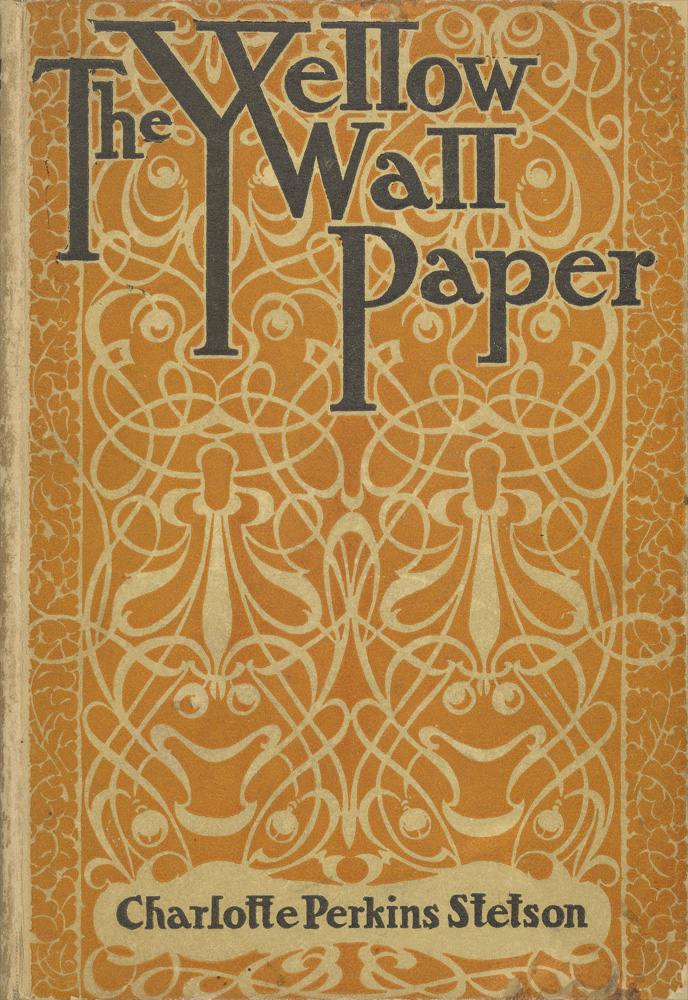
This story has been analyzed in myriad ways and is considered an important work of feminist literature. It’s a chronicle of a mental breakdown; a woman is suffering from ‘a slight hysterical tendency’ according to her physician husband, following the birth of her child. She spends the story confined to an upstairs room at a country estate and comes to believe that a woman is trapped behind the yellow wallpaper in the room.

On reading the story, you end up infuriated by the woman’s husband, and sympathetic toward her plight, but the way Gilman describes her experience through a series of journal entries also makes the story quite memorable. Her slow descent into madness is told with convincing, disturbing detail.

Gilman suffered from postpartum depression, so this story has been read with this in mind. At the time, a ‘rest cure’ was administered for treatment, which only made things worse for her, so she stopped the treatment and resumed writing, later saying that she feared a mental breakdown had she continued to follow the doctor’s cure. Gilman instead followed the advice of a female doctor, Mary Putnam Jacobi, who argued against such rest. Much has been written about Gilman and her pioneering story, for those interested, your local library will have plenty of information about her life.
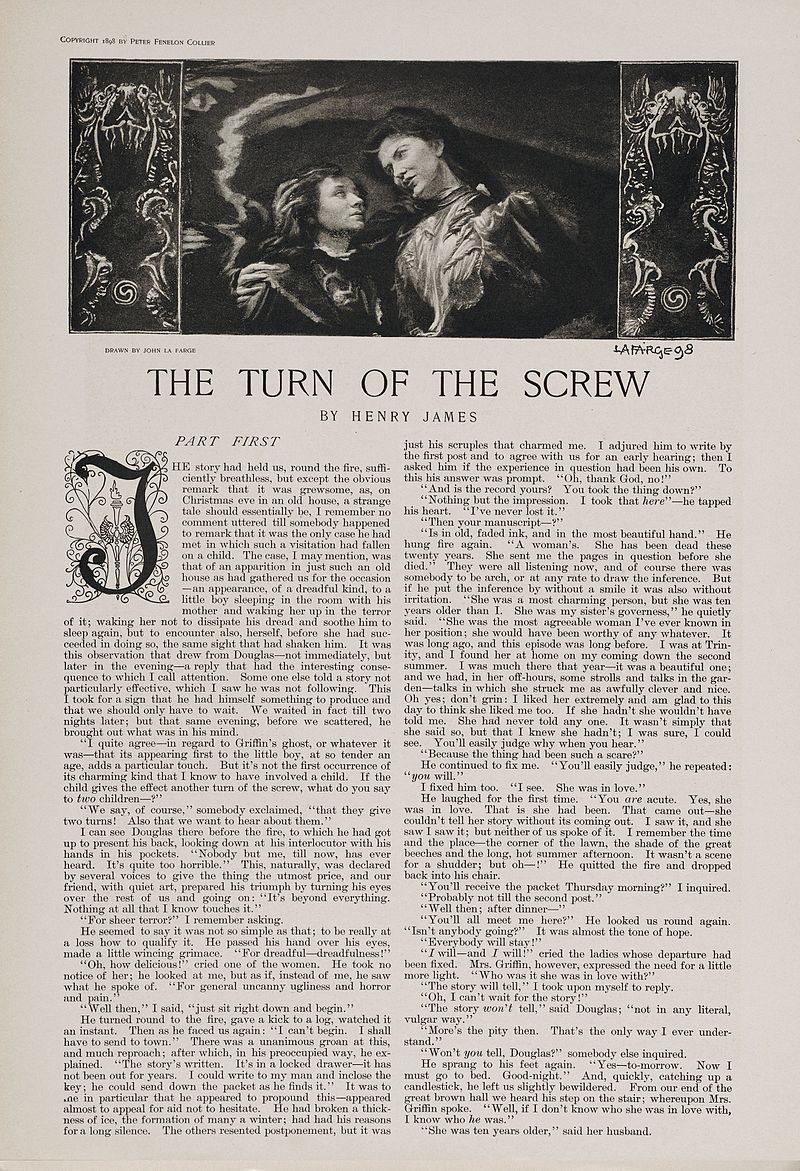
The Turn of the Screw, by Henry James (1898)

“The summer had turned, the summer had gone; the autumn had dropped upon Bly and had blown out half our lights. The place, with its gray sky and withered garlands, its bared spaces and scattered dead leaves, was like a theater after the performance–all strewn with crumpled playbills.”

The Turn of the Screw is one of the most influential, classic horror tales ever written; everyone ought to read it. It’s a gothic story of a haunting at a British country estate, and the reader is never sure whether the ghosts are real or imagined. The story is told through a frame of a man reading a manuscript of a governess who believes that the children in her charge are being haunted by the ghosts of two former employees of the estate.

I find that the presence of children in fiction will usually increase the tension, and in a well written story like this one, you feel quite concerned for the children, worried that they are either being haunted, or being cared for by someone who is unstable and not up to the task. Either way, the sadness of these children, who are seemingly ignored by their parents, is something I couldn’t shake when I read this story. It was such a disturbing tale because of everything left to the reader’s imagination. In my opinion, this is usually the way to scare the reader far more than the usual genre tropes.

James was as prolific and famous as an author can be, and his reputation rests on a number of well known works, including Daisy Miller, Wings of the Dove, Portrait of a Lady, and The Golden Bowl, to name just a few. But it is Turn of the Screw that I always think of first, and I think this is likely true of other readers. It has been adapted no less than twenty-eight times, with numerous film versions, an opera by Benjamin Britten, various stage adaptations, and new adaptations still being made today. There’s something about this unsettling story that has deeply resonated with readers for more than a century.

Frankenstein by Mary Shelley (1818)

‘Hateful day when I received life!’ I exclaimed in agony. ‘Accursed creator! Why did you form a monster so hideous that even you turned from me in disgust? God, in pity, made man beautiful and alluring, after his own image; but my form is a filthy type of yours, more horrid even from the very resemblance. Satan had his companions, fellow-devils, to admire and encourage him; but I am solitary and abhorred.’

The first ever horror and science fiction novel, first published in 1818, when Mary Shelley was just twenty years old, Frankenstein has a reputation that has been as long lasting as it is deserved. A beautifully written tale that began as a legendary writing contest between Shelley, her husband Percy, Byron, Dr. John Polidori, and others who were spending a summer together in Geneva, Frankenstein bears little resemblance to the monster most of us recognize from the many film adaptations that we’ve seen through the decades.

The monster is philosophical and brilliant, almost superhuman, and the real villains are those in the story who judge him by his ghastly appearance. There are as many interpretations of the work as there are film adaptations: a warning against humans playing God, the irresponsible Victor whose thirst for knowledge leads to catastrophe, the humans who judge the creature by how hideous he is. Several chapters in the book deal with a family of poor, blind people who treat Frankenstein with care and respect because they cannot see him. It’s written in a beautifully poetic style, was immediately successful, and still finds new and enthusiastic readers today.

There are a few different versions of the book, which Shelley revised in 1831, but most scholars prefer the earlier edition. Shelley had a very difficult early life, losing her famous mother when she was just a few weeks old. Her father, also a well-known intellectual, remarried a woman with whom Mary had a very difficult relationship. Under these circumstances it seems a miracle she was able to write such a classic. Her husband, the famous Romantic poet, also caused a scandal when he left his wife for Mary, and had numerous affairs.

I could write a lengthy essay about this book and its influence and various interpretations, but I’m by no means an expert on her; countless scholars have already done that better than I could, and the purpose of my blog this month is to offer a few thoughts on some of my favorite horror novels. This is an essential one that everyone ought to read. It’s one of the great novels in literary history, a book that will help you understand where the genre came from.

I Am Legend by Richard Matheson (1954)

Richard Matheson’s I Am Legend is a book that may be overlooked by fans of vampires and zombies, but it’s one of the originals of the genre, inspiring three direct adaptations in addition to an entire industry dedicated to post-apocalyptic monster stories. Written in 1954, and set in 1976, it’s the story of Robert Neville, one of the last humans left alive after a pandemic that has killed most of the world population and turned the survivors (aside from him) into vampire-like creatures, complete with aversions to sunlight, garlic, and crucifixes. He becomes a vampire slayer, a legend to the remaining zombies, who are terrified of him. Eventually he learns more about the disease that has claimed so many lives, and befriends a woman whom he thinks may be immune to the disease, as he is.

Like some of the other books on this list, I Am Legend is a highly influential novel, and its stature has only increased with time. I read it after having seen Charlton Heston in the campy ‘Omega Man’ and Vincent Price’s excellent depiction of Neville in The Last Man on Earth. The most recent adaptation starred Will Smith, and of course there are dozens of other movies and television shows that have been inspired by Matheson.

Matheson’s other stories and novels are also well worth reading. I greatly enjoyed The Shrinking Man, a tale inspired by fears of radioactivity. Matheson had a long and successful career writing for TV and film, including some of the best-known episodes of The Twilight Zone and Star Trek, as well as screenplays for Roger Corman’s entertaining adaptations of Poe stories, which have delighted horror fans since the 1960s. Many of his works have been adapted for film as well. He had an incredible career and influenced a whole generation of writers, filmmakers and fans. If you’ve not yet read Matheson, don’t delay–start with I Am Legend.

The Body, by Stephen King (1982)

“It’s hard and painful for you to talk about these things … and then people just look at you strangely. They haven’t understood what you’ve said at all, or why you almost cried while you were saying it. That’s the worst, I think. When the secret stays locked within not for want of a teller but for want of an understanding ear.”

Today I’m looking back to the 1980s again, a decade that was very good for commercial horror. From his excellent collection Different Seasons, The Body is probably my favorite King story. He’s incredibly prolific and has written lots of great stories and novels, but I find the realism of this one very gripping. It’s not a horror tale, exactly, but more a story of friendship and growing up.

By now almost everyone knows this story about four twelve-year-olds in Castle Rock, and their quest to see a dead body. These children all come from difficult circumstances, but form an unbreakable bond in this story, and King makes it all seem so real that we can easily relate to them. The main character, Gordie, is a storyteller, a stand in for King, I guess, since he also graduates from the University of Maine and becomes a successful writer.

I know many of King’s fans enjoy the vampires, monsters, and supernatural horror of his stories, and I like them as well and have read many of them. But to me, King is at his best when he tells a more restrained, realistic tale like this one. He’s a master of horror, I know, but I think what has given him such popularity and staying power are his observations on working class and poor lives lived in everyday kinds of places. It makes his characters quite sympathetic.

The other stories in this book are quite good, as well. Apt Pupil, Rita Hayworth and the Shawshank Redemption, and the Breathing Method are all great novellas. Three of them, of course, were made into very successful Hollywood films. Most writers would be thrilled to have even one story as successful as any of these, but King has always been in a league of his own.

Fevre Dream by George RR Martin (1982)

George RR Martin is known for his groundbreaking fantasy novels, but back in 1982 he wrote this gem of a vampire book, about a down on his luck steamship captain, Abner Marsh, who makes a bargain with an odd man, Joshua York: he gets to have his dream ship, financed completely by the mysterious stranger, but he must transport the man, his friends, and their cargo, no questions asked. As you might imagine, this arrangement does not go as planned. It’s a fun read with plenty of adventure and scares. If you enjoyed the Song of Ice and Fire novels, I think you’ll love this book. There are some interesting characters, weird plot twists, great writing, and of course, vampires.

According to Martin, his book sales around this time were poor, and contributed to his decision to become a TV writer. For years afterward, he worked on things like The Twilight Zone and Beauty and the Beast, until he wrote A Game of Thrones in 1996, which marked his return to novels. I’ve enjoyed everything he wrote. Armageddon Rag is another excellent read, this one about a cursed rock band. His short stories, science fiction novels, and Wild Cards series are also worth checking out. I only hope we get Winds of Winter sometime soon.

The Haunting of Hill House, by Shirley Jackson (1959)

“It was a house without kindness, never meant to be lived in, not a fit place for people or for love or for hope. Exorcism cannot alter the countenance of a house; Hill House would stay as it was until it was destroyed.”

I’ve been writing about a number of unnerving books this month, but The Haunting of Hill House might be the finest of them all. You can read it as a haunted house story, which it is, but I can only think of a handful of books that truly scared me, made me feel so unsettled that I couldn’t stop thinking about the book, or that kept me up at night. Shirley Jackson was such a fine writer that I can’t recommend this book, or her other works, highly enough. The trials of Eleanor Vance in Hill House are some of the most upsetting things any horror character has ever had to endure, and I found myself terrified for her as I read this book. Without giving anything away, there is a scene involving the possible presence of a supernatural entity that is one of the most the most disturbing passages I have ever read.

What makes The Haunting of Hill House work so well is that Jackson doesn’t rely on cheap scares or obvious explanations; you go along with the story without thinking. You sympathize with Eleanor and the other characters and before you know it you are tangled up in their fears and disappointments and terrors. It’s scary because Jackson makes it all seem so real and believable; usually, when reading in this genre, it is easy to set aside your feelings and realize it’s just a ghost story. Jackson makes that much harder by making her characters seem so human, by telling her tale so well.

If you only have time to read one book this season, it should be this one. There are lots of great horror writers, but Jackson was just a great writer, period, and I don’t think anyone has ever surpassed her achievement in this genre. Her short stories are also essential reading for any student of fiction.  

The Case Against Satan (1962) and The Exorcist (1971)

Both of these were popular novels long before my time, but when I was in college in the 1990s, I was quite taken with the film version of The Exorcist, which to me is one of the scariest movies ever made. Since William Peter Blatty’s novel of the same name was first published in 1971, there have been no end of books and movies about exorcism of varying quality; such films are practically their own industry at this point. People sure enjoy reading books and watching scary films about demonic possession.

Ray Russell’s The Case Against Satan, originally published in 1962, is an excellent, tightly paced and disturbing read about a case of possession and exorcism involving a young girl. It predates Blatty’s novel by nine years, so it is probably the first novel of its kind. It’s a very different read from the Exorcist, told with more attention to psychology and spiritual matters. Russell was a fine writer of Gothic tales, and I highly recommend his short stories. There are a couple of good books that collect most of them, including the very creepy Sardonicus.

The Exorcist reads more like a page turning thriller than Russell’s work. The story is more over the top, which fans of the film will recognize. If you like this genre of horror movie, I think you owe it to yourself to read this book and see where it started. Russell’s less well-known book is also a must read. Both novels do a great job of bringing this ritual to life; even if you aren’t Catholic, or don’t believe that possession is something that exists, I still think the books are well worth reading for their treatment of the topic. You can read them on the level of enjoying a good scare, but I feel that there is more here in the way Russell and Blatty discuss the nature of evil, the possibility that ‘the adversary’ exists. Many of us still believe in a spiritual life, and here we also see the belief in the dark side of that world. Both of these books stayed with me long after I read them–I found that their reputations are well-earned.

A Night in the Lonesome October, by Roger Zelazny (1993)

This novel is a wonderful seasonal treat by the legendary Zelazny. Each of the chapters is a night in October, told from the point of view of Snuff, a dog who is the companion of Jack the Ripper. Sherlock Holmes, Dracula, Dr. Frankenstein, the Wolfman, and various other spooky characters haunt the pages of this book, each with an animal familiar, all playing a game that will determine the fate of humanity. I found this book to be a tremendously appealing conceit, such a fun read and so well told. If this kind of story sounds appealing to you, do not delay: sit back, relax, pour yourself a cup of tea and enjoy it by the fire–you won’t be disappointed. If it doesn’t sound appealing to you, that makes me sad and I’d encourage you to try it anyway.

The October Country, by Ray Bradbury (1955)

We start the month with one of the finest collections of seasonal stories ever, by the great Ray Bradbury. Released in 1955, its significance in the genre can’t really be overstated, nor can Ray’s role in shaping Halloween as we know it today. Just leafing through this one is enough to give you a warm feeling of nostalgia and creepiness, to know that autumn is at hand. You start reading and immediately know you’re in the hands of a master.

I first encountered this one many years ago, and I make a point to re-read it nearly every October. The beautiful cover by Joseph Mugniani (with whom Bradbury often collaborated) sets the tone, and it keeps getting better as you read each tale. There are so many memorable stories here that it’s a bit like listening to the Beatles’ greatest hits: The Small Assassin, The Dwarf, Jack in the Box, on and on they go, each one weirder and more wonderful than the last. I love The Dwarf, the tale of a short man who visits a carnival fun house each night to see himself taller and more handsome, only to be cruelly abused by the fun house proprietor. For me, the centerpiece here is “The Homecoming,” which along with “Uncle Einar” are the strangest and most jaw-dropping of these stories. They’re so good that later in his career they became the backbone of another collection, ‘From the Dust Returned,’ which explores the Elliott family in all their glory.

Bradbury wrote so much over his long and storied career that it’s hard to pick just one novel or collection of his, but I think this one is most emblematic of all his best elements. Good-hearted, small-town people meet fantastic beings. Helpless loners and outsiders are treated cruelly by life but keep their souls intact through art and kindness. The wonder and mystery and imagination of the dark side of the world, all told with Bradbury’s poetic prose, heartfelt emotion, and wild imagination. It just doesn’t get any better than The October Country. We were so lucky to have had Ray.

Bradbury often wrote of the importance of feeding one’s imagination. Zen and the Art of Writing is a wonderful book for any writer, with lots of great observations on how to work at your craft. Mostly, he wants writers to stop thinking and just write. The ideas poured forth from his mind when he did this. One oft quoted passage from the book is: “If you did not write every day, the poisons would accumulate and you would begin to die, or act crazy, or both. You must stay drunk on writing so reality cannot destroy you.”

I think there’s a real lesson in this. Overanalyzing things, thinking too much, and soaking up too much information, which is very easy to do in our hyper-connected world, is the enemy of good writing. In my view, Bradbury’s method works. He was drunk on life and ideas and let them spill out in beautiful ways that have resonated with millions of readers for generations. May he keep finding new audiences forever. Thanks for all the stories, Ray.