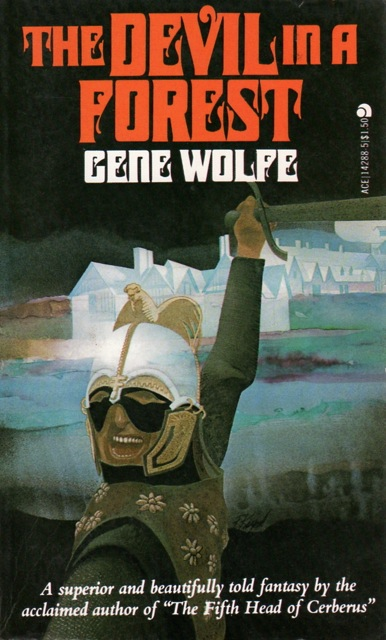
Gene Wolfe is one of my favorite writers, and this is a wonderful book of his that I found some years after reading his epic Book of the New Sun, an amazing series that I want to reread soon. Unlike that dense, lengthy work, this is a shorter novel of mystery, adventure and myth, but like Wolfe’s other novels, it is beautifully written, tightly plotted and great fun to read. I just re-read it over the holidays, after hearing the carol, ‘Good King Wenceslas,’ which reminded me of the book. Wolfe explains his writing inspiration for this novel in the epilogue:
“Shortly before Christmas one year, Gene Wolfe was singing the carol ‘Good King Wenceslas’ and was struck by the king’s questions to his page: “Yonder peasant, who is he? Where, and what his dwelling?” And by the page’s answer: “Sire, he lives a good league hence, Underneath the mountain, Close against the forest fence, By St. Agnes’ fountain.”
Wolfe recalls, “I found myself wondering who, indeed, was that nameless medieval peasant from whom most of us are, in one way or another, descended.”
The Devil in a Forest is Wolfe’s story surrounding this peasant, whose little village becomes involved in a struggle between a nameless evil and the forces of good. There is a dangerous highwayman, a mysterious murder, and strange powers that converge upon this village and create havoc for Mark, the protagonist. The attention to detail in Mark’s day to day life, and that of his fellow villagers, is quite well done and made for some interesting reading. Mark’s trials and his battle for survival are suspenseful, keeping you guessing right until the end. I enjoyed this one very much—it is so different from some of Wolfe’s other books, but his concept and the execution are excellent. I don’t want to spoil the fun for those who may be interested in reading this one, but I recommend it to anyone who has enjoyed Wolfe’s more well-known books. Fantasy writing doesn’t get much better.
“It’s hard and painful for you to talk about these things … and then people just look at you strangely. They haven’t understood what you’ve said at all, or why you almost cried while you were saying it. That’s the worst, I think. When the secret stays locked within not for want of a teller but for want of an understanding ear.”
Today I’m looking back to the 1980s again, a decade that was very good for commercial horror. From his excellent collection Different Seasons, The Body is probably my favorite King story. He’s incredibly prolific and has written lots of great stories and novels, but I find the realism of this one very gripping. It’s not a horror tale, exactly, but more a story of friendship and growing up.
By now almost everyone knows this story about four twelve-year-olds in Castle Rock, and their quest to see a dead body. These children all come from difficult circumstances, but form an unbreakable bond in this story, and King makes it all seem so real that we can easily relate to them. The main character, Gordie, is a storyteller, a stand in for King, I guess, since he also graduates from the University of Maine and becomes a successful writer.
I know many of King’s fans enjoy the vampires, monsters, and supernatural horror of his stories, and I like them as well and have read many of them. But to me, King is at his best when he tells a more restrained, realistic tale like this one. He’s a master of horror, I know, but I think what has given him such popularity and staying power are his observations on working class and poor lives lived in everyday kinds of places. It makes his characters quite sympathetic.
The other stories in this book are quite good, as well. Apt Pupil, Rita Hayworth and the Shawshank Redemption, and the Breathing Method are all great novellas. Three of them, of course, were made into very successful Hollywood films. Most writers would be thrilled to have even one story as successful as any of these, but King has always been in a league of his own.
I spent lots of time with my kids camping and at the beach this summer, as I do most years. Something I noticed, that I hadn’t seen in past years, was packs of very young, free-roaming kids hanging out and doing things without adult supervision. I mostly grew up this way, and I think this style of parenting is back in fashion thanks to writers like Jonathan Haidt, whose criticisms of childhood by screen are exactly right and worth reading about.
Where he and other parents fall badly astray, in my opinion, is in this free roaming childhood movement. Plenty of well-intentioned, educated parents are heading in this direction. They can do as they wish, but I will never join their ranks, for reasons I’ll explain in a moment. Haidt even writes in his book about letting his 14-year-old go from Flushing, Queens to the upper west side unattended in the wee hours of the night, which caused me to think he is insane, despite his good intentions. I’ve done trips like that myself as an adult and felt myself lucky to get home without being harmed, though I was verbally threatened and had a man expose himself to me on one such trip in my college days. Granted, this was in the pre-gentrification days of NY, but even so, I’d never let a child of mine wander around the subways after hours until they were at least 17 or so.
Haidt and others insist that the free roaming childhood is a wonderful thing, that it’s perfectly safe and has many benefits. I had a childhood like this myself, and it wasn’t so bad. We didn’t know anything else in the 80s, when I was a boy—my parents just let us ride bikes and go all over creation alone. We returned when we were hungry or thirsty, and that was that. Everyone did it. I do think it was healthier than playing video games all day.
However, –and this is a big caveat: I was personally acquainted with several children who never made it to adulthood because of this environment. That’s right: they died as unsupervised kids because no one was there to protect them from doing dangerous things. Forget the boogeyman. Forget far away stories of missing kids. I saw this up close and personal, so I’ll thank you to shove your one-in-a-million statistics somewhere else.
Last week I saw a group of 6 kids, none of which could have been more than five or so, hanging out by the beach where we camped. No adult in sight, except me. I watched to make sure none of them did anything dangerous. Probably they’ll all make it to adulthood.
Make of this what you will. Free range however you like, it’s no skin off my nose. I’ll be there at the beach, watching my kids to make sure they don’t drown.
In case you’re wondering, no, I’m not a helicopter parent, but I don’t like being told I’m too protective by some yuppie who read Jonathan Haidt and didn’t live through the death of loved ones or friends because no adult was around to protect them. Kids are vulnerable. They need supervision, whether they like it or not, and whether or not you find it inconvenient.
Here’s my suggestion: have them put the phones and video games down, and hand them a big, fat novel. Read it together. Do some swimming and hiking with them. Or let them play alone, but stay where you can see and hear them. That’s what I do and it works just fine. I intend to make sure they live to do dumb things when they’re adults old enough to take responsibility for their own decisions.
On Saturday, March 29, I’ll be at the Poughkeepsie book festival with copies of my novel The Osprey Man. Every child gets a voucher for a free book, and there are activities for the whole family. Hope to see you there! https://poklib.org/bookfestival/
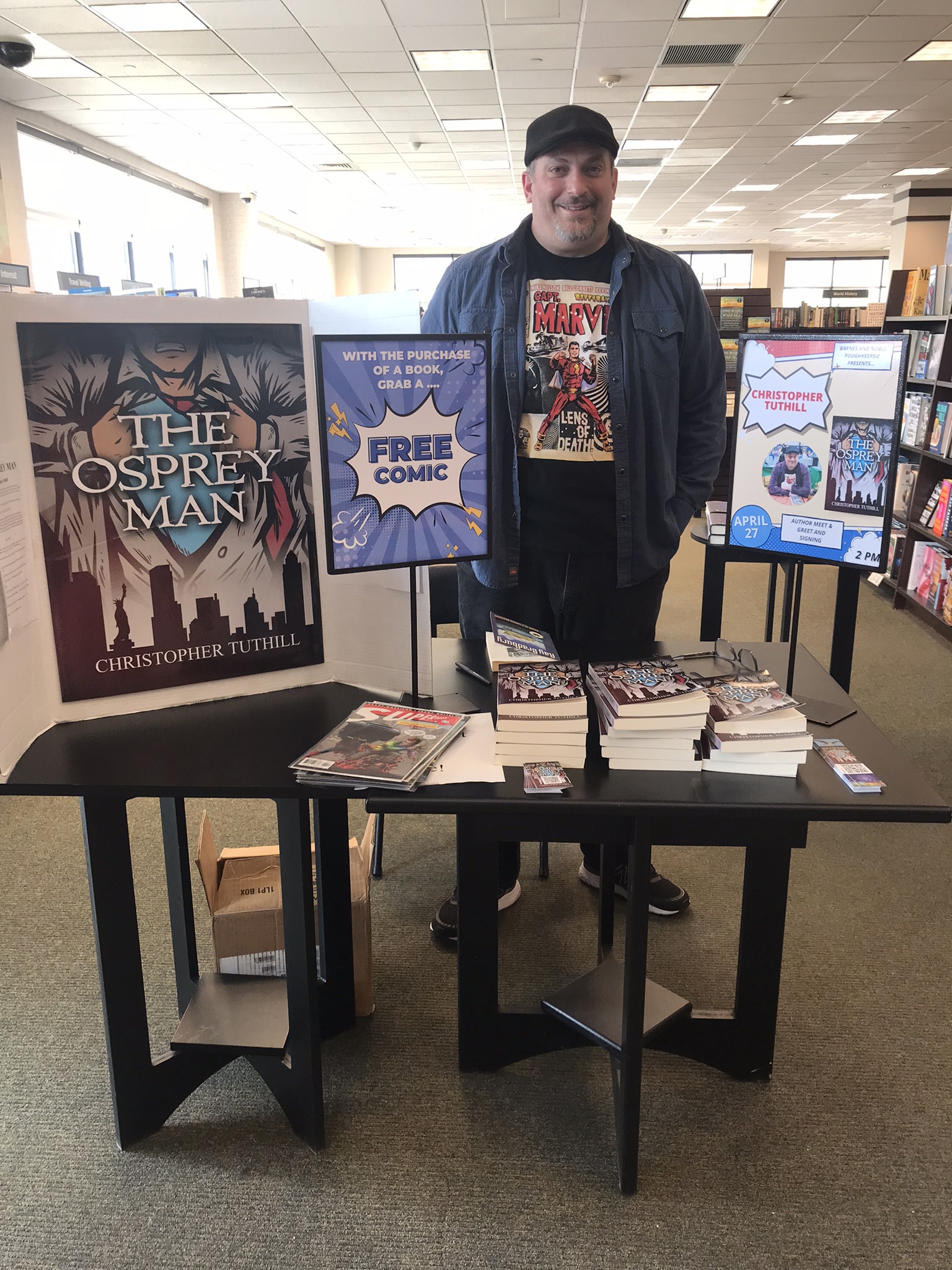
Here’s a photo of yours truly at the Barnes and Noble. I met a number of readers and signed some books, it was a great day. Hoping to do more events like this when the next book is released.
I will be at the Barnes and Noble in Poughkeepsie, NY on Saturday, April 27 at 2pm for a book talk and with copies of THE OSPREY MAN. It’s sure to be a fun time! Bring a friend, grab a coffee, and stay for some storytelling.
One of the fun things about being a parent is showing your children things you enjoyed as a child. We read lots of different books and comics and watch movies together; most of the movies and TV my children watch is contemporary, but a good chunk of it consists of gems I enjoyed growing up. They mostly choose their own books but we read some of the cream of the crop together, as well.
Last night, we watched the 1981 classic, Time Bandits, Terry Gilliam’s family adventure film. I hadn’t seen this in decades, and wow, I was surprised how well it holds up. What a wonderful film. I recall watching the movie as a child, and the memories I have of it include John Cleese hilariously playing Robin Hood, Michael Palin as a lovelorn wimp, some great adventure scenes, witty, sharp dialogue, and a whole lot of fun. It’s a wonderful story of time traveling thieves, equipped with a magical map stolen from the Supreme Being. But seeing it as an adult made me view it differently–though all these wonderful comic elements are there, it’s a tale of a lonely child, the kind who is often seen in Roald Dahl novels.
The hero of this story is a young boy named Kevin, who is sympathetic from the opening scenes of the film. His parents are more interested in watching television and buying new gadgets than they are in their poor, lonely son, who escapes to his room to read and play with toy soldiers, only to be screamed at by his dad for making too much noise.
What dad doesn’t know is that the racket up in Kevin’s room was made by a knight on horseback who crashes through a wall, leaping over Kevin. But Kevin wonders if it were a dream, since the room quickly goes back to normal.
But Kevin does escape his mundane world when the Time Bandits break through the next night. By turns hilarious, greedy, selfish, and kind, Kevin’s diminutive companions are completely inept at what they do. They’re using the map to travel through space and time, only to steal valuables from guys like Napoleon and Agamemnon. Each time they make a leap through time, they fall from the sky and crash in a heap atop one another, sometimes smashing into innocent bystanders. It’s a hilarious and painful entrance every time. Yet all they do with this incredible ability to time travel is petty thieving. At one point, Kevin, having been taken from Agamemnon’s court, where he was to be the king’s heir, is despondent at this state of affairs, telling the leader of the Bandits, Randall, that the bandits have this amazing artifact, with which they can do anything, yet they choose to just go around stealing things. Kevin says, wistfully, of Agamemnon, “Money wasn’t important to him,” to which Randall replies, “He didn’t have anything to spend it on, did he?”
It’s a telling moment in the film; the young boy has perceived that even his new swashbuckling friends are barely better than his parents. They have the key to the universe, and what they want to use it for is to become rich.
Kevin does influence his group of pals, so that at the end they rescue him from Evil, who wants the map for himself. They risk themselves to save him, and it’s heartwarming to see Kevin’s kindness rub off on them.
But then God shows up, and everyone must leave, once Evil is destroyed. Kevin is in despair at this. He points out that God let dozens of people die, just to prove a point with his map and the Time Bandits. “Why does there have to be evil?” Kevin asks. “I think it’s something to do with free will,” the Supreme Being replies.
And Kevin is sent home. He awakens to his house burning down, and is saved by a fireman. His parents could not care less about his brush with death, and bicker on the lawn about their lost toaster, ignoring their son totally. They touch pieces of evil that Kevin has returned with, and immediately explode. Agamemnon, now a fireman, smiles at Kevin as he drives away in the fire truck. The movie ends with Kevin alone.
My son was on the verge of tears at this. I thought maybe he was upset at the dead parents, but that didn’t make sense, since Kevin’s parents were cruel and mean and shallow. No, my son explained that Kevin had had so much fun with his bandit pals, and now they were gone and the boy was alone.
Not exactly a comforting ending, but I guess Terry Gilliam’s movies are not there to comfort you.
This film is told with such good humor and wit and rapid fire jokes that it’s hard to take this too seriously as an adult, but my son was right. Maybe the best adults can do is save you and protect you, then wink and nod and send you on your way. The best strangers you meet will do that. And a lot of them, including God, are worth very little unless a kind-hearted child tells them they ought to behave.
Here’s the record of THE OSPREY MAN at my local public library. Look for my book at your library, or ask your librarian about it! It’s available as an ebook in the hoopla database, or they can order a physical copy.
Here’s an interview I did with Bee Lindy at her site, Bookpleasures. It was a lot of fun to do, and you can learn a bit more about my novel THE OSPREY MAN there.
Today is also the last day you can enter to win a copy of the book, through Teddy Rose Book Reviews
I’m lucky to have a ticket to see George RR Martin in conversation with Neil Gaiman at Symphony Space tonight, which should be a great event. I have seen Neil Gaiman give a talk before, several years back when his excellent novel The Ocean at the End of the Lane came out. But I’m a huge fan of George RR Martin’s work, and have never seen him in person, so I’m excited. I’ve been reading A Song of Ice and Fire since the early 2000s, when my brother in law gave me a copy of Game of Thrones one Christmas. I really hope I get to read Winds of Winter soon! I’ll be sure to report back on tonight’s event. I’ve thoroughly enjoyed House of the Dragon, which is a great show in its own right. I was concerned it might seem anticlimactic after Game of Thrones, but they’ve done a fantastic job bringing us back to Westeros.
When I finished Dance With Dragons, I was sorry that there were no more Westeros novels (though I happily read Fire and Blood when it arrived), so I set out to read the rest of Martin’s books. For those of you who haven’t read them, his other novels are enormous fun too. Tuf Voyaging is a wonderful collection of stories about space merchant Haviland Tuf. Fevre Dream is his vampire novel, and Armageddon Rag is another good one, about a rock journalist and a seemingly cursed band called the Nazgul (of course). And I recently got an early novel he wrote, Dying of the Light, that I’m eager to read. His story collections are also filled with great stuff.
I just finished Ray Russell’s Haunted Castles, a collection of his Gothic stories. I’d never read him before, but the book was so creepy and haunting that I immediately got his novel The Case Against Satan, which I’m halfway through. His stories are pretty grim, but I also find them great fun to read. Always so many good books to read, and not enough time.




 Christopher Tuthill