October has long been my favorite month. I love Christmas, too, as well as every other holiday that affords me time to spend with my children. But there’s always been something special about October 31. As a child, I knew Halloween was a night devoted to kids, where magical things happened, where you had a bit of independence to go out with friends and have a grand time. The costumes, the folklore, the changing of the seasons, all add warmth and wonder to this grand day. My own children have enabled me to experience these feelings again. It is so fun enjoying the fall with them: decorating the house, creating costumes, getting ready. The anticipation of it, the colors and sounds and stories, are almost better than the day itself.
The stories are the things that really animate it for me. The list of writers I admire in this season is almost endless, but it begins somewhere around Shakespeare and continues into the present. Shelley, Poe, Hawthorne, Stoker, Lovecraft, Jackson, Bradbury—my list goes on and on. The only thing that stops me from reading all these authors constantly is lack of time.
This October, time permitting, I intend to have a project on this blog, where I write some thoughts about some of my very favorite tales in the genre. I can’t promise I’ll do so every day, though that is the goal. Certainly, I’ll do a post weekly, or every couple of days. These posts aren’t meant to be comprehensive, scholarly, or to offer some kind of profound critique. It’s mostly just for me, to write up thoughts and impressions and appreciation of these tales that affected me: why I like them so much, how they work, why I have such affection for them, in that vein. Hopefully I’ll add to the catalog throughout the year, with other seasonal tales. Maybe some readers out there feel the same way about some of these stories. My hope is to document some of my very favorite books and stories, and perhaps turn some readers out there onto some tales they may have overlooked, or never heard of. There are a great number of unappreciated stories out there that ought to have more attention, in my view.
So, I’ll see how it goes. If you’re a like minded reader, I hope you join in the fun by commenting or offering your own thoughts.
I’ll probably begin early, before October 1, with some other seasonal type stories to get started. I’ll throw in some children’s stories that I’ve been reading with my family as well.
I’ll post more soon. I hope those reading this enjoy the season. I plan to be outside as much as possible in the next six weeks, to enjoy the beauty of fall, before it gets too cold and the leaves are gone.
I spent lots of time with my kids camping and at the beach this summer, as I do most years. Something I noticed, that I hadn’t seen in past years, was packs of very young, free-roaming kids hanging out and doing things without adult supervision. I mostly grew up this way, and I think this style of parenting is back in fashion thanks to writers like Jonathan Haidt, whose criticisms of childhood by screen are exactly right and worth reading about.
Where he and other parents fall badly astray, in my opinion, is in this free roaming childhood movement. Plenty of well-intentioned, educated parents are heading in this direction. They can do as they wish, but I will never join their ranks, for reasons I’ll explain in a moment. Haidt even writes in his book about letting his 14-year-old go from Flushing, Queens to the upper west side unattended in the wee hours of the night, which caused me to think he is insane, despite his good intentions. I’ve done trips like that myself as an adult and felt myself lucky to get home without being harmed, though I was verbally threatened and had a man expose himself to me on one such trip in my college days. Granted, this was in the pre-gentrification days of NY, but even so, I’d never let a child of mine wander around the subways after hours until they were at least 17 or so.
Haidt and others insist that the free roaming childhood is a wonderful thing, that it’s perfectly safe and has many benefits. I had a childhood like this myself, and it wasn’t so bad. We didn’t know anything else in the 80s, when I was a boy—my parents just let us ride bikes and go all over creation alone. We returned when we were hungry or thirsty, and that was that. Everyone did it. I do think it was healthier than playing video games all day.
However, –and this is a big caveat: I was personally acquainted with several children who never made it to adulthood because of this environment. That’s right: they died as unsupervised kids because no one was there to protect them from doing dangerous things. Forget the boogeyman. Forget far away stories of missing kids. I saw this up close and personal, so I’ll thank you to shove your one-in-a-million statistics somewhere else.
Last week I saw a group of 6 kids, none of which could have been more than five or so, hanging out by the beach where we camped. No adult in sight, except me. I watched to make sure none of them did anything dangerous. Probably they’ll all make it to adulthood.
Make of this what you will. Free range however you like, it’s no skin off my nose. I’ll be there at the beach, watching my kids to make sure they don’t drown.
In case you’re wondering, no, I’m not a helicopter parent, but I don’t like being told I’m too protective by some yuppie who read Jonathan Haidt and didn’t live through the death of loved ones or friends because no adult was around to protect them. Kids are vulnerable. They need supervision, whether they like it or not, and whether or not you find it inconvenient.
Here’s my suggestion: have them put the phones and video games down, and hand them a big, fat novel. Read it together. Do some swimming and hiking with them. Or let them play alone, but stay where you can see and hear them. That’s what I do and it works just fine. I intend to make sure they live to do dumb things when they’re adults old enough to take responsibility for their own decisions.
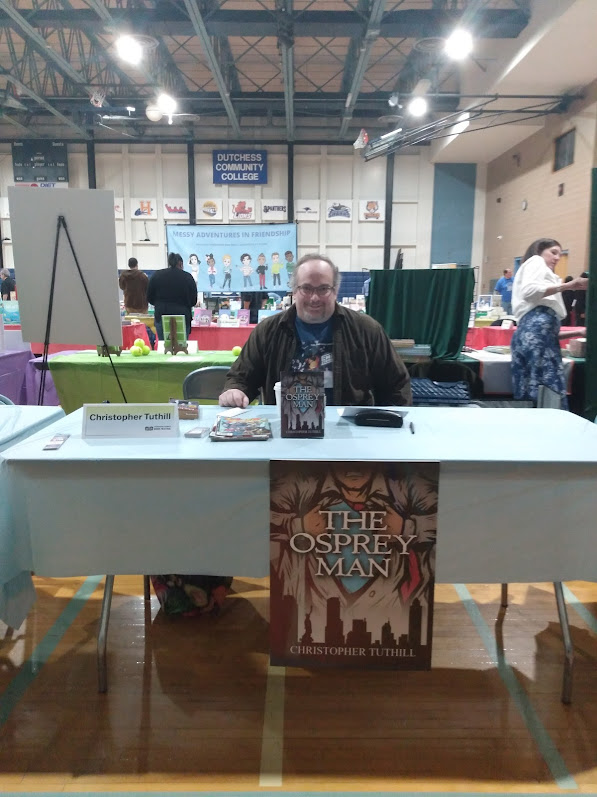
The 2025 Poughkeepsie Children’s Book Festival was a huge success. Many thanks to both the Merritt Bookstore and the Poughkeepsie Public Library, who worked tirelessly to put on a great event. It was really heartening to see so many enthusiastic children and young adults. They’re the next generation of readers and the future of our world, and they need our support.
Many thanks to all the people I met, and to those who bought books from me and the more than 100 authors who were there. My children had a great time, met some authors, and came home with lots of great stuff to read. I hope by next year’s event I’ll have another book to bring with me.
On Saturday, March 29, I’ll be at the Poughkeepsie book festival with copies of my novel The Osprey Man. Every child gets a voucher for a free book, and there are activities for the whole family. Hope to see you there! https://poklib.org/bookfestival/
One of my fondest, most primal memories of childhood is being up late in the summertime, reading a good book, while everyone else in our busy house was asleep. There were so many novels I enjoyed back then, and I read indiscriminately, for the pure joy of being lost in a fantastic new world.
There were many great series for young people back in the early 1980s, and I read many of them. The Hardy Boys, The Black Stallion, Matt Christopher’s sports stories, Encyclopedia Brown the boy detective, Danny Dunn, a boy wonder who created all kinds of machines with his pals, and on and on. There were some great works of literature too, like Madeline L’Engle’s A Wind in the Door, Mark Twain’s Tom Sawyer Detective, Ray Bradbury and The Martian Chronicles, and others. Today I can see how much more sophisticated these last three are, but as a young boy I didn’t care about their literary merit, I just wanted to read.
To read as a nine year old meant getting lost in another world that seemed so real I became irritated when my mundane surroundings intruded. It meant an escape into magic and mystery and wonder, into past eras that seemed completely real, as if I were suddenly in a time machine, transported to colonial era America, or King Arthur’s Court. Perhaps I’d go to a distant strange planet, or an isolated pacific island, or any other a million different times and places. There was nothing so wonderful in the world as being lost in those pages, many millions of miles away from wherever I was and whatever was happening around me in my little corner of the world.
I’m now fifty, and very occasionally this magnificent feeling will come over me again when I’m reading a truly great, original book. It seems to happen less and less these days; perhaps that is a failure of imagination on my part, or perhaps it just happens with age. After you’ve read so many books, they cannot all have that glorious impact, and many of them will seem merely adequate. I’ll say that in the past few months, Ron Chernow’s Hamilton was a biography that transported me to the early days of America in a way that was quite breathtaking; I don’t normally read a lot of history, but he is such a fine writer, telling the story of the founder in such an empathetic way, that I was swept up in the drama of it and couldn’t wait to read more.
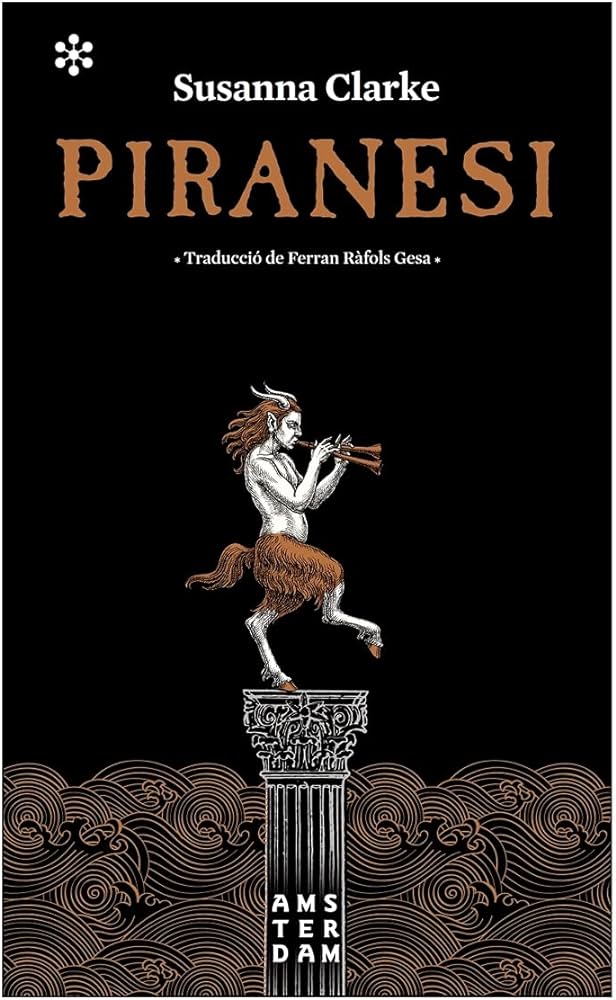
Novels are a different matter, and as I’ve read so many of them, it has become harder for me to find ones I truly love, that affect my outlook so dramatically, that can transport me in that same primal way. Susanna Clarke’s writing does that for me, and I recall a well-spent winter evening not long ago, when I was up through the night, finding revelations on every page of her incredible book, Piranesi, which I finished in one sitting. I can’t recommend her work highly enough, and I was ecstatic to learn she has a new novel arriving this fall.
In this hyper-connected age, it is increasingly difficult to shut out the outside world and enter the fortress of mystery and imagination that is a great reading experience. I read whenever I can, as much as I can, but with the demands of a job and a family it’s not always easy. I’ll stay up late at night when I’m not too tired, or read when I have downtime on the train or before the rest of my family is up. I guard my reading time jealously, just like when I was a boy, and get frustrated sometimes when there isn’t enough time or quiet for me to read every novel or work of history or criticism on my shelves. My collection is wide and varied–I have books on a great many topics, because I am never sure which one I will need at any given moment. This is one of the great things about being a librarian, as well: if I don’t have it on my shelves at home, I can almost certainly find what I need in the library.
I enjoy movies, though I’m not exactly a movie critic. I have found that films, television and video games don’t transport me the way a good book does. Maybe some people find the same elation and deep mystery watching things or playing video games, but it doesn’t happen for me. I can enjoy such media, but it won’t impact me in the same way, and while I don’t know for certain, I suspect that the effort required of a careful, thoughtful reader will always make the reward of reading that much greater. To me, it’s a bit like the difference between hiking to the top of a mountain and taking in the view, as opposed to having someone drive you up there on a paved road. (The same can be said for writing vs. AI-assisted writing, but that is the topic for some other post.)
One of the essential things about reading is the way it can change your perceptions, your outlook, your knowledge of the world, and perhaps even knowledge of yourself. The greatest works help us do this and will enrich your life in ways like nothing else. For me, reading a great book is one of the last bulwarks I have in guarding my mind from a ceaseless stream of meaningless junk that increasingly defines modern life.
The other night my young daughter, who is brilliant and perfect, happened upon the Twilight Zone episode, “Time Enough at Last,” with the great Burgess Meredith. I hesitated to show it to her, but she was eager to see it and I relented. At the end, she was in tears for Henry Bemis, the tortured man who lives through an atomic war only to be left utterly alone, despondent, bereft of all hope, sans spectacles. “I hate this,” she said. “He was finally able to read and now he can’t.” I felt like an awful father for having shown her the episode. We talked a bit about the message of the show but she was inconsolable, much like I was decades ago when I first saw it.
In these waning days of summer, I admit I feel some pressure to read what I haven’t from my list so far, but my task shall be Herculean. I have a copy of Thomas Pynchon’s Against the Day, which I have never read and will likely not get to before the end of August. I have works by Saul Bellow, Robert Caro, Don DeLillo, Tim Powers, Toni Morrison, Barbara Tuchman, Octavia Butler, and too many others to list sitting on my shelves, waiting to be opened, calling to me, but time is running out. I’ll get to a few of them, and the rest will likely need to wait for winter break, or next summer, when I will have time enough at last.
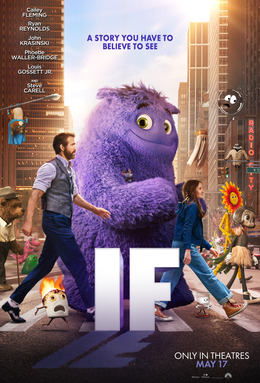
I took my nine-year-old daughter to see IF, the recent movie with Ryan Reynolds, John Krasinski, and young Cailey Fleming as the lead. It’s a sweet story about imagination and growing up. I hadn’t read any reviews and knew nothing about it before going, but I knew what we were in for when there were scenes of some of the characters watching the Jimmy Stewart classic “Harvey,” about a man and his imaginary friend, a giant rabbit.
The film deftly handles some serious subjects, including the death of a parent and the serious illness of another. Normally, I would be worried that such a tale might be guilty of mawkishness, of overloading us with too much pathos, but this movie had such good humor and genial performances that it never veers into this kind of cheap emotion.
At the heart of this story is the idea that as we age, we leave behind childish things in our eagerness to become adults. The danger is that you can completely lose your imagination, your sense of wonder, all the things that make life worth living in the first place. The main character, twelve-year-old Bea, is starting to close herself off from a world of hurt after losing her mother; her father, played by Krasinski, becomes ill with a heart condition, leaving the young girl in a scary and vulnerable situation. She stays with her kindly grandmother, played by Fiona Shaw in another fine performance, and immediately lets grandma know she’s no longer a kid, and can deal with adult problems.
While worrying about her dad, Bea meets one of her grandmother’s neighbors, an eccentric man named Cal (Ryan Reynolds), who, she learns, lives with a variety of IFs, or ‘imaginary friends’ who have been abandoned by children who grew up and grew out of them. There is a giant purple monster that is on the advertising for the film, voiced by Steve Carrell, as well as a ballerina, a spy, a teddy bear, and a whole cast of whimsical characters in search of children to help. The problem is that adults, and even most children, cannot see these imaginary beings, no matter how hard the creatures try to get their attention.
This setup may sound a bit daft, but I found it a sweet story, and one that had some surprising depth. Every adult I know can use more of the things that the movie explores—fun, warmth, laughter, imagination, and everything else that children have in abundance and that most adults lose if they aren’t careful.
If the mark of a good YA story is that it keeps children engaged while also entertaining parents, IF does the job admirably. I would go as far as saying it was a moving story. My daughter loved it, and I thought it was great too, with excellent performances by all the cast, and enough comedy to lighten the tone from some more serious themes.
If you have a tween, be sure to take them to see this film. There are few movies like this, that tell an earnest tale with warmth and humor, and this is one that adults and kids can enjoy. Kudos to Krasinski, who also wrote and directed this film, it’s an excellent, heartfelt story.
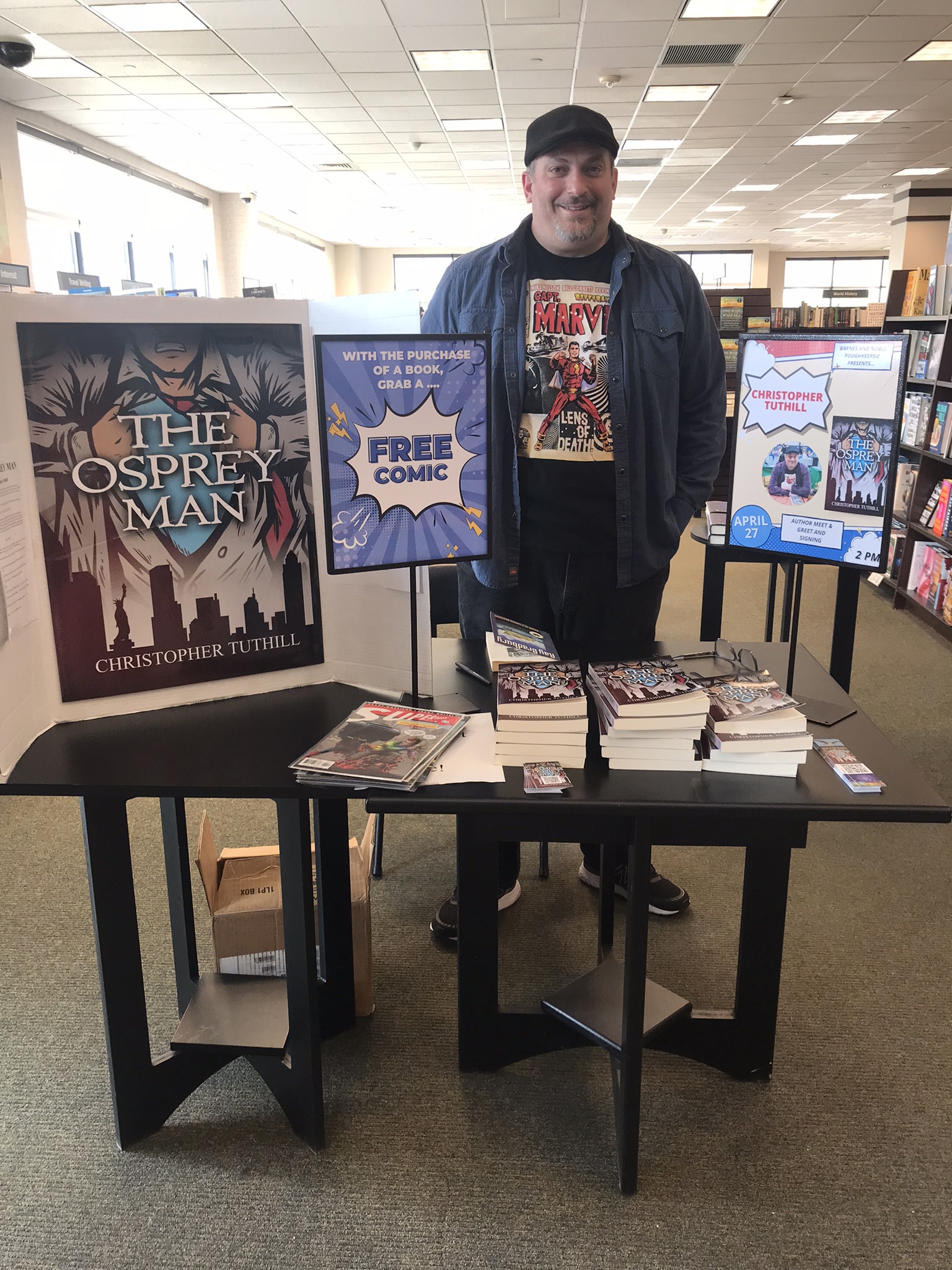
Here’s a photo of yours truly at the Barnes and Noble. I met a number of readers and signed some books, it was a great day. Hoping to do more events like this when the next book is released.
I will be at the Barnes and Noble in Poughkeepsie, NY on Saturday, April 27 at 2pm for a book talk and with copies of THE OSPREY MAN. It’s sure to be a fun time! Bring a friend, grab a coffee, and stay for some storytelling.
This Saturday, March 30, I’ll be at The Poughkeepsie Book Festival with copies of my book, THE OSPREY MAN. Each child under 17 who attends gets a voucher for $15, with which they can buy a book from one of the over 100 authors and illustrators who will be there. So come and support this great library–they put on this and plenty of other amazing events every year. Bring the family for a fun day filled with books and activities.
Hello all! Thanks to those of you who have purchased a copy of The Osprey Man. As I wrote here last August, the publisher of the novel, Daniel Willis, passed away. There was talk of his company, DX Varos, being sold to a new publisher, but that hasn’t yet materialized. I have not received any statements or royalties since Daniel’s passing, and so I want to ask that if you are thinking of buying a copy, PLEASE DON’T USE THE PUBLISHER SITE, as I’ll get nothing from it and will have no way of knowing it sold. I don’t even think the publisher is still fulfilling orders. If you want it, please write me directly–I have some copies left that I can sign and sell.
I am working on getting my rights back to the book, as it seems the publisher is no longer functioning. Thanks again for your support of the book.
I have other things in the works that I hope to share soon.






 Christopher Tuthill