Coheed and Cambria

I’m an old RUSH fan super excited by their recent reunion announcement, and so I’m the perfect audience for a band like Coheed and Cambria. A friend of mine has been raving about them for years, but it was only a couple of months ago that I finally took the plunge and started listening. I’ve bought two albums and will eventually get them all. It is so cool to see a progressive band like this doing so well.

I have very limited time, and so I usually stick to my favorite bands from earlier eras, (Jethro Tull, RUSH, YES, Led Zeppelin, The Who, ELP, King Crimson, Dylan and Tom Petty and The Kinks and so on) with a few newer ones sprinkled in here and there. Sometime around the birth of my children, and having the demands of family and my job, I kind of lost the ability to know much about new music, but these guys are so good. The epic science fiction story of The Amory Wars, (for the uninitiated, every album is set in this universe) the amazing riffs and energy of these albums, it’s fantastic. I feel like there should be some kind of rare band act passed by congress to protect these guys. They’re so great. I’m glad younger people have a modern day Rush they can follow. My kids are already singing along in the minivan.

I’ve read a couple of the omnibus comics and am getting into the story a bit, as well. I love how the comic books enhance the whole experience; it’s incredibly ambitious and also such a cool thing for fans to get into. As a teen, one of my favorite things to do was to get a new album by RUSH or some other progressive rock band and spend hours listening, reading the lyrics, looking at the artwork, all of that. I still do that when Jethro Tull or some other favorite band of mine releases a new album, or re-re-releases old ones with dozens of unearthed tracks. It’s more than just listening to songs; it’s an entire experience, and Coheed and Cambria is carrying on this glorious tradition.

I may not have been able to get Rush tickets, but I’ll be sure and try to see these guys the next time they’re touring near me.

Frankenstein by Mary Shelley (1818)

‘Hateful day when I received life!’ I exclaimed in agony. ‘Accursed creator! Why did you form a monster so hideous that even you turned from me in disgust? God, in pity, made man beautiful and alluring, after his own image; but my form is a filthy type of yours, more horrid even from the very resemblance. Satan had his companions, fellow-devils, to admire and encourage him; but I am solitary and abhorred.’

The first ever horror and science fiction novel, first published in 1818, when Mary Shelley was just twenty years old, Frankenstein has a reputation that has been as long lasting as it is deserved. A beautifully written tale that began as a legendary writing contest between Shelley, her husband Percy, Byron, Dr. John Polidori, and others who were spending a summer together in Geneva, Frankenstein bears little resemblance to the monster most of us recognize from the many film adaptations that we’ve seen through the decades.

The monster is philosophical and brilliant, almost superhuman, and the real villains are those in the story who judge him by his ghastly appearance. There are as many interpretations of the work as there are film adaptations: a warning against humans playing God, the irresponsible Victor whose thirst for knowledge leads to catastrophe, the humans who judge the creature by how hideous he is. Several chapters in the book deal with a family of poor, blind people who treat Frankenstein with care and respect because they cannot see him. It’s written in a beautifully poetic style, was immediately successful, and still finds new and enthusiastic readers today.

There are a few different versions of the book, which Shelley revised in 1831, but most scholars prefer the earlier edition. Shelley had a very difficult early life, losing her famous mother when she was just a few weeks old. Her father, also a well-known intellectual, remarried a woman with whom Mary had a very difficult relationship. Under these circumstances it seems a miracle she was able to write such a classic. Her husband, the famous Romantic poet, also caused a scandal when he left his wife for Mary, and had numerous affairs.

I could write a lengthy essay about this book and its influence and various interpretations, but I’m by no means an expert on her; countless scholars have already done that better than I could, and the purpose of my blog this month is to offer a few thoughts on some of my favorite horror novels. This is an essential one that everyone ought to read. It’s one of the great novels in literary history, a book that will help you understand where the genre came from.

I Am Legend by Richard Matheson (1954)

Richard Matheson’s I Am Legend is a book that may be overlooked by fans of vampires and zombies, but it’s one of the originals of the genre, inspiring three direct adaptations in addition to an entire industry dedicated to post-apocalyptic monster stories. Written in 1954, and set in 1976, it’s the story of Robert Neville, one of the last humans left alive after a pandemic that has killed most of the world population and turned the survivors (aside from him) into vampire-like creatures, complete with aversions to sunlight, garlic, and crucifixes. He becomes a vampire slayer, a legend to the remaining zombies, who are terrified of him. Eventually he learns more about the disease that has claimed so many lives, and befriends a woman whom he thinks may be immune to the disease, as he is.

Like some of the other books on this list, I Am Legend is a highly influential novel, and its stature has only increased with time. I read it after having seen Charlton Heston in the campy ‘Omega Man’ and Vincent Price’s excellent depiction of Neville in The Last Man on Earth. The most recent adaptation starred Will Smith, and of course there are dozens of other movies and television shows that have been inspired by Matheson.

Matheson’s other stories and novels are also well worth reading. I greatly enjoyed The Shrinking Man, a tale inspired by fears of radioactivity. Matheson had a long and successful career writing for TV and film, including some of the best-known episodes of The Twilight Zone and Star Trek, as well as screenplays for Roger Corman’s entertaining adaptations of Poe stories, which have delighted horror fans since the 1960s. Many of his works have been adapted for film as well. He had an incredible career and influenced a whole generation of writers, filmmakers and fans. If you’ve not yet read Matheson, don’t delay–start with I Am Legend.

Rings and Other Things

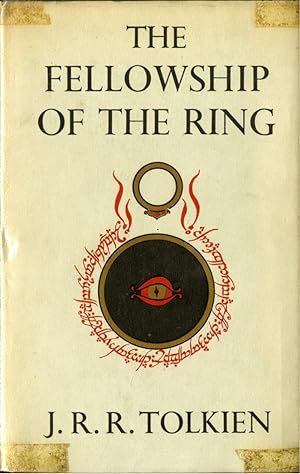
 In the past few years, whenever a sci fi, comic book, or fantasy media property comes out with something new, and someone has the incredible nerve to criticize it, whether it’s Martin Scorcese saying they’re not cinema, or some obscure blogger like me saying “hey I thought that was not good,” I’ve heard some version of “Be quiet and let people enjoy things” in defense of such media offerings. To which I say an emphatic, “fair enough!” since everyone is free to enjoy whatever they wish, no matter how vapid.

What’s unusual about some of the superfan accounts that social media algorithms have been pushing at me lately are the accusations of racism, ‘toxic fandom’ or other charges levied at people who have valid criticisms of these movies and shows. The last time I checked, film and media criticism have long provided a valuable service. Nothing is above criticism or interpretation, as any good writer knows.

 You can criticize something you’ve grown up with and enjoyed for decades without being ‘toxic’ or racist about it. I understand there are some white nationalists around who hated the new star wars and rings of power simply because they hate the diverse casts. Any normal person disavows this stuff.

But when I see constant fawning praise for fairly lame, mediocre offerings from gigantic, multinational, multibillion-dollar entities, and constant defense of such middling fare, and cries of outrage aimed at anyone who dares to say they don’t like it, I don’t understand. Are we not allowed to say we think Rings of Power is lousy? Because, let me tell you my friends, it is a total slog, a huge disappointment, despite the great cast and expensive effects and everything else. I disliked it and gave up after 3 episodes. I don’t read Tolkien to watch a dwarf scream at Elrond for missing his wedding, an exchange which I found to be unintentionally hilarious. Nor do I read his works to see Steven Seagal type characters beating people senseless, breaking arms and legs and uttering lame, action movie kinds of one-liners in a brutal fistfight. No thanks, amazon. Have fun, those of you who enjoy such things. People can enjoy whatever they wish, it makes no difference to me.

Don’t get me wrong, I like plenty of junk. Bad TV and film have an illustrious history. One of my favorite things to watch is Rifftrax, a hilarious program that takes special delight in poking fun at bad movies and television. However, I don’t make lengthy videos breaking down each Rifftrax episode and telling people how great it is and insisting that people who don’t see the value in it are toxic, because that would be an incredible waste of my time. It’s enough that I enjoy it. But then, I’m not seeking to have millions of fans following me for new Rifftrax content. Nor do I  wish to be a Rifftrax influencer or to monetize my enjoyment of Rifftrax. I just want to laugh and have a good time. But that’s just me, and to each their own.

Now, a group of fans riffing Rings of Power? That I would watch and enjoy, along with a big bowl of popcorn.

Adaptations

If you’d told me when I was twelve that we’d have endless new sci fi/superhero/fantasy movies and shows every single week, I would’ve been ecstatic. But alas, since I’m fifty and no longer twelve, I’m totally disinterested in most of it. Partly this is because I’m no longer a child, but it’s also because I enjoy new and different stories, and none of these gigantic intellectual properties do that. They just make the same exact stories over and over.

A long time ago, in a galaxy far, far away, George Lucas created something special that felt fresh. Comic books did that also, and some still do. Tolkien created a genre that has been well mined for generations. Other writers have done and continue to do this, and some films do as well. But most of the large properties simply make the same thing with slightly different characters or timelines. It obviously sells and many people love it. It doesn’t interest me, though– new and interesting stories do. But these famous, valuable names are like real estate snatched up by greedy developers.

At times, older fans can get prickly about newer things. I’ve felt that way as well, mainly because the experience of reading an amazing novel can never be matched by any movie, no matter how well done. As George RR Martin recently commented, very rarely does a great book get a truly worthy interpretation, but when it happens it’s quite amazing. Dune managed it, in my opinion, and Jackson’s Lord of the Rings did, as well. But more often they just leave you cold.

Don’t adapt this, son. Don’t even try.

Most of these newer films are not made for middle aged guys, so I just accept that it isn’t for me, and go back to the books. But I admit, and as Martin said, I find the arrogance of some of these adaptations hard to believe. Luckily I will always have my bookshelves.

DUNE

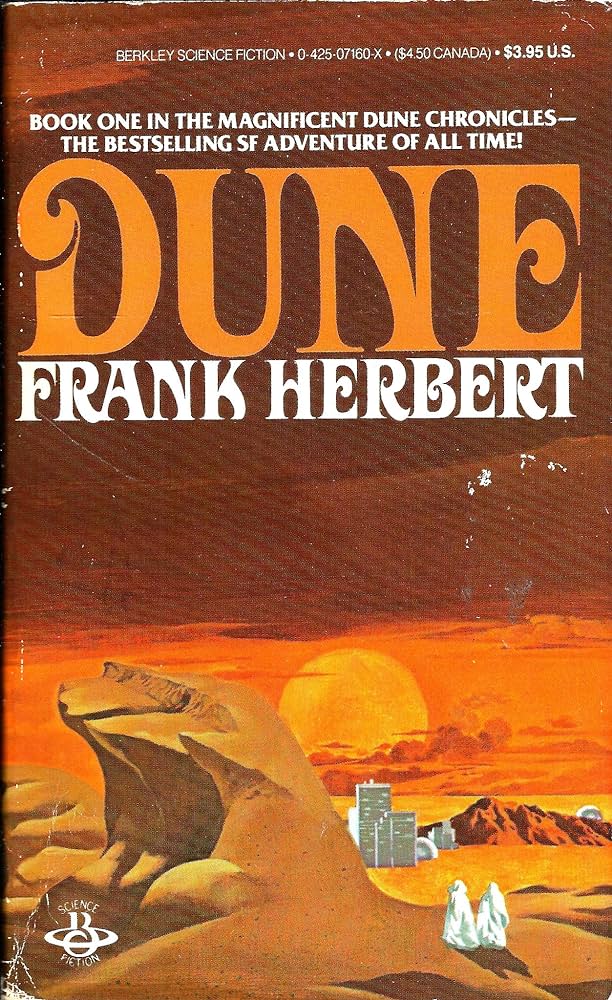
“Once men turned their thinking over to machines in the hope that this would set them free. But that only permitted other men with machines to enslave them.” –Frank Herbert, DUNE

The new Dune film is amazing, far better than anything that fans of the book had any right to expect. I loved it. I started rereading the book as soon as I got home; I read the above quote and had to put the book down for a moment. Frank Herbert wrote that in 1965–probably quite a bit earlier, as ’65 is the publication date. What a visionary.

The film changed a few things, but that’s to be expected in a work of this size and scope; it would be impossible to adhere to everything Herbert wrote. At some point I may write up some further thoughts. But suffice to say it was great and left me speechless. Once I finish the first book, I’ll probably continue with the others, too. I loved the first three books in the cycle and enjoyed the next three as well, though I felt they weren’t at the same level of quality as the first two or three.

A good friend of mine also recommended the many sequels written by Brian Herbert and Kevin Anderson, so I may go down that Golden Path, as well.

I’m really in awe of Denis Villenueve and the whole cast of this movie, particularly Javier Bardem, who I felt carried much of the film as Stilgar. We’re lucky that a director as good as Villenueve was able to make this. In my opinion, this achievement is as great as Peter Jackson and Lord of the Rings, and will be remembered for a long time.

Philip K Dick

Every Saturday I have a ritual, in which I go to the library used book sale. I always stop first at the science fiction section and see if there is anything by Philip K Dick, who is one of my favorite writers. I haven’t found one in the roughly eight years I’ve been doing this.

This week, for the first time, I took my three year old. I carried him into the store and put him down. He grabbed a board book that was on display. We went to the Science Fiction section. He ran to a random area of the shelf and grabbed a book off the shelf and held it up to me. “Get this one daddy,” he said. “You can read it to me, too. I want this one.” Here’s the book.

The Zap Gun, by Philip K. Dick

I’ve read dozens of his books. This felt like the start of some crazed scene in one of his novels to me. Perhaps the boy was directed there by some outside intelligence. Maybe aliens planted it there. Or another dimension is seeping into ours. Perhaps an unlikely coincidence. I think I’ll be taking the lad again.

Star Wars: Rebellion

A long time ago in a galaxy far, far away…

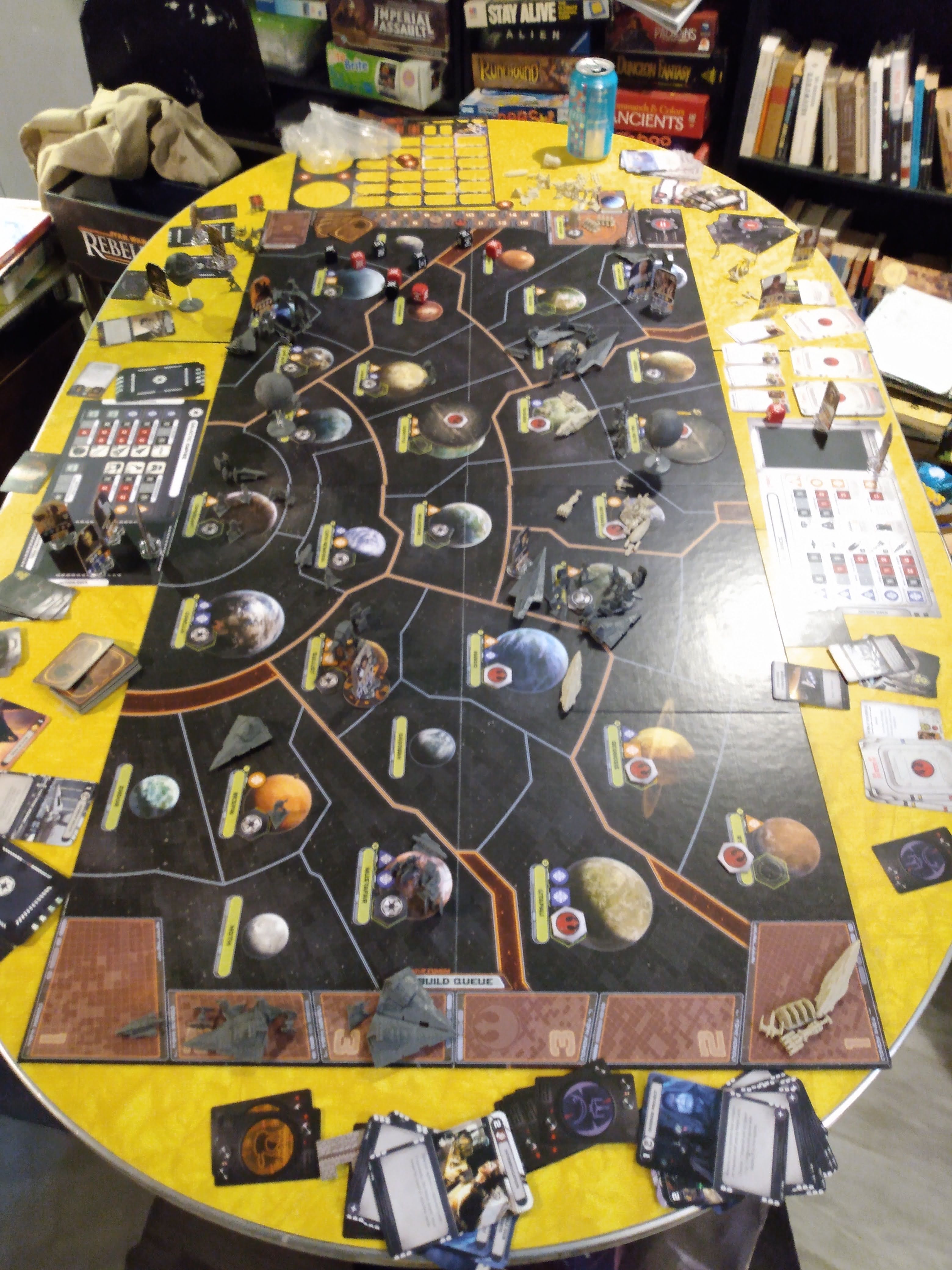
There was an endless appetite for games based on our favorite heroes and villains. Star Wars Rebellion, I am happy to report, is one of the very best of the bunch. Made by Fantasy Flight Games, it has their usual high quality minis, a beautiful board with numerous planets and systems, and lots of cards and markers and characters. It’s for 2-4 players, though I have only played the two player version. One side plays the rebels, the other is the dark side.

Rebellion is varied enough and features enough twists and turns that I think it has a high level of replayability. My 10 year old and I have played it 6 or seven times since we got it, and it’s always been fun and surprising. Essentially, the rebel player has a hidden base that the empire is trying to find. If the rebels can stave off the superior firepower of the empire and hang on for enough turns, while increasing their sympathy throughout the galaxy, they’ll win. But the moment the empire finds the rebel base, it’s over for the rebels. Each time we’ve played, both of us had a chance to win by the final round, making for an exciting and unexpected end with each game.

Each player has special attributes and cards to help them win; the rebels, for example, are aided by cards that allow them to change the location of the base, should the empire draw near. Other cards will allow sabotage, and to increase your reach through the galaxy. The rebels will gain victory points through a series of objective cards that award points when completed. The empire, meanwhile, has far superior numbers and brutal planet destroying weapons like the Death Star, making them hard to beat.

The character cards are also well designed. Each of the rebel characters have special skills and powers that allow them to succeed at basic missions, like gaining loyalty in systems, establishing weapons production, or conducting raids on the empire. The empire characters have similar skills, and are able to corrupt the rebels, destroy them with the death star, or otherwise ruin their chances to win. For example, in one very funny moment in our game, Obi Wan was turned to the dark side, which is rather hard to envision if you’re a fan of the old films, like me.

There are plenty of opportunities for battles, and that’s a lot of the fun of this game. You can move into systems and attack with your fleet of finely constructed X-Wings, Tie-Fighters, Star Destroyers and ground forces. You’re aided in battle by the leaders you’ve chosen and special cards that you draw through each round of combat. Nothing hurts so badly as building up a legion of rebel troops only to have them wiped out by Stormtroopers and AT-ATs (take it from me.)

This game is not cheap–the price runs around $90, but if you’re a fan of strategic war games, and of Star Wars, and you think you’ll have time to play this one, I’d say go ahead and buy it. It’s a lengthy game, often taking a few sessions of an hour or two each (or most of a day, if you’re able) to complete. I have found it a great way to spend time with my son, who has delighted in beating me a number of times.

Rebellion is pretty true to the spirit of the films. I love it, and recommend it highly, rating it five out of five stars. Maybe six out of five if you’re a star wars fans into miniatures and epic boardgames.

Asimov’s Foundation

I loved Isaac Asimov’s Foundation series when I first read it as a teen. It’s still one of my all time favorite science fiction series–it imprinted on me at a young age, before I had read very much, but it holds up quite well. Asimov’s later installments, in which he revisited and added to the series, were great too.

I’m not setting out to review the books right now, nor the new, slick production from Apple TV. What I will say about the show, after watching a couple episodes and then giving up, is that it must take some gargantuan ego or confidence to change such a classic work until it’s unrecognizable, and still call it Foundation. I have no idea where the show is going and didn’t care much after what I’ve watched. The production is expensive and looks cool and the actors are quite talented but the story was so different from what I read that it seemed strange to say it’s based on Asimov. Aside from the title and the most general plot setup, it wasn’t. It seems I’m in the minority, and many people love it, but that’s my opinion. I’ll probably just re-read Foundation instead.

Call me old fashioned; I don’t mind. Books don’t always need expensive adaptations. This series seemed ripe for such a show, but it wasn’t to my taste at all.

Kindred, by Octavia Butler

I found Kindred to be such an amazing achievement; wonderfully written, creating such a believable, harrowing world. I plan to read the rest of Butler’s novels in due course, but had to let my thoughts on this one simmer for awhile. This isn’t light beach reading or something you pick up to be distracted. It’s considered one of the monumental works of 20th century science fiction, deservedly so.

Dana, an African American writer, is transported back to the antebellum south, and this is where the horror begins. It is hard to do this book justice, but the day to day life of a slave in the American south is described in great and horrifying detail. Dana becomes the protector of young Rufus Weylin, the heir to a plantation, and she later learns that he is one of her ancestors. Dana travels back and forth between the 1820s and 1976, finding that while she has been in the past for several hours, days, or months, she has usually only been gone for comparatively short periods of time in the present.

Slaves on the Weylin plantation are brutalized, raped, and tortured, and yet Weylin’s father, Tom, their master, is considered by the slaves to be mild in comparison to other slave owners. Families are casually torn apart to pay debts, or in some cases just to prove a point. Dana’s account of these atrocities gives the reader an idea of what slave life was like, and the unimaginable horror of just surviving and enduring.

The book is set during the bicentennial, which is when it was written, and this setting is significant, given how much America was celebrating at that time. But this book is a clear reminder of our brutal, racist, genocidal past. It’s something we must reckon with, if we want to make this country more just and fair.

Kindred is a book everyone should read. It’s a landmark of American literature, a brilliantly written and researched novel and a powerful work of literature. The characters are very nuanced and have so much depth to them. The depiction of the slave community, and the brutality they were subjected to, are so moving and heartbreaking. They are faced with unthinkable choices for their survival, and Dana’s struggle to help them and eventually be liberated has echoes of historical slave narratives, as many critics have pointed out. Butler has said in interviews that she wanted “to make people feel history, and she succeeded brilliantly.