
My twelve year old son, who loves Tolkien, said, “It’s like they took one line and made an anime movie about it.” Indeed, my boy. This grim, humorless trek through Middle-earth had a few fun moments, but not nearly enough of them to justify its two plus hour running time. Miranda Otto and Brian Cox are pretty good. This film’s entire raison d’etre appears to be that WB was about to lose the license to make more cash-generating adventures in Tolkien’s world. I give it a B-. For all its flaws, it’s still much better than the awful slop amazon keeps pushing at me. I hope Andy Serkis’ return in 2026 is more fun than this was.
Category: Reviews
Rings and Other Things
In the past few years, whenever a sci fi, comic book, or fantasy media property comes out with something new, and someone has the incredible nerve to criticize it, whether it’s Martin Scorcese saying they’re not cinema, or some obscure blogger like me saying “hey I thought that was not good,” I’ve heard some version of “Be quiet and let people enjoy things” in defense of such media offerings. To which I say an emphatic, “fair enough!” since everyone is free to enjoy whatever they wish, no matter how vapid.
What’s unusual about some of the superfan accounts that social media algorithms have been pushing at me lately are the accusations of racism, ‘toxic fandom’ or other charges levied at people who have valid criticisms of these movies and shows. The last time I checked, film and media criticism have long provided a valuable service. Nothing is above criticism or interpretation, as any good writer knows.
You can criticize something you’ve grown up with and enjoyed for decades without being ‘toxic’ or racist about it. I understand there are some white nationalists around who hated the new star wars and rings of power simply because they hate the diverse casts. Any normal person disavows this stuff.
But when I see constant fawning praise for fairly lame, mediocre offerings from gigantic, multinational, multibillion-dollar entities, and constant defense of such middling fare, and cries of outrage aimed at anyone who dares to say they don’t like it, I don’t understand. Are we not allowed to say we think Rings of Power is lousy? Because, let me tell you my friends, it is a total slog, a huge disappointment, despite the great cast and expensive effects and everything else. I disliked it and gave up after 3 episodes. I don’t read Tolkien to watch a dwarf scream at Elrond for missing his wedding, an exchange which I found to be unintentionally hilarious. Nor do I read his works to see Steven Seagal type characters beating people senseless, breaking arms and legs and uttering lame, action movie kinds of one-liners in a brutal fistfight. No thanks, amazon. Have fun, those of you who enjoy such things. People can enjoy whatever they wish, it makes no difference to me.
Don’t get me wrong, I like plenty of junk. Bad TV and film have an illustrious history. One of my favorite things to watch is Rifftrax, a hilarious program that takes special delight in poking fun at bad movies and television. However, I don’t make lengthy videos breaking down each Rifftrax episode and telling people how great it is and insisting that people who don’t see the value in it are toxic, because that would be an incredible waste of my time. It’s enough that I enjoy it. But then, I’m not seeking to have millions of fans following me for new Rifftrax content. Nor do I wish to be a Rifftrax influencer or to monetize my enjoyment of Rifftrax. I just want to laugh and have a good time. But that’s just me, and to each their own.
Now, a group of fans riffing Rings of Power? That I would watch and enjoy, along with a big bowl of popcorn.
Horizon
I found the first installment of Horizon to be an excellent epic Western, the kind of film that is rarely in theaters anymore. The movie is ambitious and sprawling, a tale that spans years and the lives of multiple characters in the settling of the western frontier. It’s not a sanitized version of that era, though there is plenty of drama. The cast is excellent, and the story is gripping. It’s long, and though it doesn’t move at a breakneck pace, it kept me interested the whole way through and I’m eager to see what comes next.
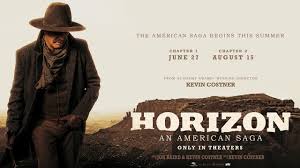
This isn’t exactly a groundbreaking movie, but that is ok. Westerns have a long and rich history in film and literature. The best of them, like Lonesome Dove, tell a story about America and about human nature that keeps us engaged and entertained. I felt that Horizon is up there with some of the better genre offerings. At the heart of this tale is Kevin Costner’s character, Hayes Ellison, who is the kind of stock figure we’ve seen in many Westerns—the tacit, reluctant hero. I was reminded of William Munny from Unforgiven, though Ellison is less brutal. He must protect a woman and young child from a band of outlaws seeking vengeance, and he does so almost grudgingly at first, like all good heroes, but once called into service he swings into action with the kind of cool performance moviegoers will appreciate.
Other plotlines include a group of settlers in over their heads, the target of a band of Apaches unhappy with the incursion on their territory. In one particularly grim scene, a band of outlaws looking to make easy money target a group of native women and children for their scalps; it’s easy money, at $100 a head. This is not the kind of thing you might have seen in a Western of an earlier era. It was a grisly sequence and underscores that there are really no heroes in this kind of story, though there is plenty of tension and conflict.
The film left me eager to see the remaining installments. I loved the scale of it—the film looks gorgeous, shot in Utah with stunning effect. A lot of care went into all of this—the story, yes, but also the sets and costumes, the languages of the native peoples—everything.
I’ve read some things about the poor box office performance of this film, which is a shame, because it’s a great movie. Perhaps it’s an old-fashioned kind of tale, from a bygone era of cinema. If so, that’s a sad development. There’s little enough at the multiplex for people to see that isn’t animated, or part of a comic book multiverse. Nothing wrong with those kinds of movies; my children love them. But it felt good to see a movie made for adults, which spoke a language of film that I haven’t seen for a while. If the days of these kinds of films have passed, because they require too much attention, that is a shame. Perhaps the audience for such films has shrunk so much that they are no longer profitable, the way it is becoming harder to sell good novels or good theater. If so, we will all be poorer for it. Even so, the measure of a work of art has little to do with how marketable it is. There are examples of this all through the history of art and literature. So, I’d urge you to go see Horizon—it’s a movie that in my opinion is worth the time and attention.
IF
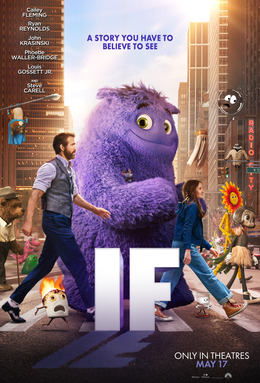
I took my nine-year-old daughter to see IF, the recent movie with Ryan Reynolds, John Krasinski, and young Cailey Fleming as the lead. It’s a sweet story about imagination and growing up. I hadn’t read any reviews and knew nothing about it before going, but I knew what we were in for when there were scenes of some of the characters watching the Jimmy Stewart classic “Harvey,” about a man and his imaginary friend, a giant rabbit.
The film deftly handles some serious subjects, including the death of a parent and the serious illness of another. Normally, I would be worried that such a tale might be guilty of mawkishness, of overloading us with too much pathos, but this movie had such good humor and genial performances that it never veers into this kind of cheap emotion.
At the heart of this story is the idea that as we age, we leave behind childish things in our eagerness to become adults. The danger is that you can completely lose your imagination, your sense of wonder, all the things that make life worth living in the first place. The main character, twelve-year-old Bea, is starting to close herself off from a world of hurt after losing her mother; her father, played by Krasinski, becomes ill with a heart condition, leaving the young girl in a scary and vulnerable situation. She stays with her kindly grandmother, played by Fiona Shaw in another fine performance, and immediately lets grandma know she’s no longer a kid, and can deal with adult problems.
While worrying about her dad, Bea meets one of her grandmother’s neighbors, an eccentric man named Cal (Ryan Reynolds), who, she learns, lives with a variety of IFs, or ‘imaginary friends’ who have been abandoned by children who grew up and grew out of them. There is a giant purple monster that is on the advertising for the film, voiced by Steve Carrell, as well as a ballerina, a spy, a teddy bear, and a whole cast of whimsical characters in search of children to help. The problem is that adults, and even most children, cannot see these imaginary beings, no matter how hard the creatures try to get their attention.
This setup may sound a bit daft, but I found it a sweet story, and one that had some surprising depth. Every adult I know can use more of the things that the movie explores—fun, warmth, laughter, imagination, and everything else that children have in abundance and that most adults lose if they aren’t careful.
If the mark of a good YA story is that it keeps children engaged while also entertaining parents, IF does the job admirably. I would go as far as saying it was a moving story. My daughter loved it, and I thought it was great too, with excellent performances by all the cast, and enough comedy to lighten the tone from some more serious themes.
If you have a tween, be sure to take them to see this film. There are few movies like this, that tell an earnest tale with warmth and humor, and this is one that adults and kids can enjoy. Kudos to Krasinski, who also wrote and directed this film, it’s an excellent, heartfelt story.
On Critics, and Other Matters
At times, sending out stories and manuscripts and getting no response can get frustrating. But that’s the way it is, and complaining about it doesn’t do any good. It is maddening when you see some of the awful things that become bestsellers, that get all kinds of attention and large publishing deals. Unfair, maybe, but that’s how it goes. First, you must write a great book, and then you must either know someone, or be in the right place at the right time. Some writers will beat the odds, so I keep plugging away, and in any case, I write for myself and won’t stop no matter what happens.
Which brings me to the subject of criticism, and gatekeepers. There are many of these that writers need to ignore. I was thinking of that curious thing, the writing workshop. In my experience, most of these were not at all a supportive environment; in fact, they were quite the opposite, in most cases, with students attacking each other’s work in an effort, I guess, to impress the instructor, a person who had published something and whose approval many in the class usually craved.
The comments on my stories were sometimes helpful, sometimes not, occasionally rude and off putting, and I listened to almost none of it except those written honestly. And yet, even an honest critic might be wrong. Gatekeepers at publishing houses, as well as literary agents, are quite often wrong about a great many things. Just check out the mountains of rejection letters received by people like Ursula LeGuin, Stephen King, Frank Herbert, and plenty of others.

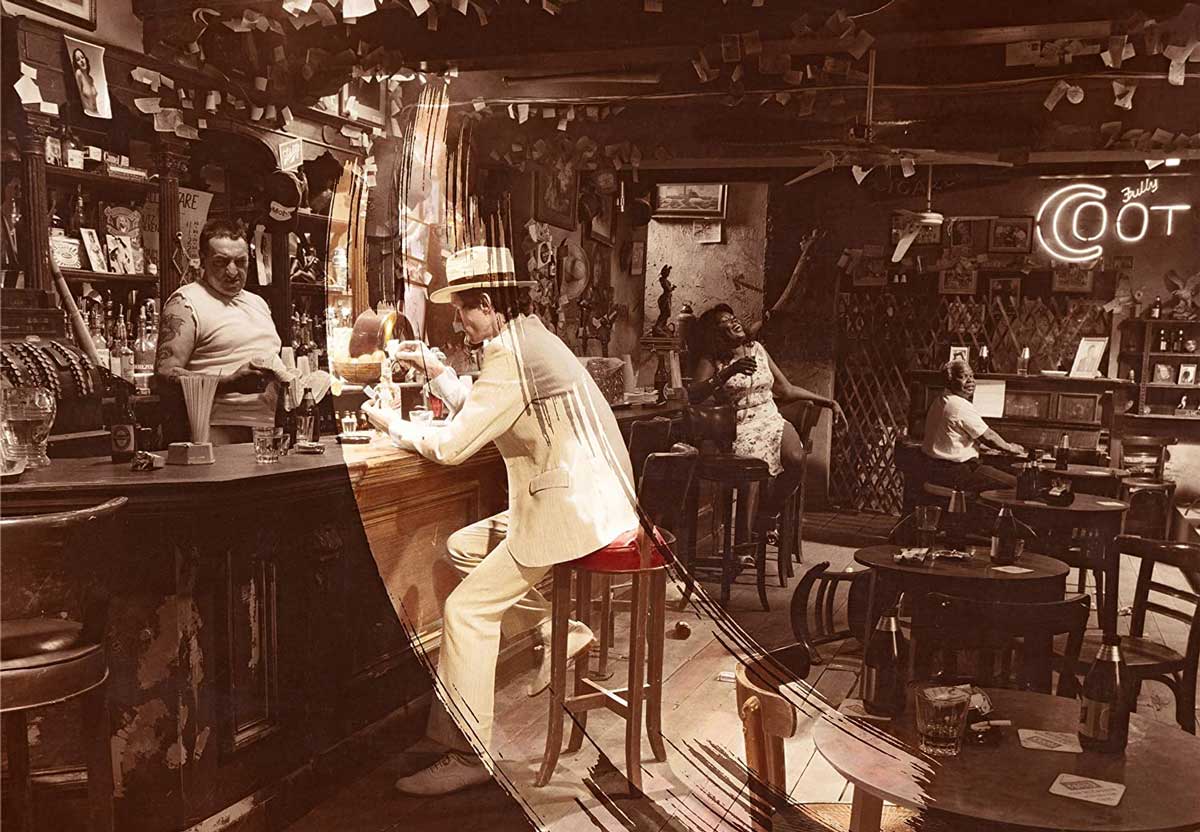
Last night, I couldn’t sleep and was listening to Led Zeppelin, one of my favorite bands. As I sometimes do with artists I admire, I went and looked up contemporary reviews of their groundbreaking records, which have sold over a hundred million copies. One snob said Robert Plant’s lyrics were awful. Rolling Stone wrote that the whole office laughed in mockery at “In Through the Out Door,” the band’s final album, recorded in the terrible wake of the death of Plant’s son. Quite hilarious, you bunch of hipster morons, was all I could think. What a terrible record that brought nothing but happiness and sold tens of millions of copies. Yep, Zeppelin sure were a laughingstock.
I’m now fifty, and I don’t do reviews of new books very often anymore. I used to years ago, for a couple of online sites, but I found that unless I want to spend a lot of time digesting a book, and can say something thoughtful and supportive, there is little point. These things are so subjective, and a random critic has as much to say on the topic of a new book as any thoughtful reader, of which there are a great many. Instead, I’ll do goodreads reviews of books I enjoy, sometimes. And I’ll let my friends and contacts know which books I’m reading. Major outlets like the New York Times and other venues might help a reader decide whether to buy something, I suppose, but more often it is a badge of honor that the author of the book can proudly wear. It may help boost sales. Or if it’s a negative review, they may never live it down.
As the years pass, I’ve realized that apart from a very few trusted book critics, I’d rather just read a book and make up my own mind. The opinions of editors and agents and others in the publishing business are meaningless. In the end, there are your words, your story, and you tell it as best you can. You hope someone likes it, but whether they do or not hardly matters at all. You’re left with your honesty and your effort, and that’s about all you can do. Anything less is not enough, no matter what accolades other people might want to give you. And if you stick to your own vision and work, you can never lose, no matter what any critic says.
Rereading The Wheel of Time
“The Wheel of Time turns, and ages come and pass, leaving memories that become legend. Legend fades to myth, and even myth is long forgotten when the Age that gave it birth comes again. In one Age, called the Third Age by some, an Age yet to come, an Age long past, a wind rose in the Mountains of Mist. The wind was not the beginning. There are neither beginnings nor endings to the turning of the Wheel of time. But it was a beginning.”
― Robert Jordan, The Eye of the World
So begins Robert Jordan’s fourteen-book, 4.4 million word saga, The Wheel of Time, a tale which has sold over ninety million copies since the first novel in the series was published in 1990.
Some three decades ago, or an age ago, in Wheel terms, when I was in high school and college, I happily devoured the first four books in Robert Jordan’s high fantasy series. It hit me at exactly the right time; I had recently read The Lord of the Rings and was constantly on the lookout for more epic fantasy. Jordan’s story fit the bill, and I enjoyed every minute I spent in his world.

As the series went on, I became disappointed with the next two or three books and eventually gave up on them. For me, what started out as an excellent fantasy adventure tale that was heading in a satisfying, if not entirely original direction became bogged down with an unwieldy plot and too many characters. Each new installment of the series introduced more plot elements, settings and people until I stopped seeing the heroes like Rand, Moiraine, Perrin, Egwene, Matt and the rest of the cast of characters that had started out on such a promising adventure in The Eye of the World.
My friends who were fantasy aficionados felt the same way. By the time the later installments of the books came out, I had moved on and lost interest. There were always plenty of other books to read, and other fantasy worlds to explore by writers like Tad Williams, Ursula LeGuin, and many others I was busy discovering. When new Jordan books arrived, I was interested in them but not tempted enough to buy and read them. I’d already spent thousands of pages with The Wheel of Time, and it seemed there was no end in sight.
When I saw that amazon was adapting the Wheel of Time, I thought it might be a good chance for them to tighten up this story a bit, maybe streamline things and tell a rousing tale. I watched season one with great hope but did not really enjoy it. However, I did go back to read The Eye of the World and The Great Hunt, books one and two of the series.

I’m happy to say that after thirty years, these first two installments hold up well. I had forgotten most of the plot over three decades, but I very much enjoyed Jordan’s setup in the Shire-like Two Rivers, the flight from the Myrddraal and the Trollocs, and the slow unveiling of the truth of Rand’s destiny. The magic system is well developed: female wizards wield a magical force called The One Power and must train for years to do it. The philosophical underpinnings of the Wheel, where the world is in a continuous cycle of history, were a fun innovation for the fantasy genre that gave the setting plenty of depth, to my mind.
For me, some of this story aged less well, specifically the adolescent romantic longings of the main characters. I guess I was ok with this kind of thing when I was a teen and in my early twenties, but such doe-eyed yearning was not exactly to my taste this time around. But I let it go, because the story is fun and engaging enough to keep me interested.
What I also found striking in my re-read was the all-female wizardry of the Aes Sedai. They are a powerful order, akin to the Bene Gesserit of Dune. The political maneuverings of their different classes allow for plenty of intrigue and some great plot twists. The idea that men have tainted the One Power is also reminiscent of LeGuin’s Earthsea books.
I could do with less of Jordan’s at times florid descriptions of how gorgeous and powerful some of these women are, though–he lays it on thick at times. In The Great Hunt there is a sequence where some evil women of the Seanchan, an invading army, have leashed and enslaved Aes Sedai and other women who can wield the One Power. I’m not sure the story needed this sadistic plot point, but I guess Jordan had his reasons.
Clearly, plenty of readers disagree with my criticisms, and loved the entire cycle, including the final three books, finished posthumously by the amazingly prolific Brandon Sanderson. It’s sad that Jordan didn’t live to finish the series, but it seems he had a good steward to bring to to its conclusion.

I enjoyed re-reading these two books very much, partly for nostalgia’s sake, but also because they’re a lot of fun. The Great Hunt has a particularly stirring climax, where Rand and his friends face impossible odds as they pursue an ancient, magical horn that will call back legendary heroes of a past age. There are some engaging action sequences with high stakes for everyone involved. Rand, who now knows he is The Dragon Reborn, the great hero on which the hope of the world rests, must fight a demonic being to save his friends. The different creatures and races in the book are also quite well described and evocative. Some of the nightmarish dream sequences, in which Rand and his friends face their darkest fears, brought on by the evil beings that are hunting them down, are well told and gripping. Like Herbert and Tolkien, Jordan took a lot of care in creating these alien societies, and they’re quite detailed and consistent. Jordan had a lot of panache in telling these stories, and it’s easy to see why so many fans stuck with him. Maybe I’ll make it all the way through to the end, this time.
It does seem clear by the end of book two, though, the direction in which this story is moving, so I’m unsure why this series could not have reached a perfectly satisfying conclusion in three or four books. That’s just one reader’s opinion, and others have felt differently, but with so many other good books to read, I can’t say with certainty that I’ll read the other twelve books in this series. Maybe this summer I’ll dive back in for The Dragon Reborn.
Paths of Glory
This World War I game from GMT is probably the most involved, epic wargame I have ever played. Like other games from GMT, this is big on strategy and history, and rewards thoughtful, careful gameplay. Pick your side: The Allies, or the Central Powers.

The game begins in August 1914, and each turn takes one season. Each side receives six turns in this season, in which they can use one of seven cards in their hands to move troops, reinforce, attack, or play other historical events that help their cause. Each side is trying to raise their Victory Point threshold high enough to end the game, before either time runs out in 1918, or an armistice is reached, giving victory with the side who has a better VP total.
I won’t lie–the rule book for this game is a bit daunting when you open the box. It’s thick, with lots of detail. But my eleven year old son read it and was conversant with the rules and eager to play. So it’s not too complicated for someone who plays a lot of Axis and Allies, for example, but it will require some effort, time, and a love of history to enjoy.
I found this game to be a really engaging way to learn some things about the first World War. As my son said, “I feel like I am re-living history, with alternate outcomes for a lot of these battles.” Granted, my son is a history buff who loves to read, but to me that is a high compliment indeed for any game.

After around 12 rounds, or three years, we found ourselves in almost exactly the same VP totals as when the war started. It’s not easy to pull ahead in this–armies get entrenched and are hard to defeat. We fought for years on the European front, with neither side scoring a decisive victory until we neared the game’s final act, when the US entered the war and the allies defeated the Germans. It was quite a mirror of the actual war, with many lives lost even while there was almost no movement in the trenches.
I give this game my highest recommendation. It was clearly made with a lot of care and attention to detail. It takes some time to learn how to play–we had it set up over multiple weekends, and only finished our first full game after probably 8-10 hours of play–but it’s worth it. The board is beautifully produced, the rules are clear, and the sense of history is quite strong as you play. If you’re a history buff or a wargamer, this is a great game, well worth buying and playing. It isn’t cheap; you can find a copy for around $80. GMT sometimes runs sales on their site, which is a good way to pick this one up.
Wild Cards
For most of my life I’ve read copious amounts of fantasy and science fiction. I recall the Wild Cards series coming out in the late 80s; an acquaintance of mine sang the book’s praises, but the idea of comic book characters was something that at the time, as a 16 year old, I felt I was outgrowing. Maybe I was self-conscious reading Batman and Superman and the X-Men as an older teen, and advertising that I still loved those characters seemed unwise. Though of course, I read them at home, away from my peers.
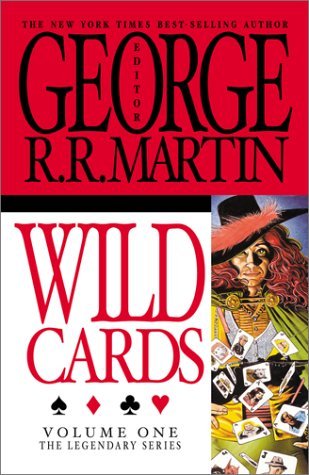
During the recent holiday break, I was looking for something light to read, and picked up the first volume of Wild Cards, that series I had shunned in my young, foolish days. If George RR Martin edited it, it must be good, I reasoned. I’ve been wanting to read Winds of Winter for some years now, but alas, it seems I’ll have to wait for that. I have read almost everything else George published, so I gave it a try.
How I wish I could go back 30+ years and tell sixteen year old me to read Wild Cards. I was the perfect demographic for it back then. I guess I still am. What a fun, crazy ride I had with these stories. I didn’t love all of them, but there were enough good ones to keep me interested, and the ones I didn’t like as much still had some cool elements.
Wild Cards, for those of you unfamiliar with this now-32-volume series, is a shared world alternate universe filled with superheroes, in which, at the end of World War II, an alien virus outbreak turns a large segment of humanity into mutants. It kills some of them outright, horribly disfigures others (known as Jokers) and turns some into superhumans (aces). It’s a funny, neat idea, full of noirish and comic elements, enough to keep an adult comic book reader happy during these long winter nights. I particularly enjoyed Roger Zelazny’s entry, as well as Martin’s. I don’t want to spoil the stories, they are too fun. If you enjoy comic books, but want something a little darker and more adult themed, give these books a try.
I’d never read something like this collection before. I loved the idea of a shared world in which lots of writers try their hand in storytelling in the same setting. I also really enjoyed the way these comics were written with adults in mind. I’d never seen this before in fiction, except perhaps when I read the novelization of the 1989 Batman movie as a teen. These stories reminded me of Frank Miller’s work with Batman, and Alan Moore’s many legendary tales of Swamp Thing, Watchmen, and others. I don’t regularly read comic books these days, but this first volume in the Wild Cards series made me want to revisit my favorites, and maybe read some more in the Wild Cards series.
The Wikipedia entry for this series says that Martin and his friends started the series after playing a GURPS style RPG based on superheroes, which makes perfect sense. The detailed backstories in each tale in this volume are a perfect fit with an RPG campaign of this style. Probably most people who have played in a campaign thought of turning it into a book (what a great idea!), but leave it to uncle George to actually pull it off. I was also reminded of the wonderful Dragonlance books, which were similarly based on a D and D campaign. I may also have to try Thieves World, which is a series I never read, but which was also a shared world.
There are so many books, and never enough time for me to read all my favorites, but I’m glad I gave this series a try. Winter is the perfect time to stay inside and curl up with a book. You’ll have fun with Wild Cards, I think. I just hope Winds of Winter comes out soon.
Memoir ’44
We are heading into winter, perhaps the best time of year for board games!
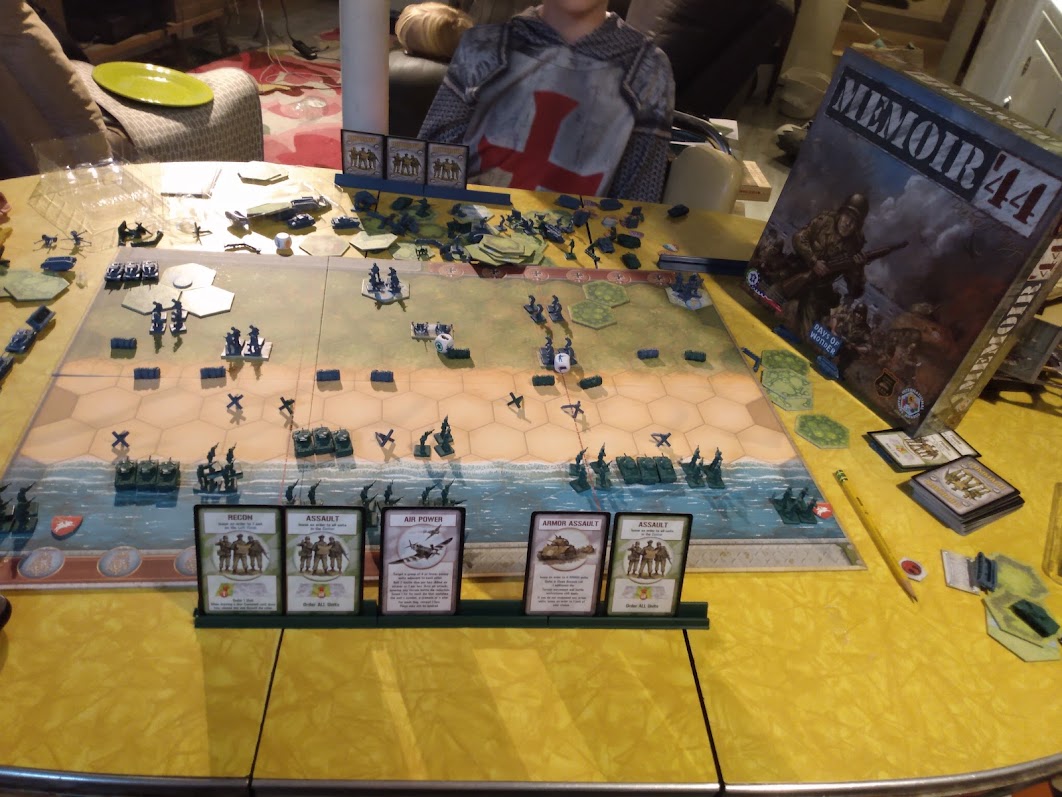
My 11 year old is crazy about tabletop games, and World War Two games in particular. He really loves games with minis, so we have tried a number of those in many genres, but one of his very favorites for years now has been Axis and Allies. The only problem with that game is its epic length. It can take a long time just to set it up, and the game itself can take several sessions of a couple hours, over several days.
Enter Memoir ’44. Made by Days of Wonder, this game includes 15 different scenarios from D-Day. It’s a card based game with lots of die rolls, and beautifully produced miniatures. We’ve played four of the scenarios so far, and each of them took only around a half hour to complete. It’s lively and fun and if you enjoy wargames but don’t have three or four hours to play one, I would strongly recommend this game. You’ll probably like it so much that you’ll end up playing more than one scenario in a session, anyway.
The game is played in turns during which a player activates a card, which allows them to move troops on one or more sections of the board. You can then engage the enemy by rolling dice, subtracting points for various obstacles like trees, bunkers, barbed wire, and so forth.
I really loved playing this one with my son, and he has enjoyed it immensely as well. It makes great gift, and won’t break the bank– I got a copy of it for around $50. There is enough variety to make each scenario feel quite different; Days of Wonder has also created many different expansions, so if you enjoy this one and play all fifteen scenarios enough that you want more variety, you will never run out of more to play if you’re so inclined. There are also expansions that allow up to eight players, which sounds like it would be lots of fun.
I’d rate this one five out of five stars. So much fun to play, and beautifully designed.
Star Wars: Rebellion
A long time ago in a galaxy far, far away…
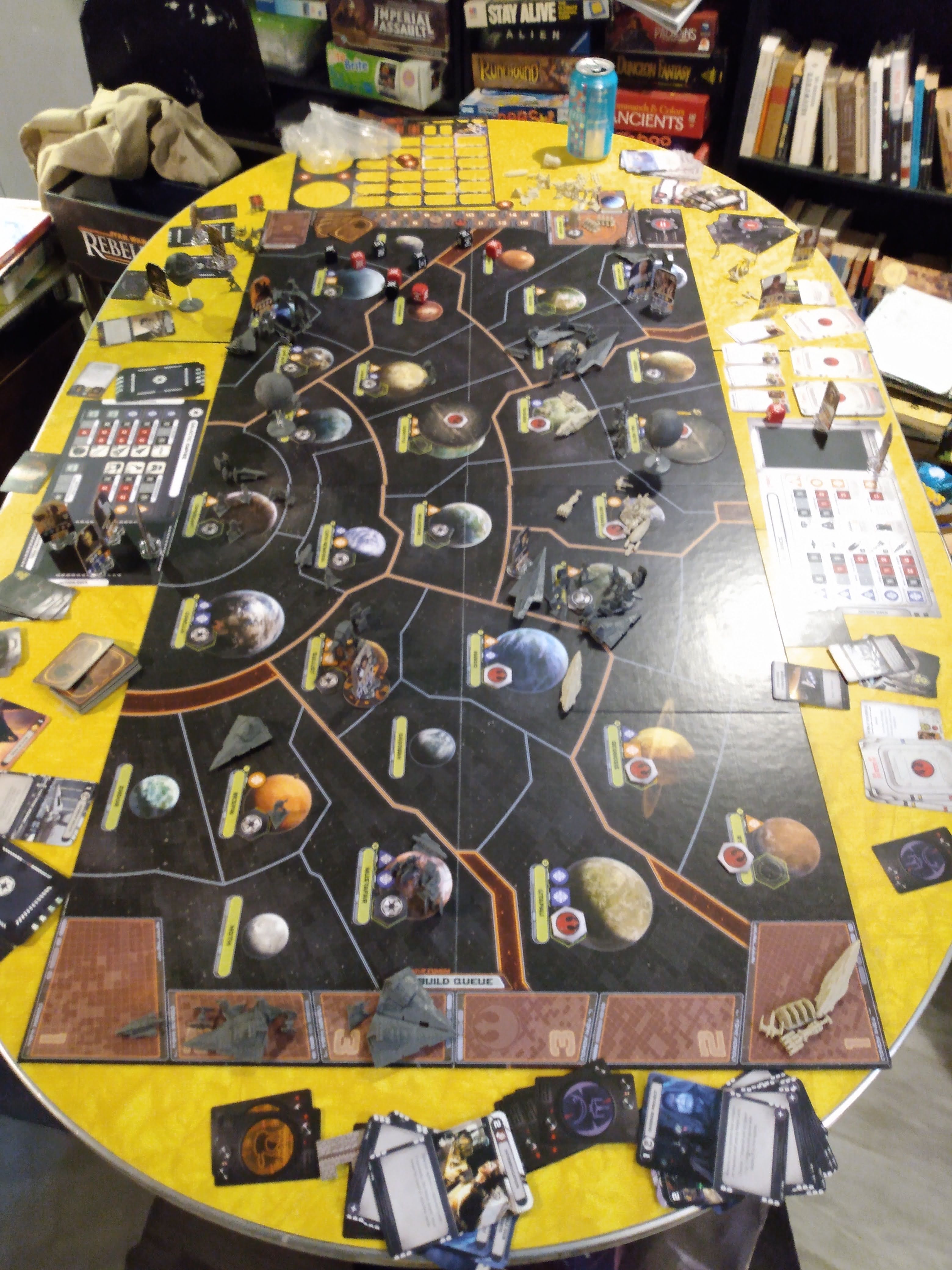
There was an endless appetite for games based on our favorite heroes and villains. Star Wars Rebellion, I am happy to report, is one of the very best of the bunch. Made by Fantasy Flight Games, it has their usual high quality minis, a beautiful board with numerous planets and systems, and lots of cards and markers and characters. It’s for 2-4 players, though I have only played the two player version. One side plays the rebels, the other is the dark side.

Rebellion is varied enough and features enough twists and turns that I think it has a high level of replayability. My 10 year old and I have played it 6 or seven times since we got it, and it’s always been fun and surprising. Essentially, the rebel player has a hidden base that the empire is trying to find. If the rebels can stave off the superior firepower of the empire and hang on for enough turns, while increasing their sympathy throughout the galaxy, they’ll win. But the moment the empire finds the rebel base, it’s over for the rebels. Each time we’ve played, both of us had a chance to win by the final round, making for an exciting and unexpected end with each game.
Each player has special attributes and cards to help them win; the rebels, for example, are aided by cards that allow them to change the location of the base, should the empire draw near. Other cards will allow sabotage, and to increase your reach through the galaxy. The rebels will gain victory points through a series of objective cards that award points when completed. The empire, meanwhile, has far superior numbers and brutal planet destroying weapons like the Death Star, making them hard to beat.
The character cards are also well designed. Each of the rebel characters have special skills and powers that allow them to succeed at basic missions, like gaining loyalty in systems, establishing weapons production, or conducting raids on the empire. The empire characters have similar skills, and are able to corrupt the rebels, destroy them with the death star, or otherwise ruin their chances to win. For example, in one very funny moment in our game, Obi Wan was turned to the dark side, which is rather hard to envision if you’re a fan of the old films, like me.
There are plenty of opportunities for battles, and that’s a lot of the fun of this game. You can move into systems and attack with your fleet of finely constructed X-Wings, Tie-Fighters, Star Destroyers and ground forces. You’re aided in battle by the leaders you’ve chosen and special cards that you draw through each round of combat. Nothing hurts so badly as building up a legion of rebel troops only to have them wiped out by Stormtroopers and AT-ATs (take it from me.)
This game is not cheap–the price runs around $90, but if you’re a fan of strategic war games, and of Star Wars, and you think you’ll have time to play this one, I’d say go ahead and buy it. It’s a lengthy game, often taking a few sessions of an hour or two each (or most of a day, if you’re able) to complete. I have found it a great way to spend time with my son, who has delighted in beating me a number of times.
Rebellion is pretty true to the spirit of the films. I love it, and recommend it highly, rating it five out of five stars. Maybe six out of five if you’re a star wars fans into miniatures and epic boardgames.
 Christopher Tuthill