“There should be a word for that brief period just after waking when the mind is full of warm pink nothing. You lie there entirely empty of thought, except for a growing suspicion that heading towards you, like a sockful of damp sand in a nocturnal alleyway, are all the recollections you’d really rather do without, and which amount to the fact that the only mitigating factor in your horrible future is the certainty that it will be quite short.”
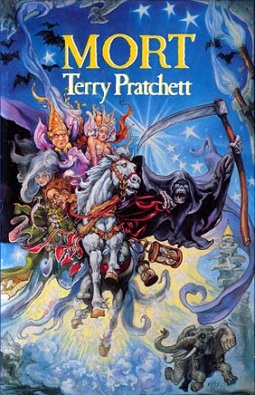
Today’s post is brief, as I’m heading out for the weekend, but I wanted to keep adding to my Halloween list of capsule reviews. I’ve been doing short reviews of some pretty heavy and disturbing horror fiction this month, and I thought I’d lighten things up and add the great Terry Pratchett to this reader’s guide to Halloween. There are a great many places you can start with the wonderful Discworld series, but Mort is as good as any of them. The fourth in the saga, published in 1987, this is the first in his ‘Death’ sequence. Mort is Death’s apprentice and he’s pretty unsuited for the job. He falls in love with death’s daughter, believe it or not, which leads to plenty of magic, slapstick and other hijinks as always in Ank-Morpork. If you like this kind of humor, it doesn’t get much better than Pratchett, and this book will give you lots of laughs, which we can all use right about now.
Yesterday my son and I were lucky to see Jeff Shaara, the historian and novelist, speak on his book Rise to Rebellion, the first of his two novels of the American Revolution. The books are terrific reads centered around some of the main players in the revolution, including Franklin, Adams, Washington, Jefferson, and others. Like his father, Michael, who wrote the Pulitzer winning classic The Killer Angels about Gettysburg (and which Jeff continued in two gripping books to complete a civil war trilogy), Jeff does a lot of research for his books and uses painstaking historical details to tell the story through the point of view of these characters. It truly makes history come alive in a way that general readers as well as history buffs will savor. My son, who is a well-read thirteen-year-old, loves Shaara’s books as well, and has read a number of them, including one on World War II and his most recent book on the Cuban missile crisis. Shaara also said that his newest book, due next May, is told from the point of view of Lincoln, starting in 1861 and ending in 1863; I’m sure my son and I will be picking up that one as well.
After a lively talk in which Shaara went over some of the details of these historical figures, there were some great questions from the audience about his writing process, and his thoughts on various historical events. He pointed out that while he understood why no one really writes much in popular fiction about someone like Robert E Lee anymore, he felt that it is a mistake to simply ignore or try to erase such historical figures. In a book like Gods and Generals, he showed Lee as the flawed man he was, and Shaara does a great service with work like this. It’s unhelpful to simply view Lee as an evil traitor, or on the other hand, as a noble son of the South. Instead, Shaara paints a picture of an imperfect man who, while acting gallantly in the eyes of the south, committed treason in the eyes of the North. He certainly made some choices that led down a destructive path, for a cause that was indeed evil. Yet it helps to put these actions in the context of the events through which Lee lived, to better understand what happened. But these days, most of us in this country don’t want nuance.
Shaara was also asked his opinion of the current state of the United States, since this event was part of the celebrations that are taking place as part of the 250th anniversary of the signing of the Declaration of Independence. He said what many in the auditorium were feeling, that we are in a very dark time, and that he feared what the future may hold.
If you enjoy history, or even if you don’t, you ought to read some of his books. You can start anywhere, but since we’re at that 250th anniversary, I’d suggest starting with Rise to Rebellion and the Boston massacre. It’s a great book, and a timely way to learn some things about our history that you may not know. It may even inspire you to do some things to help make sure this republic of ours survives through these perilous times for more anniversaries.
Thanks to the Poughkeepsie Public library for hosting this event. This was our second time seeing Mr. Shaara—he is usually at Gettysburg on every anniversary of the battle, and we saw him there last year on a family trip.
Sarah Orne Jewett is a Maine writer known for tales like The Country of Pointed Firs, A White Heron, and numerous short stories and poems that bring the region to life. One of the really interesting things about reading her books is that not only do you get a sense of what Maine was like in the late 1800s, you also get to hear the way people spoke, the diction and accent that they had. If you’re traveling in Maine you will still hear an accent that differs from other regions of the country, and even other areas in New England and the northeast. As time goes on and people are more apt to move around, these kinds of accents are being lost, but you can still hear it when you travel off the beaten path.
“In Dark New England Days” is a gothic story with a deep sense of doom and foreboding from the beginning. We are introduced to the sad case of the three Knowles sisters, ‘Closed-mouth old maids’ who spent their lives taking care of their cruel old father who has now died of a stroke. Mercifully, from the sounds of the story, as one character declares: “The old Cap’n kept ’em child’n long as he lived, an’ then they was too old to l’arn different.” His body is on display in their home–quite macabre by today’s standards, but more commonplace when the story was written. Even so, it is enough to give you the creeps from the opening lines of the story.
On the evening he dies, the sisters, Betsy, Hannah, and Susan, pull out an old chest belonging to their dead father, who had been a seafaring man, and learn that he’d been hoarding gold his whole life, though they lived in abject poverty. They are ecstatic with their new wealth and for the first time in many years they seem to have hope. Yet even as they stare at their gold: “He stopped to listen, came nearer, stopped again, and then crept close to the old house. He stepped upon the banking, next the window with the warped shutter; there was a knot-hole in it high above the women’s heads, towards the top. As they leaned over the chest, an eager eye watched them.”
The next morning, the money is gone: “The sisters had been rich for one night; in the morning they waked to find themselves poor with a bitter pang of poverty of which they had never dreamed.” They blame a neighbor with whom their father had a feud: Enoch Holt, and take him to court. He escapes without a guilty verdict, but not before Hannah Knowles stands before the court and declares: “Curse your right hand, then!” cried Hannah Knowles, growing tall and thin like a white flame drawing upward. “Curse your right hand, yours and all your folks’ that follow you! May I live to see the day!”
It is a chilling scene, and an awful declaration. The misery with which the sisters lived under their tyrant of a father is only made worse by the cruelty of the theft. But as in any good gothic tale, there are some fates worse than death, some things worse even than a sad, lonely life of poverty. I don’t wish to give away the ending, so I highly recommend reading this story and some others by Jewett.
Today we are not without plenty of so-called horror movies, gore-fests and plenty of over-the-top films and television to give us superficial scares. In my view, stories like this one do the job in a much more convincing, chilling fashion. The tale sets you up and gets its hooks in and doesn’t let go.
“God kills, and so shall we; indiscriminately He takes the richest and the poorest, and so shall we; for no creatures under God are as we are, none so like Him as ourselves, dark angels not confined to the stinking limits of hell but wandering His earth and all its kingdoms.”
Anne Rice’s achievement in this book, among other things, was to bring vampires into a more modern context. It’s also such a well-written book that even people who don’t normally care for horror will find themselves up late turning the pages of this tale. The story of Louis and Lestat is well known by genre fans by now, but in 1976, it was something new and different. What would it be like if a vampire were stalking modern day America? How would such a creature survive? They’re immortal, after all, so what would a vampire’s life trajectory look like? How would it navigate society without causing alarm?
Rice set out to answer these and many other questions about her antihero, and readers responded to the tune of eight million copies sold; Rice has sold over 100 million copies of her other works, including the rest of the Vampire Chronicles, which this book spawned.
I really enjoyed the way this one got into the details of vampire life and the day-to-day troubles of such creatures. For example, when unable to find human prey, they’ll kill whatever small animals are at hand, including rats. Gross, and also not something I would have considered. But what really made this book work for me was the relationship between Louis and Lestat. Since vampires live forever, they eventually have disagreements with one another and fall out, which makes perfect sense. In a way they are tragic figures, though they’re predators. Doomed to live forever and have no one truly know them, they form intense bonds with each other, but eventually things go wrong. Immortality in this world is more like a curse.
Interview was made into a successful movie, and more recently, a television show, as well as comic adaptations. Rice went on to write many more books in her Vampire Chronicles until her death in 2021.
I’m an old RUSH fan super excited by their recent reunion announcement, and so I’m the perfect audience for a band like Coheed and Cambria. A friend of mine has been raving about them for years, but it was only a couple of months ago that I finally took the plunge and started listening. I’ve bought two albums and will eventually get them all. It is so cool to see a progressive band like this doing so well.
I have very limited time, and so I usually stick to my favorite bands from earlier eras, (Jethro Tull, RUSH, YES, Led Zeppelin, The Who, ELP, King Crimson, Dylan and Tom Petty and The Kinks and so on) with a few newer ones sprinkled in here and there. Sometime around the birth of my children, and having the demands of family and my job, I kind of lost the ability to know much about new music, but these guys are so good. The epic science fiction story of The Amory Wars, (for the uninitiated, every album is set in this universe) the amazing riffs and energy of these albums, it’s fantastic. I feel like there should be some kind of rare band act passed by congress to protect these guys. They’re so great. I’m glad younger people have a modern day Rush they can follow. My kids are already singing along in the minivan.
I’ve read a couple of the omnibus comics and am getting into the story a bit, as well. I love how the comic books enhance the whole experience; it’s incredibly ambitious and also such a cool thing for fans to get into. As a teen, one of my favorite things to do was to get a new album by RUSH or some other progressive rock band and spend hours listening, reading the lyrics, looking at the artwork, all of that. I still do that when Jethro Tull or some other favorite band of mine releases a new album, or re-re-releases old ones with dozens of unearthed tracks. It’s more than just listening to songs; it’s an entire experience, and Coheed and Cambria is carrying on this glorious tradition.
I may not have been able to get Rush tickets, but I’ll be sure and try to see these guys the next time they’re touring near me.
“You can do one thing or you can do another, kill a man or take a tire off his car, because sooner or later you’re going to forget what it was you done and just be punished for it.”
One of the most anthologized and well-regarded short stories of the last century, A Good Man is Hard to Find, like some of the other stories on this list, deserves its towering reputation. O’Connor was a master of the short story, and this tale is one of the most shocking gothic stories I’ve ever read. I can still recall the palpable dread I felt as I first read it many years ago in a college class on the short story.
This tale involves a family that is out for a drive when unspeakable violence occurs, but there is plenty of foreshadowing, with the grandmother mentioning the ‘loss of values’ in the modern world; she also points out a graveyard filled with slaves from a bygone era. She remembers that there was a plantation in the area, and convinces her son, Bailey, to take a turn onto a deserted road, where the family has a sudden accident, flipping their car, and are met by the “Misfit,” a terrifying killer.
This tale is suffused with the south, and with notions of God and the possibilities of salvation and grace. The grandmother attempts to placate the Misfit, who clearly means the family harm, saying he is one of her ‘babies,’ and touches his shoulder. But there’s no salvation here for anyone, it seems.
I think it is best to read something like this, with such a well-known reputation, with an open mind. It’s better not to seek out or think too much about any of the criticism of it at first, just read it. It will probably leave you feeling desolate, as some of the very best horror stories tend to do.
Flannery O’Connor wrote two novels and thirty-one short stories and is considered one of the great American writers of the 20th century. Sadly, she was ill with Lupus and died at just 39. Who knows what she may have achieved had she lived longer; as it is, she left behind an amazing legacy.
‘Hateful day when I received life!’ I exclaimed in agony. ‘Accursed creator! Why did you form a monster so hideous that even you turned from me in disgust? God, in pity, made man beautiful and alluring, after his own image; but my form is a filthy type of yours, more horrid even from the very resemblance. Satan had his companions, fellow-devils, to admire and encourage him; but I am solitary and abhorred.’
The first ever horror and science fiction novel, first published in 1818, when Mary Shelley was just twenty years old, Frankenstein has a reputation that has been as long lasting as it is deserved. A beautifully written tale that began as a legendary writing contest between Shelley, her husband Percy, Byron, Dr. John Polidori, and others who were spending a summer together in Geneva, Frankenstein bears little resemblance to the monster most of us recognize from the many film adaptations that we’ve seen through the decades.
The monster is philosophical and brilliant, almost superhuman, and the real villains are those in the story who judge him by his ghastly appearance. There are as many interpretations of the work as there are film adaptations: a warning against humans playing God, the irresponsible Victor whose thirst for knowledge leads to catastrophe, the humans who judge the creature by how hideous he is. Several chapters in the book deal with a family of poor, blind people who treat Frankenstein with care and respect because they cannot see him. It’s written in a beautifully poetic style, was immediately successful, and still finds new and enthusiastic readers today.
There are a few different versions of the book, which Shelley revised in 1831, but most scholars prefer the earlier edition. Shelley had a very difficult early life, losing her famous mother when she was just a few weeks old. Her father, also a well-known intellectual, remarried a woman with whom Mary had a very difficult relationship. Under these circumstances it seems a miracle she was able to write such a classic. Her husband, the famous Romantic poet, also caused a scandal when he left his wife for Mary, and had numerous affairs.
I could write a lengthy essay about this book and its influence and various interpretations, but I’m by no means an expert on her; countless scholars have already done that better than I could, and the purpose of my blog this month is to offer a few thoughts on some of my favorite horror novels. This is an essential one that everyone ought to read. It’s one of the great novels in literary history, a book that will help you understand where the genre came from.
George RR Martin is known for his groundbreaking fantasy novels, but back in 1982 he wrote this gem of a vampire book, about a down on his luck steamship captain, Abner Marsh, who makes a bargain with an odd man, Joshua York: he gets to have his dream ship, financed completely by the mysterious stranger, but he must transport the man, his friends, and their cargo, no questions asked. As you might imagine, this arrangement does not go as planned. It’s a fun read with plenty of adventure and scares. If you enjoyed the Song of Ice and Fire novels, I think you’ll love this book. There are some interesting characters, weird plot twists, great writing, and of course, vampires.
According to Martin, his book sales around this time were poor, and contributed to his decision to become a TV writer. For years afterward, he worked on things like The Twilight Zone and Beauty and the Beast, until he wrote A Game of Thrones in 1996, which marked his return to novels. I’ve enjoyed everything he wrote. Armageddon Rag is another excellent read, this one about a cursed rock band. His short stories, science fiction novels, and Wild Cards series are also worth checking out. I only hope we get Winds of Winter sometime soon.
These days, everybody is a critic. And every movie is based on a comic book, so there is plenty to criticize. I enjoy going to the movies with my kids, and consider the experience time well spent with them, no matter what. Even so, I have opinions, and now you’re gonna hear mine regarding the new Fantastic Four movie.
First off, let me say I’m pro family. I like babies very much and doted on my children endlessly. I still do, even though they’re not babies anymore.
“What the hell do babies have to do with Fantastic Four!” you might ask, and you’d be right to yell that at me. Well, the first half hour of this film consisted of a pregnancy test, an ecstatic mom and dad, and a fawning Thing and Human Torch constantly saying how they could not wait for the baby, how great it was that the baby was coming. How wonderful it will be to have a baby at Fantastic Four headquarters! Everyone exclaimed this, over and over. They make dinner and drink wine and talk about parenthood and read a book by Dr. Spock about child rearing and share many tearful, sensitive moments in anticipation of the new baby.
Oh, when are they gonna get to the fireworks factory?
I exaggerate, but not by much. Dr. what’s his name, Mr. Fantastic, ably played by the omnipresent Pedro Pascal, is worried he won’t be a good enough dad. He’s so very very concerned that the baby may be strange like he is, you see. He devises ways to observe the baby in utero. He is a loving father, a good person! You must know this. You better know this. He will be a GOOD DAD! Invisible woman frets and worries she may not be a good enough mom. She is going to be a GREAT MOM. We know this, she knows it. She worries and that is why she’ll be a perfect mommy. That baby has great parents!
Finally, a BAD GUY appears. His name is Galactus, and he’s pretty bad. But he’s given little to do aside from saying he wants to blow up the earth etc etc. UNLESS! And here’s the big twist: UNLESS he can have the baby! He dispatches the Silver Surfer to GET THAT BABY! The silver surfer is the coolest character in this film by a long shot. She gives not one fuck about babies or anything else, and just wants to fight the fantastic four. Thank you, Silver Surfer! You alone seem to know your assignment! Kick some ass!
Eventually there is a giant battle and NY is razed and the fantastic four defeat the bad guy. The baby, of course, has mystical magical powers and will enrich the fantastic four’s inner lives beyond their wildest dreams.
What happened to clobberin’ time? Well, there’s that fight scene, but as my son said, “Why did they wait almost two hours to get to the fighting?”
“I don’t know, son,” I replied, “I just don’t know.”
And we both wept.
As the end credits rolled, a sensitive folk tune played. It sounded like the singer was about to cry. It was all very touching, what with the baby and whatnot.
I think I would have had a better time just reading the old Jack Kirby comic. You will, too. I give this movie one star because the robot was kind of cool, and so was the Silver Surfer. The retro sets and graphics were neat. Otherwise, I don’t get why you spend a billion dollars on a movie and just talk about a baby the whole time.
My opinion of the new Jethro Tull album doesn’t make much difference, but here it is anyway: it’s a total joy to even have one. Since I was a teenager, this has been my favorite band, and there will come a day that I won’t get any more new ones, so I’m enjoying the hell out of it.
We’ve been lucky enough to have three new Jethro Tull albums since 2022, and all of them have been fantastic. The Zealot Gene was a tour-de-force of biblical proportions, mingling sacred text and modern life, while 2023’s RokFlote was an epic exploration of Norse myths. Curious Ruminant is perhaps more down to earth, more contemplative, but no less searching–it’s a truly impressive artistic journey that gets better with repeated listenings.
The album should be listened to straight through, in one sitting, if you can manage it. As with all of Ian Anderson’s best records, this one ebbs and flows and gives the listener the feeling they’re looking at a giant canvas, revealed bit by bit, or reading a complex book and learning more in each chapter.
The opening song is the high-energy ‘Puppet and Puppet-Master,’ a reflection on the songster and his audience. We know we’re in capable hands as the band shows its chops with some fine electric guitar, organ and flute solos as Anderson delivers his tongue in cheek dramatization of what it’s like to get up there every night and play. “Holding court on a black box stage, dangling from the strings, I twirl and face the music,” he sings; the subject matter reminds me of ‘A Raft of Penguins,’ from his excellent 2003 album, Rupi’s Dance, which was a song about his nervousness in playing with an orchestra.
“Dunsinane Hill” is a real treat if you’re a Tull fanatic who also loves Shakespeare, like me. Having grown up in Scotland, one can only imagine how much MacBeth must have inspired Ian over the years. I absolutely love this song and it’s conceit: intrigue between two politicians discussing betrayal. Here the flute plays a merry folk tune even as the narrator says “I look over my shoulder/To see my brother warrior, damned spot to wash away.” I give this reimagining of the bard ten out of ten stars.
“Stygian Hand” is a sort of companion to Dunsinane thematically. Have you ever been nervous walking down a dark street alone? Here’s a song to help you. Bring a symbol of faith to ward off the devil and hope for the best. The accordian features prominently on this one. It’s a fun song and gives bit of levity to the otherwise fairly serious proceedings on this album.
“The Tipu House” is another up-tempo number, and here Anderson is singing of ‘All God’s children’; the subject is a tenement Anderson saw in Barcelona, and the residents, including young kids playing in less than ideal conditions. The flute is as manic as on any Tull track, the melody will leave you humming. It’s neat trick, to get an audience feeling empathy for their fellow man even while tapping their feet and singing along.
Other songs in this collection continue to encourage us to recognize our shared humanity, including the nearly 17 minute “Drink from the Same Well,” a fantastic piece of music that’s a meditation on differences that drive people apart. It seems a plea to remember that we’re all human and are worthy of respect, much as Aqualung was. The music is eastern-influenced, and Anderson said the bulk of the instrumental work dates from 2007, which explains why it would not sound out of place on his albums of that era.
“Over Jerusalem” is a song of lament for Israel that sounds like it could have been the twin of ‘Swing it Far’ from Thick as a Brick 2. You get the sense that Anderson, who has played in Israel many times over the years, donating all the money to charity, is as deeply saddened by the current situation as anyone.
“Savannah of Paddington Green” is a song about ecology, a subject Anderson has written of before, most famously in “Skating Away,” way back in 1973. “Threatening species, we turned on ourselves, like others before us, now left on the shelves,” he sings, wondering what the future may hold for our planet.
The final track on this one is a sort of goodbye, called “Interim Sleep,” a meditation on one’s final act. Most of us don’t want to think of the end, but I suppose Mr. A feels the weight of time.
“When interim sleep takes me
I want you close beside
No tears, no sad goodbye
I am calm and still as a fallen autumn leaf”
This is really quite sweet, and moving, as well as very unlike most Jethro Tull songs in that it’s personal and straightforward. Anderson has always preferred things that are more abstract, but that isn’t to say he lacks emotion. After all, his most famous song is a searing heavy rock number about a homeless vagrant, featuring a face melting guitar solo that Jimmy Page himself approved of as it was played. The best Tull songs are like this, melding high and low, profane and holy, mundane and beautiful.
The title track has the classic sound of this band–heavy guitar, flute, coupled with philosophical lyrics. Anderson is pondering life, ‘asking why am I here, answering, why am I anywhere,’ and ending with ‘cogito ergo sum.’ At 77, he’s as much a seeker as he ever was. I’m glad he’s taken us all along for the ride, and I sure hope it doesn’t end anytime soon.






 Christopher Tuthill