I can honestly say that this is an animated film at which you can take a nice relaxing nap. I see a lot of animated films with my children and I cannot always do that. Five stars for restfulness.
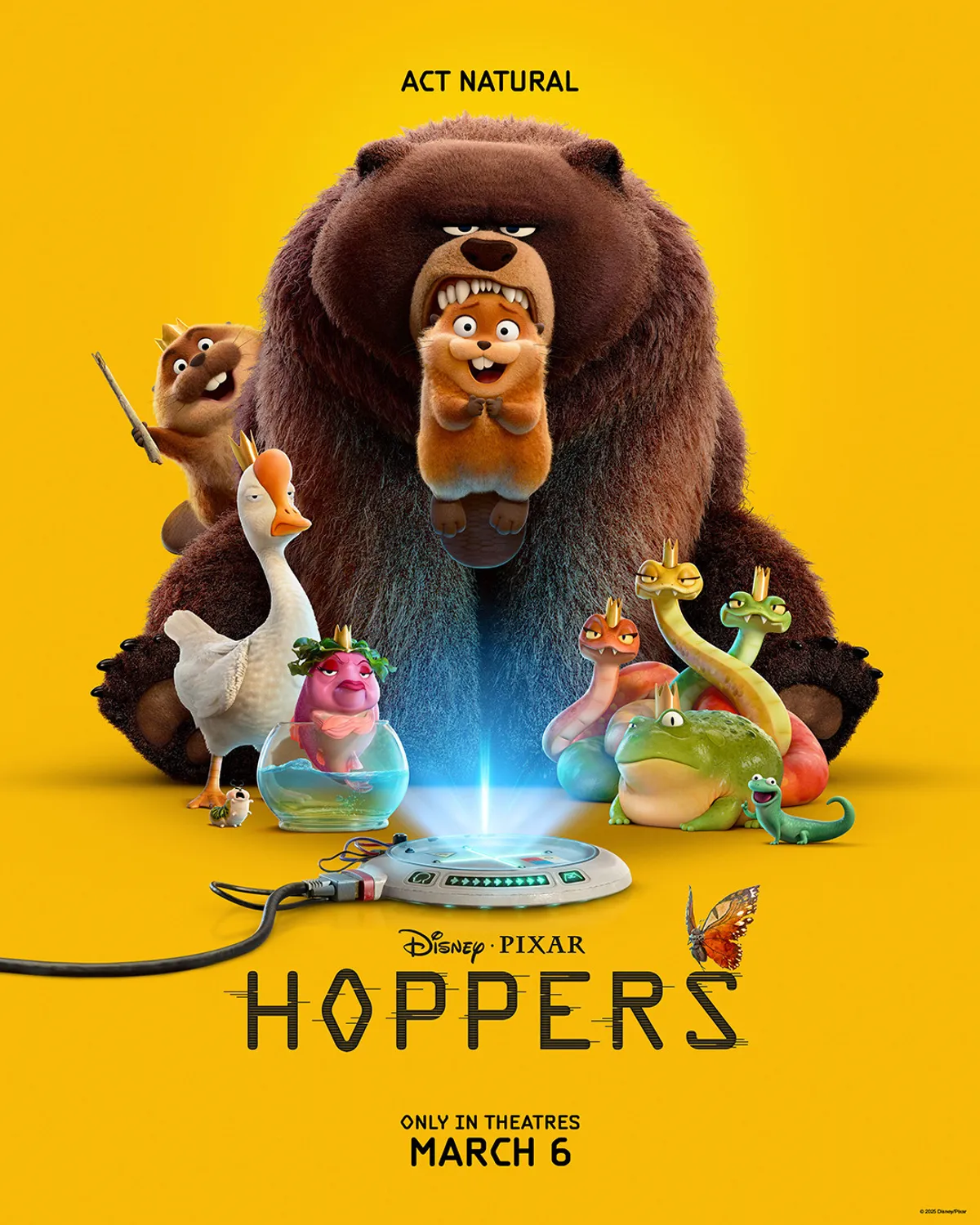

I can honestly say that this is an animated film at which you can take a nice relaxing nap. I see a lot of animated films with my children and I cannot always do that. Five stars for restfulness.
Somehow, it’s been a quarter century since The Fellowship of the Ring first hit multiplexes. That was half a lifetime ago for me. I recall waiting for the movies eagerly, feeling very concerned that they wouldn’t be any good, that they’d get Tolkien all wrong and mess up my favorite book.
I needn’t have worried. They were great films, much better than anyone had a right to expect, and I loved them from the start. Oh, there were plenty of complaints from lots of people about what Peter Jackson and his team got wrong about Tolkien, but such criticisms were in the minority, far outweighed by the millions who loved the movies. The artistic achievement here was really beyond what even the most ardent fan might have hoped. The music, the costumes, the cast, the locations, the attention to detail, the story all came together in a way that rarely happens. The filmmakers created something grand that has stood the test of time.
I am somewhat surprised that a bigger deal hasn’t been made of this anniversary, but never mind that. I saw that the extended version of Fellowship was in the theater and asked my thirteen-year-old son what he thought. He’s read the books and seen the movies and was enthusiastically in favor of seeing them on a big screen, an experience he’d never had. My ten-year-old daughter also wanted to see it; she fretted a little that she’d not yet read the books, but she soon got over this and happily came along.
My daughter’s response to the films was quite sweet, and for me, it put to rest once and for all the idea that these films were somehow no good. I know Christopher Tolkien, as well as some Tolkien superfans, hated the movies, but whenever I heard such criticisms over the years, I couldn’t have cared less, and after seeing my daughter’s adoring reaction to the movies, I think whether someone disliked these films is not something I could ever be persuaded to care about. She loved the epic scope of it, the characters and the settings and the battles. She loved Gimli and Gandalf and the hobbits and everything in between. Again: she is ten years old and now can’t wait to read The Lord of the Rings. It was her introduction to this vast, glorious epic. She knows about Tolkien, since she’s heard me talking about his books and has seen all the games and memorabilia I have, but these movies further sparked her imagination, just as Harry Potter and other books and movies have. There is nothing at all wrong with her uncritical love of these movies, nor with the way the rest of the audience have found happiness or escape or emotion in it. Any critic, no matter how well versed (or not) in Tolkien, is free to dislike the movies as much as they wish, but it’s quite clear they are missing the point and need to perhaps understand that we all come to these things differently.
For my part, after having lived with these interpretations of the books for so long, I was amazed at how well they held up. They still look better than anything else out there, which is a real testament to the craftsmanship, hard work, and love with which they were made. It’s of course condensed and simplified from the novel, but I don’t care about that at all. Filmmakers are required to do things to sell a movie; it’s a different medium that requires different things than a book does, especially when so much money is at stake. Given such constraints, it is a miracle these movies were as good as they were.
My children loved seeing The Fellowship of the Ring so much that we went back Saturday to see The Two Towers, and Sunday for The Return of the King. We are now reading the books together. I can’t think of a better way to spend a weekend. If you’ve never seen these movies on the big screen, I highly recommend it.
I just watched Franco Zeffirelli’s Romeo and Juliet with my thirteen year old son, and we both enjoyed it so much. I last viewed it when I was a Freshman in high school, nearly forty years ago. I recall being very moved by it, but doing my best to keep my enthusiasm for it hidden from my classmates. I still have many lines from it committed to memory thanks to my ninth grade English teacher.
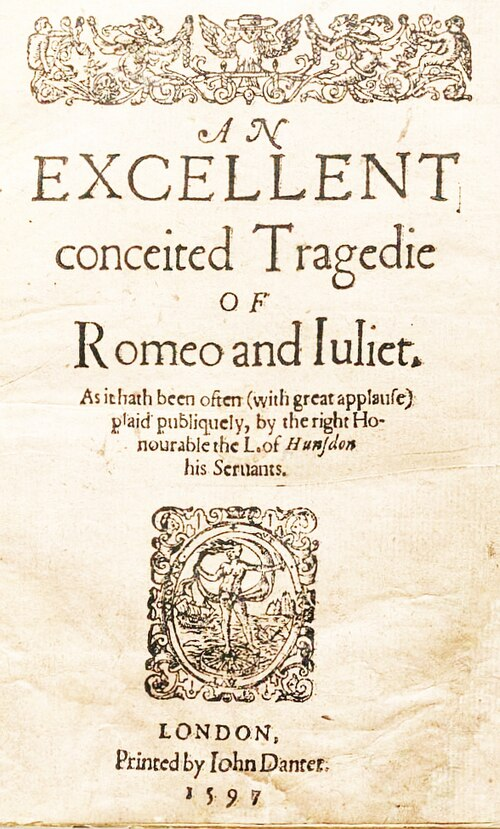
In viewing it now: my goodness what an amazing production. The costumes, the sets, the locations, the cast are all superb. This has got to be one of the best film versions of a Shakespeare play ever made. One of the things I found quite arresting was the duel scene; the sweat and dirt and grit and athleticism of the cast made it feel startlingly real. The same is true of the passionate desperation with which Romeo and Juliet fall for each other. Completely reckless and irresponsible, as the young so often can be.
There’s the beauty of the language, of course–my son remarked with surprise at several points in the play, when he realized where some famous quote came from: “A plague on both your houses!” “A rose by any other name would smell as sweet.” “Parting is such sweet sorrow.” On and on it went. Only in reading and seeing these plays performed do you get a true appreciation of how magnificent they are, and how much of our culture owes a great debt to Shakespeare.
I found this tragedy terribly sad as a fourteen year old, so upsetting that I didn’t much want to watch it or read it again. I have read it a few times since then over the years, but now that I have children of my own, the story was far more wrenching to me. When you’re young I don’t think you really know just how inexperienced and innocent you are. The passage of time and a different perspective have made this play much greater in my eyes.
Friendship, with Tim Robinson, was great fun; if you enjoy the over-the-top characters and situations in his sketch comedy, you’ll find plenty of laughs in this tale of a misfit who can’t seem to act normally. The movie reminded me of The Cable Guy, the equally hilarious story of a man who wants so badly to be friends with a customer that he stalks him, committing crimes in the hopes of forging a connection.
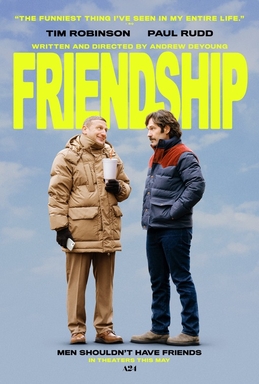
This story was a bit more dramatic than that, as Robinson’s character, Craig, desperately craves the approval of his new neighbor, Austin (Paul Rudd), an incredibly cool dude and local weatherman who at first takes an interest in Craig, before finding out how unhinged he is. When Craig acts like a lunatic at Austin’s party, Austin politely suggests they go their separate ways. But Craig, who has no other friends, and seemingly no other hobbies aside from buying clothes and obsessing over them, feels totally betrayed by this rejection. He has bought a drum kit, lost his phone, and started acting like the carefree spirit he believes Austin to be, and won’t let this bromance die without a fight.
What follows is the relentless destruction of Craig’s life—he loses everything—his wife, his job, and what little dignity he once possessed, as he pursues his lost friend, only to find that Austin isn’t who he seems. At one point, in total despair, he screams at Austin “You all accepted me way too fast! You can’t do that! You made me feel too free! People need rules!”
These lines, delivered with Robinson’s trademark, bug-eyed wildness, had me dying with laughter and encapsulated this poor man’s dilemma. He’s an awkward psychopath who holds a good job, with nice clothes, a nice house and family, but he is emotionally stunted, living through his phone, spending his days wishing he could fit in and be a normal guy, something he enviously watches his colleagues and coworkers do with seemingly effortless ease. For work he creates an addictive app, when not making up ad campaigns for local politicians. His wife, who has recently beaten cancer, cannot stand him, nor can his teenage son.
If there was a flaw in the movie, I thought it was in this home life. It seemed beyond belief that Craig would have married so highly above himself and had such a good job. But then again, most sitcoms have this same exact setup: an oaf with a beautiful wife and family who barely tolerate him. And there are lots of weirdos walking among us, doing all sorts of crazy things under the veneer of normality. I really enjoyed this movie, even if I am more partial to Robinson’s more light spirited anarchic stuff.
Speaking of which, I found the first episodes of his new HBO show, The Chair Company, to be totally hilarious and loved everything about it. In this one, Robinson again plays a suffering everyman, this time seeking justice against an office furniture business after enduring a hysterically funny mishap in front of his entire workplace. Robinson is so good at these kinds of characters, barely holding his life together, trying to keep a lid on a brimming rage that bursts out over and over, through minor and major inconveniences. After his fall, he is determined to root out the villains who have embarrassed him, no matter the cost. The first two episodes moved him down this dark path in a painfully funny manner, and I can’t wait to see just how outrageous it gets over the course of the story.
‘Hateful day when I received life!’ I exclaimed in agony. ‘Accursed creator! Why did you form a monster so hideous that even you turned from me in disgust? God, in pity, made man beautiful and alluring, after his own image; but my form is a filthy type of yours, more horrid even from the very resemblance. Satan had his companions, fellow-devils, to admire and encourage him; but I am solitary and abhorred.’

The first ever horror and science fiction novel, first published in 1818, when Mary Shelley was just twenty years old, Frankenstein has a reputation that has been as long lasting as it is deserved. A beautifully written tale that began as a legendary writing contest between Shelley, her husband Percy, Byron, Dr. John Polidori, and others who were spending a summer together in Geneva, Frankenstein bears little resemblance to the monster most of us recognize from the many film adaptations that we’ve seen through the decades.
The monster is philosophical and brilliant, almost superhuman, and the real villains are those in the story who judge him by his ghastly appearance. There are as many interpretations of the work as there are film adaptations: a warning against humans playing God, the irresponsible Victor whose thirst for knowledge leads to catastrophe, the humans who judge the creature by how hideous he is. Several chapters in the book deal with a family of poor, blind people who treat Frankenstein with care and respect because they cannot see him. It’s written in a beautifully poetic style, was immediately successful, and still finds new and enthusiastic readers today.
There are a few different versions of the book, which Shelley revised in 1831, but most scholars prefer the earlier edition. Shelley had a very difficult early life, losing her famous mother when she was just a few weeks old. Her father, also a well-known intellectual, remarried a woman with whom Mary had a very difficult relationship. Under these circumstances it seems a miracle she was able to write such a classic. Her husband, the famous Romantic poet, also caused a scandal when he left his wife for Mary, and had numerous affairs.
I could write a lengthy essay about this book and its influence and various interpretations, but I’m by no means an expert on her; countless scholars have already done that better than I could, and the purpose of my blog this month is to offer a few thoughts on some of my favorite horror novels. This is an essential one that everyone ought to read. It’s one of the great novels in literary history, a book that will help you understand where the genre came from.
Richard Matheson’s I Am Legend is a book that may be overlooked by fans of vampires and zombies, but it’s one of the originals of the genre, inspiring three direct adaptations in addition to an entire industry dedicated to post-apocalyptic monster stories. Written in 1954, and set in 1976, it’s the story of Robert Neville, one of the last humans left alive after a pandemic that has killed most of the world population and turned the survivors (aside from him) into vampire-like creatures, complete with aversions to sunlight, garlic, and crucifixes. He becomes a vampire slayer, a legend to the remaining zombies, who are terrified of him. Eventually he learns more about the disease that has claimed so many lives, and befriends a woman whom he thinks may be immune to the disease, as he is.

Like some of the other books on this list, I Am Legend is a highly influential novel, and its stature has only increased with time. I read it after having seen Charlton Heston in the campy ‘Omega Man’ and Vincent Price’s excellent depiction of Neville in The Last Man on Earth. The most recent adaptation starred Will Smith, and of course there are dozens of other movies and television shows that have been inspired by Matheson.
Matheson’s other stories and novels are also well worth reading. I greatly enjoyed The Shrinking Man, a tale inspired by fears of radioactivity. Matheson had a long and successful career writing for TV and film, including some of the best-known episodes of The Twilight Zone and Star Trek, as well as screenplays for Roger Corman’s entertaining adaptations of Poe stories, which have delighted horror fans since the 1960s. Many of his works have been adapted for film as well. He had an incredible career and influenced a whole generation of writers, filmmakers and fans. If you’ve not yet read Matheson, don’t delay–start with I Am Legend.
These days, everybody is a critic. And every movie is based on a comic book, so there is plenty to criticize. I enjoy going to the movies with my kids, and consider the experience time well spent with them, no matter what. Even so, I have opinions, and now you’re gonna hear mine regarding the new Fantastic Four movie.

First off, let me say I’m pro family. I like babies very much and doted on my children endlessly. I still do, even though they’re not babies anymore.
“What the hell do babies have to do with Fantastic Four!” you might ask, and you’d be right to yell that at me. Well, the first half hour of this film consisted of a pregnancy test, an ecstatic mom and dad, and a fawning Thing and Human Torch constantly saying how they could not wait for the baby, how great it was that the baby was coming. How wonderful it will be to have a baby at Fantastic Four headquarters! Everyone exclaimed this, over and over. They make dinner and drink wine and talk about parenthood and read a book by Dr. Spock about child rearing and share many tearful, sensitive moments in anticipation of the new baby.
I exaggerate, but not by much. Dr. what’s his name, Mr. Fantastic, ably played by the omnipresent Pedro Pascal, is worried he won’t be a good enough dad. He’s so very very concerned that the baby may be strange like he is, you see. He devises ways to observe the baby in utero. He is a loving father, a good person! You must know this. You better know this. He will be a GOOD DAD! Invisible woman frets and worries she may not be a good enough mom. She is going to be a GREAT MOM. We know this, she knows it. She worries and that is why she’ll be a perfect mommy. That baby has great parents!
Finally, a BAD GUY appears. His name is Galactus, and he’s pretty bad. But he’s given little to do aside from saying he wants to blow up the earth etc etc. UNLESS! And here’s the big twist: UNLESS he can have the baby! He dispatches the Silver Surfer to GET THAT BABY! The silver surfer is the coolest character in this film by a long shot. She gives not one fuck about babies or anything else, and just wants to fight the fantastic four. Thank you, Silver Surfer! You alone seem to know your assignment! Kick some ass!
Eventually there is a giant battle and NY is razed and the fantastic four defeat the bad guy. The baby, of course, has mystical magical powers and will enrich the fantastic four’s inner lives beyond their wildest dreams.
What happened to clobberin’ time? Well, there’s that fight scene, but as my son said, “Why did they wait almost two hours to get to the fighting?”
“I don’t know, son,” I replied, “I just don’t know.”
And we both wept.
As the end credits rolled, a sensitive folk tune played. It sounded like the singer was about to cry. It was all very touching, what with the baby and whatnot.
I think I would have had a better time just reading the old Jack Kirby comic. You will, too. I give this movie one star because the robot was kind of cool, and so was the Silver Surfer. The retro sets and graphics were neat. Otherwise, I don’t get why you spend a billion dollars on a movie and just talk about a baby the whole time.
No offense to babies.
I know that 50-year-olds are not the key demographic for comic book films, but I’ll give my opinion anyway, since as someone who has loved Superman for more than forty years, I’m as qualified as anyone to offer mine.

I suppose the new Superman film accomplished what it set out to do, serving as the first of DC’s planned ‘universe.’ Having watched Marvel run circles around them at the box office since 2008, they used a hired Gunn (pun intended) to get the kryptonite rolling. I was interested to see what they’d do, but I knew in my heart no one could ever replace Christopher Reeve for me. He was just too good in that role, and I first saw it when I was about 5 years old, so he’ll always be my favorite. But I’m always game for a new version, and my 10- and 12-year-olds were eager to see this incarnation. Off we went.
Eighty minutes into this film, I was wondering why Superman had so little to do, and why he’d just been pummeled from one end of the theater to the other, with no end in sight. Imprisoned and helpless and tearful is not my favorite kind of Superman. I know he needs conflict and drama, but I wasn’t enjoying it much. I wished I’d saved some money and watched the 1978 version. I found myself confused as to why a movie called Superman had much better things for Guy Gardner, of all people, to do. Better lines, as well.
James Gunn made the very funny and lucrative Guardians of the Galaxy films, and the new Superman felt like it was trying to be that sort of movie, an ensemble cast of wisecracking misfits. In my view, Gunn is great at comedy/action films like that, and I think he’d probably make an awesome Green Lantern film. But for me, this Superman lacked something. Plenty of people might disagree with me, but I wanted more about the main character and his story. Otherwise, it might as well be called Justice League.
This one felt like a generic mess, way too convoluted in the way that almost all these films are, and worse, it was boring. For long stretches of this thing I could barely keep my attention focused on what I was seeing. The cast is great and this isn’t their fault. But I wonder: how can you hire an actor as talented as Wendell Pierce and give him nothing to do? A bedrock of American comics like Superman deserved better than this hodgepodge of a movie.
My children enjoyed it pretty well and found it funny, and that is the audience for this. They’ll grow up watching the rest of whatever movies DC sees fit to release. A shame that this one didn’t have more heart.

My twelve year old son, who loves Tolkien, said, “It’s like they took one line and made an anime movie about it.” Indeed, my boy. This grim, humorless trek through Middle-earth had a few fun moments, but not nearly enough of them to justify its two plus hour running time. Miranda Otto and Brian Cox are pretty good. This film’s entire raison d’etre appears to be that WB was about to lose the license to make more cash-generating adventures in Tolkien’s world. I give it a B-. For all its flaws, it’s still much better than the awful slop amazon keeps pushing at me. I hope Andy Serkis’ return in 2026 is more fun than this was.
I found the first installment of Horizon to be an excellent epic Western, the kind of film that is rarely in theaters anymore. The movie is ambitious and sprawling, a tale that spans years and the lives of multiple characters in the settling of the western frontier. It’s not a sanitized version of that era, though there is plenty of drama. The cast is excellent, and the story is gripping. It’s long, and though it doesn’t move at a breakneck pace, it kept me interested the whole way through and I’m eager to see what comes next.
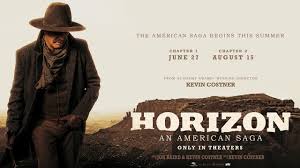
This isn’t exactly a groundbreaking movie, but that is ok. Westerns have a long and rich history in film and literature. The best of them, like Lonesome Dove, tell a story about America and about human nature that keeps us engaged and entertained. I felt that Horizon is up there with some of the better genre offerings. At the heart of this tale is Kevin Costner’s character, Hayes Ellison, who is the kind of stock figure we’ve seen in many Westerns—the tacit, reluctant hero. I was reminded of William Munny from Unforgiven, though Ellison is less brutal. He must protect a woman and young child from a band of outlaws seeking vengeance, and he does so almost grudgingly at first, like all good heroes, but once called into service he swings into action with the kind of cool performance moviegoers will appreciate.
Other plotlines include a group of settlers in over their heads, the target of a band of Apaches unhappy with the incursion on their territory. In one particularly grim scene, a band of outlaws looking to make easy money target a group of native women and children for their scalps; it’s easy money, at $100 a head. This is not the kind of thing you might have seen in a Western of an earlier era. It was a grisly sequence and underscores that there are really no heroes in this kind of story, though there is plenty of tension and conflict.
The film left me eager to see the remaining installments. I loved the scale of it—the film looks gorgeous, shot in Utah with stunning effect. A lot of care went into all of this—the story, yes, but also the sets and costumes, the languages of the native peoples—everything.
I’ve read some things about the poor box office performance of this film, which is a shame, because it’s a great movie. Perhaps it’s an old-fashioned kind of tale, from a bygone era of cinema. If so, that’s a sad development. There’s little enough at the multiplex for people to see that isn’t animated, or part of a comic book multiverse. Nothing wrong with those kinds of movies; my children love them. But it felt good to see a movie made for adults, which spoke a language of film that I haven’t seen for a while. If the days of these kinds of films have passed, because they require too much attention, that is a shame. Perhaps the audience for such films has shrunk so much that they are no longer profitable, the way it is becoming harder to sell good novels or good theater. If so, we will all be poorer for it. Even so, the measure of a work of art has little to do with how marketable it is. There are examples of this all through the history of art and literature. So, I’d urge you to go see Horizon—it’s a movie that in my opinion is worth the time and attention.
 Christopher Tuthill