‘Hateful day when I received life!’ I exclaimed in agony. ‘Accursed creator! Why did you form a monster so hideous that even you turned from me in disgust? God, in pity, made man beautiful and alluring, after his own image; but my form is a filthy type of yours, more horrid even from the very resemblance. Satan had his companions, fellow-devils, to admire and encourage him; but I am solitary and abhorred.’
The first ever horror and science fiction novel, first published in 1818, when Mary Shelley was just twenty years old, Frankenstein has a reputation that has been as long lasting as it is deserved. A beautifully written tale that began as a legendary writing contest between Shelley, her husband Percy, Byron, Dr. John Polidori, and others who were spending a summer together in Geneva, Frankenstein bears little resemblance to the monster most of us recognize from the many film adaptations that we’ve seen through the decades.
The monster is philosophical and brilliant, almost superhuman, and the real villains are those in the story who judge him by his ghastly appearance. There are as many interpretations of the work as there are film adaptations: a warning against humans playing God, the irresponsible Victor whose thirst for knowledge leads to catastrophe, the humans who judge the creature by how hideous he is. Several chapters in the book deal with a family of poor, blind people who treat Frankenstein with care and respect because they cannot see him. It’s written in a beautifully poetic style, was immediately successful, and still finds new and enthusiastic readers today.
There are a few different versions of the book, which Shelley revised in 1831, but most scholars prefer the earlier edition. Shelley had a very difficult early life, losing her famous mother when she was just a few weeks old. Her father, also a well-known intellectual, remarried a woman with whom Mary had a very difficult relationship. Under these circumstances it seems a miracle she was able to write such a classic. Her husband, the famous Romantic poet, also caused a scandal when he left his wife for Mary, and had numerous affairs.
I could write a lengthy essay about this book and its influence and various interpretations, but I’m by no means an expert on her; countless scholars have already done that better than I could, and the purpose of my blog this month is to offer a few thoughts on some of my favorite horror novels. This is an essential one that everyone ought to read. It’s one of the great novels in literary history, a book that will help you understand where the genre came from.
I was at the Morgan Library and Museum this week and wanted to give a brief reflection on their current exhibits, and how much I enjoyed them. We are lucky to have this museum in New York, and I can’t recommend a visit highly enough. Originally, it was J.P. Morgan’s personal library, and later became a public institution. There are always different exhibitions there; over the years, I’ve seen things ranging from Blake engravings, to Mary Shelley and Frankenstein, to Tolkien, to Dickens, among others. If you live in or near New York, by all means go for a visit. They also have lectures and concerts regularly, and every Friday evening is free admission from 5-8. Educators and students also receive a discount.
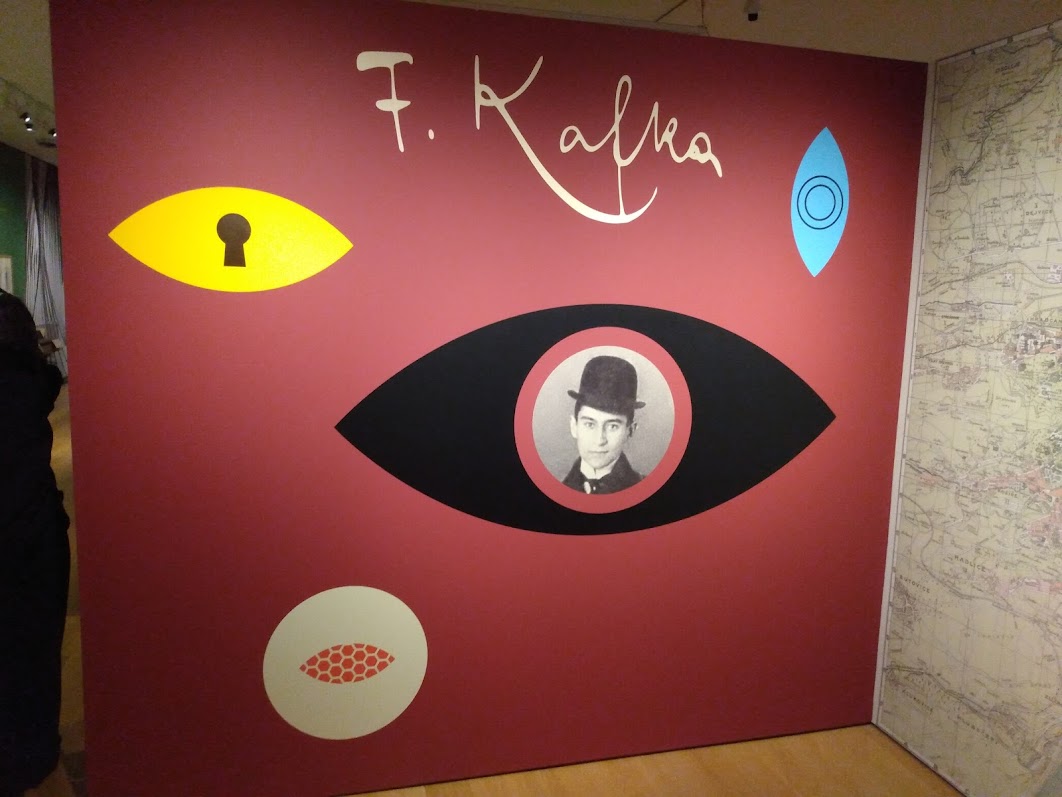
Franz Kafka
I made this recent trip for the Franz Kafka exhibition, which was every bit as wonderful as I’d hoped. There were many of his handwritten manuscripts, journals, letters, photographs, and other personal effects on display. Anyone with an interest in him and his work should definitely go. It gave me a more intimate look into his life and work, and I found something quite haunting about it. Such a tragedy that he died so young, and it made me wonder what else he might have accomplished had he lived longer.
Kafka’s work has meant quite a lot to me, especially when I was a young man, and so I was very pleased to see him celebrated at the library. I still recall the chills I got reading The Metamorphosis as an undergraduate, and the feeling of urgency I had in finding the rest of his stories and books and reading those, too. I was so inspired that at one point I wrote my own little comical story about a superintelligent, powerful cockroach, which won an award from my college’s literary magazine. I am sure it was embarrassingly bad, but I had so much fun writing it.
I particularly enjoyed the handwritten copy of the Metamorphosis that was on display, and which was accompanied by contemporary textbooks of insect larvae and roaches. I had not thought of the Darwinian connection before seeing it laid out in this way, but as the display suggested, these were somewhat new fields of study at the time, with which Kafka would have been acquainted, and may have inspired him to write the story. Kafka is, of course, a towering figure in modern literature and his influence on contemporary fiction and culture is hard to overstate. This exhibit did a lot to help me appreciate him more as a human being and an artist. Photos of him and his fiancee, as well as details of his ill health, lent a very personal touch to a writer who sometimes can seem very remote and cryptic.
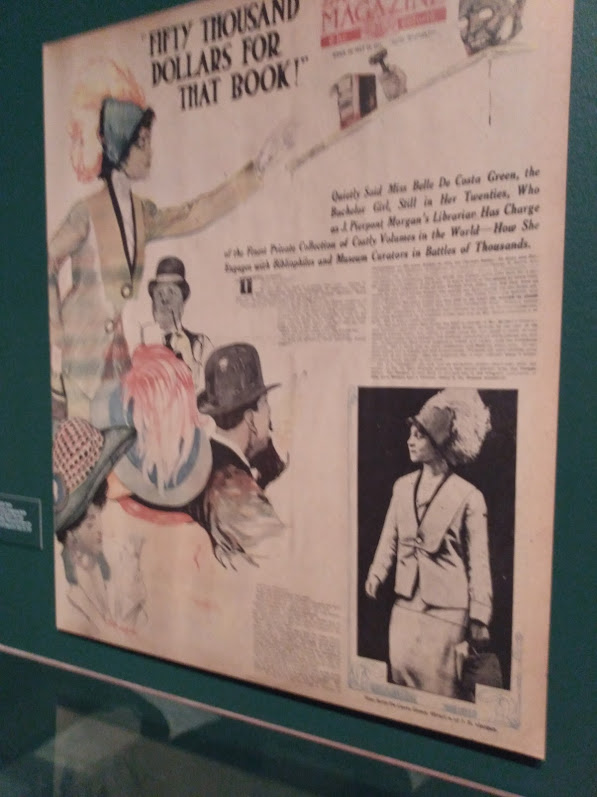
Belle da Costa Greene
After having seen the effective, thought provoking Kafka exhibit, I moved back to the first floor to see the other exhibition, about which I knew nothing. But what an experience visitors will have in learning about the life of Belle da Costa Greene, the first director of the Morgan. She was an amazing person who built the Morgan’s collection of rare books and manuscripts, and was a well known authority on these treasures. In the process of creating the library, she traveled the world to make acquisitions, and shaped it into a world class institution.
Belle’s father was the first black graduate of Harvard, and Belle and her family passed as white in segregated America. Much of the exhibit explores this part of her life, and it’s a breathtaking biography. She was a brilliant scholar and a cultural force at the Morgan, but a lot of her life was tinged with tragedy. The details about her her nephew were quite moving; he was a soldier in World War II who committed suicide when his fiancée learned he was not white and broke off their engagement. The exhibit gave other harrowing examples of stories like this, of ‘passing’ blacks in a segregated country.
I appreciated the display of Belle’s own collection of books and cultural treasures. She had exquisite tastes and collected illuminated manuscripts, paintings, sculpture, and other artifacts. It was an interesting window into her personal life.
This exhibit also included many examples of illuminated manuscripts, for which Belle had a passion and much expertise. It’s a bit overwhelming seeing all of these ancient books laid out for perusal, and it’s best to take your time and look at the intricate detail of things like the Crusader’s Bible, among other medieval treasures.
I also learned that the NYPL used to have a library school, and at one point there was a course in rare books taught at the Morgan, using their resources. There was a syllabus on display that was a really fascinating look at library education from the 1920s. I’d love to take a course like this, incidentally. (I took a couple of rare books courses while doing my MLS and loved them, but to do it at a library like the Morgan would be a lifelong dream for any bibliophile.)
Belle’s life seems quite ripe for a film or a biography. And her life’s story should cause anyone to reflect on this country’s shameful past. These pernicious evils–racial segregation, passing, and other injustices–were not so long ago, and we have a long way to go to become a world that treats everyone equally. Belle’s remarkable life is a testament to what an exceptional person and scholar she was, and I was happy to see so many people learning about her. I can’t recommend the exhibit highly enough. Everyone should go.
I hope Belle would be pleased by the legacy she left at the Morgan. Her hard work and dedication live on through the collections and the stories they tell us about our culture and history.
One of my fondest, most primal memories of childhood is being up late in the summertime, reading a good book, while everyone else in our busy house was asleep. There were so many novels I enjoyed back then, and I read indiscriminately, for the pure joy of being lost in a fantastic new world.
There were many great series for young people back in the early 1980s, and I read many of them. The Hardy Boys, The Black Stallion, Matt Christopher’s sports stories, Encyclopedia Brown the boy detective, Danny Dunn, a boy wonder who created all kinds of machines with his pals, and on and on. There were some great works of literature too, like Madeline L’Engle’s A Wind in the Door, Mark Twain’s Tom Sawyer Detective, Ray Bradbury and The Martian Chronicles, and others. Today I can see how much more sophisticated these last three are, but as a young boy I didn’t care about their literary merit, I just wanted to read.
To read as a nine year old meant getting lost in another world that seemed so real I became irritated when my mundane surroundings intruded. It meant an escape into magic and mystery and wonder, into past eras that seemed completely real, as if I were suddenly in a time machine, transported to colonial era America, or King Arthur’s Court. Perhaps I’d go to a distant strange planet, or an isolated pacific island, or any other a million different times and places. There was nothing so wonderful in the world as being lost in those pages, many millions of miles away from wherever I was and whatever was happening around me in my little corner of the world.
I’m now fifty, and very occasionally this magnificent feeling will come over me again when I’m reading a truly great, original book. It seems to happen less and less these days; perhaps that is a failure of imagination on my part, or perhaps it just happens with age. After you’ve read so many books, they cannot all have that glorious impact, and many of them will seem merely adequate. I’ll say that in the past few months, Ron Chernow’s Hamilton was a biography that transported me to the early days of America in a way that was quite breathtaking; I don’t normally read a lot of history, but he is such a fine writer, telling the story of the founder in such an empathetic way, that I was swept up in the drama of it and couldn’t wait to read more.
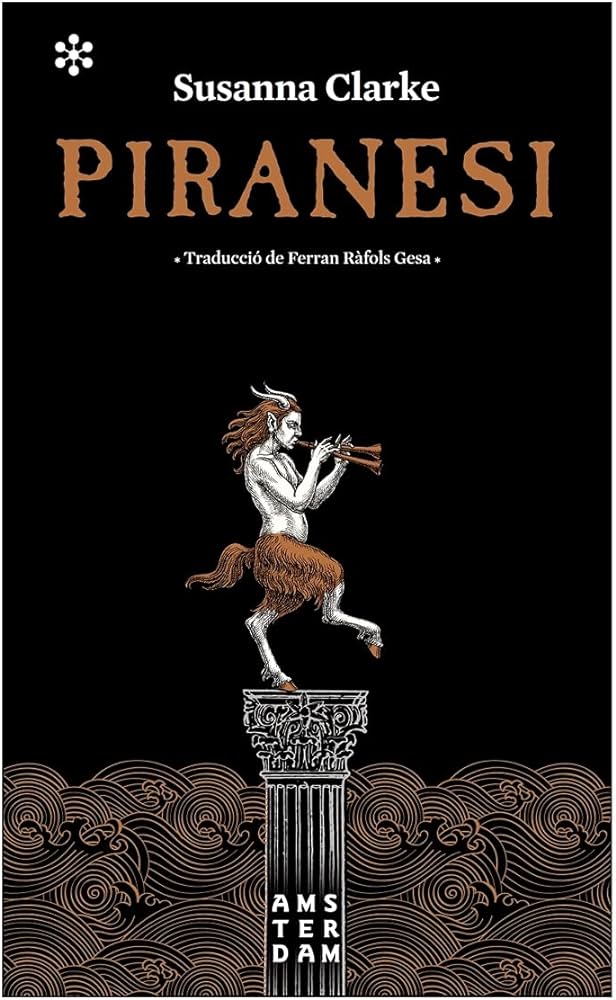
Novels are a different matter, and as I’ve read so many of them, it has become harder for me to find ones I truly love, that affect my outlook so dramatically, that can transport me in that same primal way. Susanna Clarke’s writing does that for me, and I recall a well-spent winter evening not long ago, when I was up through the night, finding revelations on every page of her incredible book, Piranesi, which I finished in one sitting. I can’t recommend her work highly enough, and I was ecstatic to learn she has a new novel arriving this fall.
In this hyper-connected age, it is increasingly difficult to shut out the outside world and enter the fortress of mystery and imagination that is a great reading experience. I read whenever I can, as much as I can, but with the demands of a job and a family it’s not always easy. I’ll stay up late at night when I’m not too tired, or read when I have downtime on the train or before the rest of my family is up. I guard my reading time jealously, just like when I was a boy, and get frustrated sometimes when there isn’t enough time or quiet for me to read every novel or work of history or criticism on my shelves. My collection is wide and varied–I have books on a great many topics, because I am never sure which one I will need at any given moment. This is one of the great things about being a librarian, as well: if I don’t have it on my shelves at home, I can almost certainly find what I need in the library.
I enjoy movies, though I’m not exactly a movie critic. I have found that films, television and video games don’t transport me the way a good book does. Maybe some people find the same elation and deep mystery watching things or playing video games, but it doesn’t happen for me. I can enjoy such media, but it won’t impact me in the same way, and while I don’t know for certain, I suspect that the effort required of a careful, thoughtful reader will always make the reward of reading that much greater. To me, it’s a bit like the difference between hiking to the top of a mountain and taking in the view, as opposed to having someone drive you up there on a paved road. (The same can be said for writing vs. AI-assisted writing, but that is the topic for some other post.)
One of the essential things about reading is the way it can change your perceptions, your outlook, your knowledge of the world, and perhaps even knowledge of yourself. The greatest works help us do this and will enrich your life in ways like nothing else. For me, reading a great book is one of the last bulwarks I have in guarding my mind from a ceaseless stream of meaningless junk that increasingly defines modern life.
The other night my young daughter, who is brilliant and perfect, happened upon the Twilight Zone episode, “Time Enough at Last,” with the great Burgess Meredith. I hesitated to show it to her, but she was eager to see it and I relented. At the end, she was in tears for Henry Bemis, the tortured man who lives through an atomic war only to be left utterly alone, despondent, bereft of all hope, sans spectacles. “I hate this,” she said. “He was finally able to read and now he can’t.” I felt like an awful father for having shown her the episode. We talked a bit about the message of the show but she was inconsolable, much like I was decades ago when I first saw it.
In these waning days of summer, I admit I feel some pressure to read what I haven’t from my list so far, but my task shall be Herculean. I have a copy of Thomas Pynchon’s Against the Day, which I have never read and will likely not get to before the end of August. I have works by Saul Bellow, Robert Caro, Don DeLillo, Tim Powers, Toni Morrison, Barbara Tuchman, Octavia Butler, and too many others to list sitting on my shelves, waiting to be opened, calling to me, but time is running out. I’ll get to a few of them, and the rest will likely need to wait for winter break, or next summer, when I will have time enough at last.
This Saturday, March 30, I’ll be at The Poughkeepsie Book Festival with copies of my book, THE OSPREY MAN. Each child under 17 who attends gets a voucher for $15, with which they can buy a book from one of the over 100 authors and illustrators who will be there. So come and support this great library–they put on this and plenty of other amazing events every year. Bring the family for a fun day filled with books and activities.
My labor day thought: I totally understand why people refuse to work low paying jobs. I’ve been searching unsuccessfully for part time gigs for some time now. I had one interview where the pay was less than twenty bucks an hour. And you needed a master’s degree plus some years of experience for this professional level, academic job in a library. I told them no thanks and explained that the pay was outrageously, insultingly low. They agreed but explained it was all the money they were allotted for the position.
My full time job’s real dollar earning value has gone way down over the years, pathetically so. My pay has remained exactly the same for years while the cost of everything skyrockets, hence my search for extra work. Luckily I like my job, I enjoy helping students and working in a library, and I’m thankful for that. Yet somehow CUNY finds ways to pay their upper management hundreds of thousands of dollars a year while the rest of us struggle to buy groceries and drown in debt. Not a great feeling.
So, if you’re going to pay a worker some insulting amount of money that barely covers gas as they give up their evening or Saturday, no thanks.
I hate talking and thinking about money, but it’s pretty frustrating to never have enough of it. Yes, I understand that I’m not starving or homeless. I should be thankful I have a job, and I am. I just wish my institution valued us, even a little bit. They make it very clear they do not.
Join a union. They built our middle class and their scarcity is the reason the middle class is hurting so badly now.
I’ve been busy preparing a manuscript for release next year; don’t want to give away too much about it, but it will appeal to those who like comedy and spooky stories. It’ll be a great seasonal read for Halloween, and I hope to have the release coincide with that, perhaps late summer.
Think The ‘Burbs meets The Haunting of Hill House. It’s a tale as old as time: Good, Evil, and Home Improvement.
I’ve also been working on a new book, about which I will say even less, since I’m still on draft #1. But it’s humor and fantasy, mixed with some more serious elements.
My hope is that these novels will build on the audience for my first book, The Osprey Man, and appeal to an even wider audience. I learned a lot through the release of my first book, and I hope the rollouts for these forthcoming books will be even better.
By the way, if you’re reading this, but haven’t read The Osprey Man, check out the pinned post on this blog for some reviews. Readers have loved this tale of two youths creating a comic book together, and memorializing their friend. It’s just $15 through my website–contact me for a signed copy. You can also purchase through the publisher for the same price, or get the ebook for just $5.99. It’s great for general readers, or for a young person in your life who loves to read. You can also ask your local library to purchase it; that is a great way to support writers.
Here’s the record of THE OSPREY MAN at my local public library. Look for my book at your library, or ask your librarian about it! It’s available as an ebook in the hoopla database, or they can order a physical copy.






 Christopher Tuthill