A Night in the Lonesome October, by Roger Zelazny (1993)

This novel is a wonderful seasonal treat by the legendary Zelazny. Each of the chapters is a night in October, told from the point of view of Snuff, a dog who is the companion of Jack the Ripper. Sherlock Holmes, Dracula, Dr. Frankenstein, the Wolfman, and various other spooky characters haunt the pages of this book, each with an animal familiar, all playing a game that will determine the fate of humanity. I found this book to be a tremendously appealing conceit, such a fun read and so well told. If this kind of story sounds appealing to you, do not delay: sit back, relax, pour yourself a cup of tea and enjoy it by the fire–you won’t be disappointed. If it doesn’t sound appealing to you, that makes me sad and I’d encourage you to try it anyway.

Young Goodman Brown, by Nathaniel Hawthorne (1835)

I first read Young Goodman Brown in high school and recall being puzzled by it. Hawthorne’s prose was perhaps a bit too dense for me, as I suspect it was for most of my ninth grade English class. But there was something unsettling about it, and I returned to it again and again through the years. Eventually, Hawthorne became one of my favorite writers, but it was an acquired taste.

We’re in the Puritan village of Salem; the tale was written in 1835 but Hawthorne is reaching back to the witch trials of 1692-93. The story seems straightforward. Young Goodman Brown leaves his wife, Faith, to go out on some ‘evil purpose,’ against her wishes. He travels past the town meeting house in Salem Village, and Hawthorne sets a foreboding tone:

“It was all as lonely as could be; and there is this peculiarity in such a solitude, that the traveller knows not who may be concealed by the innumerable trunks and the thick boughs overhead; so that, with lonely footsteps, he may yet be passing through an unseen multitude.”

“What if the devil himself should be at my very elbow!” Brown remarks, as he continues on his way. He meets others from the village on his path, including a man who is older than him, around age fifty, but who looks just like him, and remarks in a very matter of fact way that he had done terrible things with Young Goodman Brown’s grandfather:

“I helped your grandfather, the constable, when he lashed the Quaker woman so smartly through the streets of Salem. And it was I that brought your father a pitch-pine knot, kindled at my own hearth, to set fire to an Indian village, in King Philip’s War. They were my good friends, both; and many a pleasant walk have we had along this path, and returned merrily after midnight. I would fain be friends with you, for their sake.” The stranger goes on to say that he is acquainted will the deacon, the governor, and other elders of the town. This shakes Brown’s understanding of his own family and village, leaving him quite unsettled.

This stunning section ramps up the tension until Brown hears the voice of his wife, Faith, and is distraught that she is in the woods. He arrives at a clearing where all the village is assembled; he and Faith are to be initiated in a ceremony, binding them to the devil. He calls out to Faith that she must resist and “look up to heaven,” at which point the villagers disappear.

Brown is unsure whether the entire story was a dream, but it bewilders him to the point that “A stern, a sad, a darkly meditative, a distrustful, if not a desperate man, did he become, from the night of that fearful dream.” Hawthorne’s final sentence is: “And when he had lived long, and was borne to his grave, a hoary corpse, followed by Faith, an aged woman, and children and grand-children, a goodly procession, besides neighbors, not a few, they carved no hopeful verse upon his tombstone; for his dying hour was gloom.”

It may not be entirely fashionable today to believe in good and evil or supernatural powers, but this story still leaves me unsettled. The idea that your friends and neighbors, or your entire conception of the world, may be totally wrong, is something no one wants to admit. But the devil is right there in the story, cheerfully informing Brown that his father committed atrocities, that his grandfather enthusiastically persecuted his neighbors, and that Brown himself is on friendly terms with evil. Everyone in Salem is implicated; the story takes place during the Witch trials, at which Hawthorne’s own grandfather was a judge, making this tale even more grim.

There are no easy interpretations or answers in this tale. Brown lives the rest of his days haunted by his knowledge. There’s no redemption for him from God, or from anyone else, even his beloved Faith.

Hawthorne wrote plenty more in this vein: A Scarlet Letter, The House of Seven Gables, and numerous stories, and all of them leave me with this same feeling of helplessness in the face of evil. They’re also incredible to read, with the stylized, romantic prose adding to the sense of gloom and mystery.

I am not sure of Hawthorne is still taught in high schools, but he ought to be. This is one of the best short stories you’ll ever read, one that has stayed with me in the three and a half decades since I first encountered it.

The October Country, by Ray Bradbury (1955)

We start the month with one of the finest collections of seasonal stories ever, by the great Ray Bradbury. Released in 1955, its significance in the genre can’t really be overstated, nor can Ray’s role in shaping Halloween as we know it today. Just leafing through this one is enough to give you a warm feeling of nostalgia and creepiness, to know that autumn is at hand. You start reading and immediately know you’re in the hands of a master.

I first encountered this one many years ago, and I make a point to re-read it nearly every October. The beautiful cover by Joseph Mugniani (with whom Bradbury often collaborated) sets the tone, and it keeps getting better as you read each tale. There are so many memorable stories here that it’s a bit like listening to the Beatles’ greatest hits: The Small Assassin, The Dwarf, Jack in the Box, on and on they go, each one weirder and more wonderful than the last. I love The Dwarf, the tale of a short man who visits a carnival fun house each night to see himself taller and more handsome, only to be cruelly abused by the fun house proprietor. For me, the centerpiece here is “The Homecoming,” which along with “Uncle Einar” are the strangest and most jaw-dropping of these stories. They’re so good that later in his career they became the backbone of another collection, ‘From the Dust Returned,’ which explores the Elliott family in all their glory.

Bradbury wrote so much over his long and storied career that it’s hard to pick just one novel or collection of his, but I think this one is most emblematic of all his best elements. Good-hearted, small-town people meet fantastic beings. Helpless loners and outsiders are treated cruelly by life but keep their souls intact through art and kindness. The wonder and mystery and imagination of the dark side of the world, all told with Bradbury’s poetic prose, heartfelt emotion, and wild imagination. It just doesn’t get any better than The October Country. We were so lucky to have had Ray.

Bradbury often wrote of the importance of feeding one’s imagination. Zen and the Art of Writing is a wonderful book for any writer, with lots of great observations on how to work at your craft. Mostly, he wants writers to stop thinking and just write. The ideas poured forth from his mind when he did this. One oft quoted passage from the book is: “If you did not write every day, the poisons would accumulate and you would begin to die, or act crazy, or both. You must stay drunk on writing so reality cannot destroy you.”

I think there’s a real lesson in this. Overanalyzing things, thinking too much, and soaking up too much information, which is very easy to do in our hyper-connected world, is the enemy of good writing. In my view, Bradbury’s method works. He was drunk on life and ideas and let them spill out in beautiful ways that have resonated with millions of readers for generations. May he keep finding new audiences forever. Thanks for all the stories, Ray.

31 Tales of Halloween

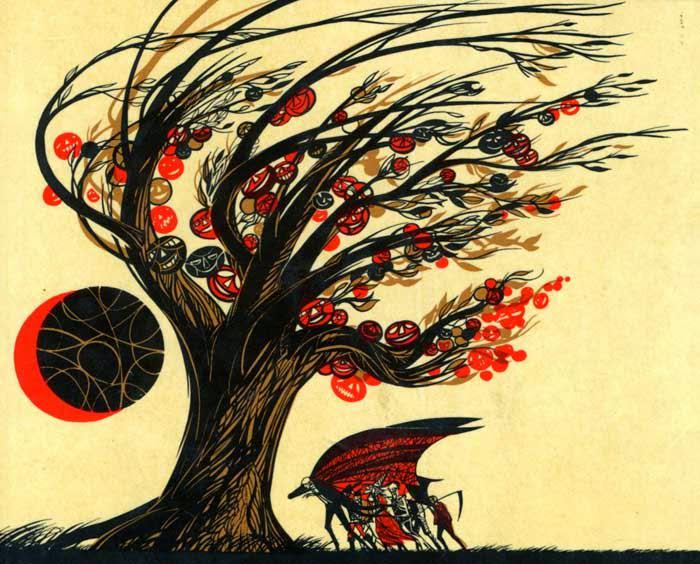
‘The Halloween Tree,’ by Ray Bradbury, 1964

October has long been my favorite month. I love Christmas, too, as well as every other holiday that affords me time to spend with my children. But there’s always been something special about October 31. As a child, I knew Halloween was a night devoted to kids, where magical things happened, where you had a bit of independence to go out with friends and have a grand time. The costumes, the folklore, the changing of the seasons, all add warmth and wonder to this grand day. My own children have enabled me to experience these feelings again. It is so fun enjoying the fall with them: decorating the house, creating costumes, getting ready. The anticipation of it, the colors and sounds and stories, are almost better than the day itself.

The stories are the things that really animate it for me. The list of writers I admire in this season is almost endless, but it begins somewhere around Shakespeare and continues into the present. Shelley, Poe, Hawthorne, Stoker, Lovecraft, Jackson, Bradbury—my list goes on and on. The only thing that stops me from reading all these authors constantly is lack of time.

This October, time permitting, I intend to have a project on this blog, where I write some thoughts about some of my very favorite tales in the genre. I can’t promise I’ll do so every day, though that is the goal. Certainly, I’ll do a post weekly, or every couple of days. These posts aren’t meant to be comprehensive, scholarly, or to offer some kind of profound critique. It’s mostly just for me, to write up thoughts and impressions and appreciation of these tales that affected me: why I like them so much, how they work, why I have such affection for them, in that vein. Hopefully I’ll add to the catalog throughout the year, with other seasonal tales. Maybe some readers out there feel the same way about some of these stories. My hope is to document some of my very favorite books and stories, and perhaps turn some readers out there onto some tales they may have overlooked, or never heard of. There are a great number of unappreciated stories out there that ought to have more attention, in my view.

So, I’ll see how it goes. If you’re a like minded reader, I hope you join in the fun by commenting or offering your own thoughts.

I’ll probably begin early, before October 1, with some other seasonal type stories to get started. I’ll throw in some children’s stories that I’ve been reading with my family as well.

I’ll post more soon. I hope those reading this enjoy the season. I plan to be outside as much as possible in the next six weeks, to enjoy the beauty of fall, before it gets too cold and the leaves are gone.

Happy Autumnal equinox. Enjoy your fall!

New Project

Here’s the start of something I’ve been working on for awhile. It was supposed to be out this fall, but my plans fell through, and I’ve been looking for a new publisher.

This one is a dark fantasy/comedy about a neighborhood gone bad. Think ‘The ‘Burbs’ meets Haunting of Hill House, with a touch of Something Wicked This Way Comes. I’ll be sharing chapters of it here in the coming weeks.

If you enjoyed what you read, please comment and let me know, and share it.

And Happy Solstice!

Happy Halloween!

It’s my favorite day of the year! Here’s a seasonal story I published a couple of years ago, called “The All Hallows Knight,” in which a young boy tries to revive the spirit of the dead, and gets more than he expected. Happy All Hallows Eve, one and all. https://issuu.com/theparagonjournal/docs/final_version_tales_of_reverie/10

Art is by Joseph Mugnaini, who did many wonderful illustrations for Ray Bradbury’s work. This one is from The Halloween Tree, first published in 1972.