Talisman: The Chaotic Neutral Boardgame

I started playing Talisman in the late 1980s, when the second edition was widely available at gaming shops across the land. My friend had a copy of it, as well as all the expansions, and between sessions of Paranoia, Dungeons and Dragons, Car Wars, or Tales From the Floating Vagabond, we played Talisman. It’s quicker than an RPG campaign, but has a great fantasy theme to it, and an epic feel that always kept us entertained for hours of play.

As teens, my friends and I had a hard time getting together every week to play RPGs, but the great thing about Talisman was that you could choose a ready made character and get adventuring right away—there’s no lengthy campaign and if some of us couldn’t make it, we could play anyway, without a well thought out campaign getting messed up.

In Talisman, you draw cards, attempt to level up, and move across the land until you are powerful enough to challenge the center region of the board. If you try this too soon, you’re liable to be quickly destroyed, so a lot of the game tends to be adventuring and trying to kill monsters and increase your strength or magical ability. The title of the game refers to the magical object you need to enter the final space on the board, ‘The Crown of Command,’ where you can cast the command spell and kill everyone else on the board.

The game encourages you to backstab and attack your friends, which is part of the fun, as long as everyone has a sense of humor about it. (I learned through experience that not everyone does.) Most of the fun was messing around, joking about whatever werewolf or dragon or ghoul you had to fight, losing your gold, losing lives, and generally just roaming the board, trying to improve your stats. Some people find this boring, but my group of friends loved it. It was perfect for us, and would always become a lengthy game of improv, with the knight making dramatic pronouncements as he attempted to banish an evil spirit, or a troll grunting his way through combat with a giant spider. We’d feign outrage and hurt feelings as our friends attacked us, stole our gold, or assassinated us. As soon as we could we’d try to even the score and level up. Some of our friends only played once, as they took it more seriously and didn’t enjoy the verbal sparring, but I could never understand why. If you’re an adventuring warrior, you must expect some chicanery now and then.
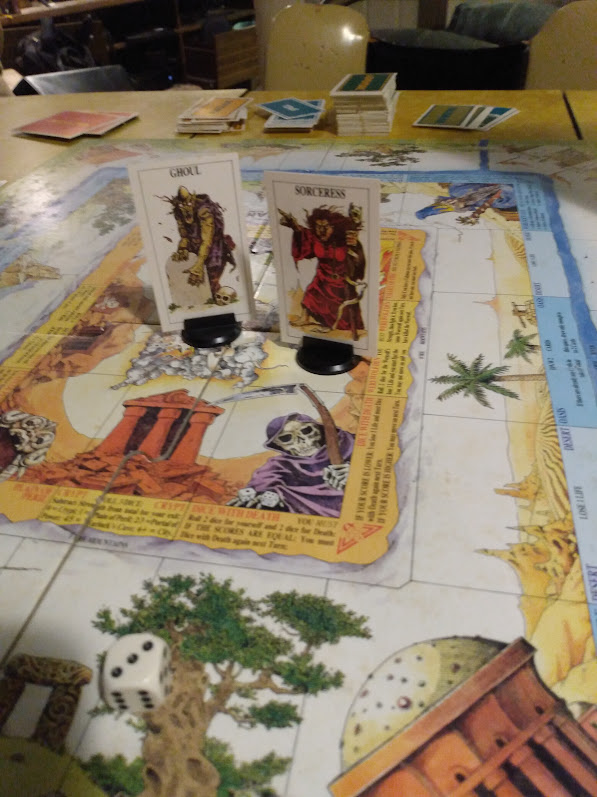
I absolutely loved this game, and had a million laughs in many, many hours of play with my friends. We continued playing it in college, but as time went on and friends moved away, our group stopped gathering, and that, as they say, was that. After college we all had jobs and too much to do to spend an entire Saturday goofing around in taverns and trying to fight monsters. Some years later, I asked my friend what happened to his game, but it was long gone, likely cleaned out of the attic by his mom.

I always found time to play other games, and have had copies of Catan, and others hanging around for years. Occasionally I’d play a one off rpg with friends. When I saw that Fantasy Flight had done a 4th edition of Talisman, I immediately got it, and played it often with friends and family. Some of my old group enjoyed it for nostalgia’s sake, and it still has a wonderful fantasy theme to it. To be honest, the 4th edition is a fantastic game, probably more involved and better than the one I played in the 80s.

Even so, there was something I missed about that Games Workshop edition. I wanted to have it, loved the art, and it had imprinted on me at such a young age that I was overcome with nostalgia whenever I saw an image of it. Alas, copies of it went for hundreds of dollars.

Today, we live in a golden age of boardgames. There are a great many good ones, award winning wargames and eurogames and cooperative ones and everything in between. I’ve become something of a collector of games and play them as often as possible with my children. I’m particularly fond of Tolkien themed boardgames; there were only a few of these back in the day, and now they are everywhere, and they’re all great.

Yet even as I acknowledge that these newer games are more sophisticated, I miss the simpler games of my youth, the ones that have a short rulebook, some evocative fantasy art, some simple mechanics, that allow a lot of free reign to just mess around with your friends. I really enjoy plenty of current games, but I truly love the ones I played as a boy.

There’s something to be said for a simple hack and slash fantasy experience, a real meat grinder of a game that encourages reckless aggression and where a bad roll of the dice can kill your character off forever. It’s funnier this way, more chaotic but just as enjoyable to me, or more so, than a game that rewards careful, smart strategic play.
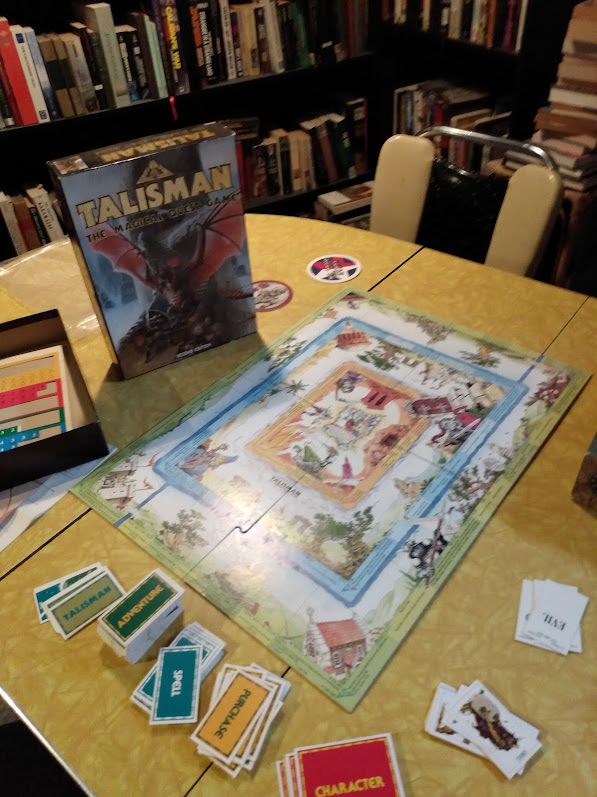
Let’s say you’ve played a conservative game and outmaneuvered your friends. Guess what, Einstein? You just rolled a one. You’re dead, and you have only two lives left. Next turn, you roll a one again. Now you lose all your possessions and become a toad for three turns. On his next turn, your best friend comes and steals everything you worked for and then squashes you. Back to the drawing board, genius. You’re done. It’s hilarious. I love it.

You may also find yourself in the lead for the entire game, only to have some bad rolls in the end and lose to your friend who had been running so far behind the entire game you forgot she was even playing.

As board games go, Talisman is chaotic neutral, the funniest and greatest alignment you could possibly have. It’s unreliable, irritating sometimes, kind and generous one moment and brutally vicious the next. Kind of like life.

And so, of course, in my middle age, I could not resist getting a copy of the second edition. Some poor soul out on ebay parted with this beauty for a reasonable price and made me very happy. I can’t wait to get the old gang together so we can share some laughs and maybe a dagger in the back.

Paths of Glory

This World War I game from GMT is probably the most involved, epic wargame I have ever played. Like other games from GMT, this is big on strategy and history, and rewards thoughtful, careful gameplay. Pick your side: The Allies, or the Central Powers.

The game begins in August 1914, and each turn takes one season. Each side receives six turns in this season, in which they can use one of seven cards in their hands to move troops, reinforce, attack, or play other historical events that help their cause. Each side is trying to raise their Victory Point threshold high enough to end the game, before either time runs out in 1918, or an armistice is reached, giving victory with the side who has a better VP total.

I won’t lie–the rule book for this game is a bit daunting when you open the box. It’s thick, with lots of detail. But my eleven year old son read it and was conversant with the rules and eager to play. So it’s not too complicated for someone who plays a lot of Axis and Allies, for example, but it will require some effort, time, and a love of history to enjoy.

I found this game to be a really engaging way to learn some things about the first World War. As my son said, “I feel like I am re-living history, with alternate outcomes for a lot of these battles.” Granted, my son is a history buff who loves to read, but to me that is a high compliment indeed for any game.

After around 12 rounds, or three years, we found ourselves in almost exactly the same VP totals as when the war started. It’s not easy to pull ahead in this–armies get entrenched and are hard to defeat. We fought for years on the European front, with neither side scoring a decisive victory until we neared the game’s final act, when the US entered the war and the allies defeated the Germans. It was quite a mirror of the actual war, with many lives lost even while there was almost no movement in the trenches.

I give this game my highest recommendation. It was clearly made with a lot of care and attention to detail. It takes some time to learn how to play–we had it set up over multiple weekends, and only finished our first full game after probably 8-10 hours of play–but it’s worth it. The board is beautifully produced, the rules are clear, and the sense of history is quite strong as you play. If you’re a history buff or a wargamer, this is a great game, well worth buying and playing. It isn’t cheap; you can find a copy for around $80. GMT sometimes runs sales on their site, which is a good way to pick this one up.

Memoir ’44

We are heading into winter, perhaps the best time of year for board games!

My 11 year old is crazy about tabletop games, and World War Two games in particular. He really loves games with minis, so we have tried a number of those in many genres, but one of his very favorites for years now has been Axis and Allies. The only problem with that game is its epic length. It can take a long time just to set it up, and the game itself can take several sessions of a couple hours, over several days.

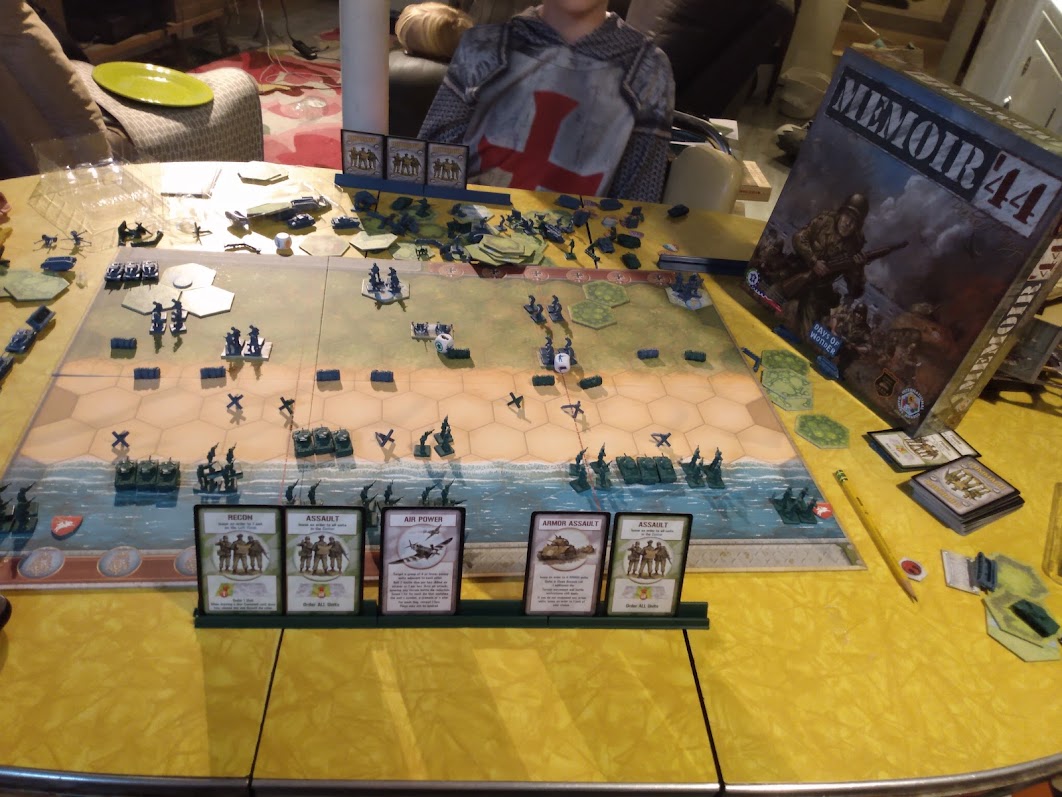
Enter Memoir ’44. Made by Days of Wonder, this game includes 15 different scenarios from D-Day. It’s a card based game with lots of die rolls, and beautifully produced miniatures. We’ve played four of the scenarios so far, and each of them took only around a half hour to complete. It’s lively and fun and if you enjoy wargames but don’t have three or four hours to play one, I would strongly recommend this game. You’ll probably like it so much that you’ll end up playing more than one scenario in a session, anyway.

The game is played in turns during which a player activates a card, which allows them to move troops on one or more sections of the board. You can then engage the enemy by rolling dice, subtracting points for various obstacles like trees, bunkers, barbed wire, and so forth.

I really loved playing this one with my son, and he has enjoyed it immensely as well. It makes great gift, and won’t break the bank– I got a copy of it for around $50. There is enough variety to make each scenario feel quite different; Days of Wonder has also created many different expansions, so if you enjoy this one and play all fifteen scenarios enough that you want more variety, you will never run out of more to play if you’re so inclined. There are also expansions that allow up to eight players, which sounds like it would be lots of fun.

I’d rate this one five out of five stars. So much fun to play, and beautifully designed.

Star Wars: Rebellion

A long time ago in a galaxy far, far away…

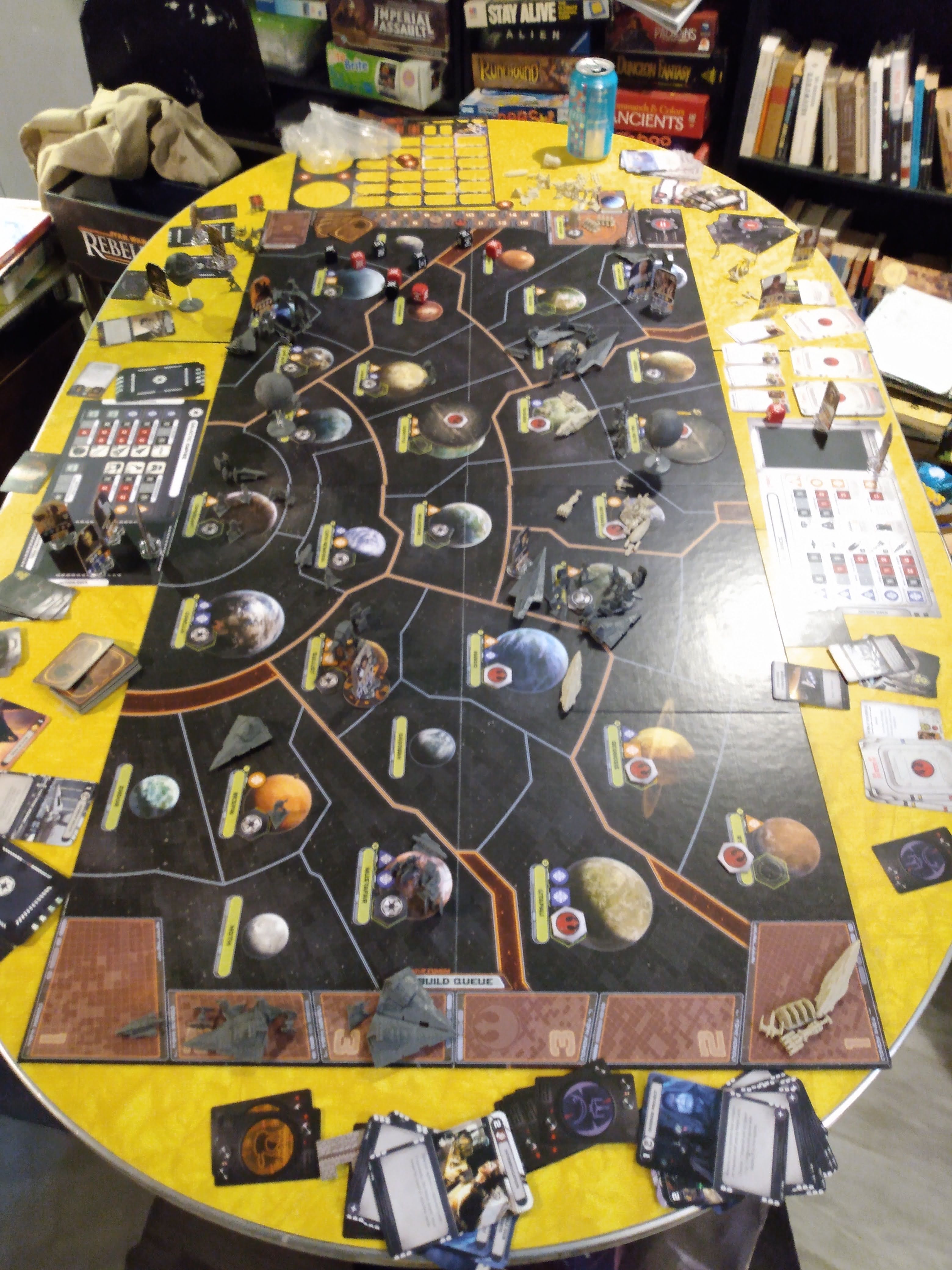
There was an endless appetite for games based on our favorite heroes and villains. Star Wars Rebellion, I am happy to report, is one of the very best of the bunch. Made by Fantasy Flight Games, it has their usual high quality minis, a beautiful board with numerous planets and systems, and lots of cards and markers and characters. It’s for 2-4 players, though I have only played the two player version. One side plays the rebels, the other is the dark side.

Rebellion is varied enough and features enough twists and turns that I think it has a high level of replayability. My 10 year old and I have played it 6 or seven times since we got it, and it’s always been fun and surprising. Essentially, the rebel player has a hidden base that the empire is trying to find. If the rebels can stave off the superior firepower of the empire and hang on for enough turns, while increasing their sympathy throughout the galaxy, they’ll win. But the moment the empire finds the rebel base, it’s over for the rebels. Each time we’ve played, both of us had a chance to win by the final round, making for an exciting and unexpected end with each game.

Each player has special attributes and cards to help them win; the rebels, for example, are aided by cards that allow them to change the location of the base, should the empire draw near. Other cards will allow sabotage, and to increase your reach through the galaxy. The rebels will gain victory points through a series of objective cards that award points when completed. The empire, meanwhile, has far superior numbers and brutal planet destroying weapons like the Death Star, making them hard to beat.

The character cards are also well designed. Each of the rebel characters have special skills and powers that allow them to succeed at basic missions, like gaining loyalty in systems, establishing weapons production, or conducting raids on the empire. The empire characters have similar skills, and are able to corrupt the rebels, destroy them with the death star, or otherwise ruin their chances to win. For example, in one very funny moment in our game, Obi Wan was turned to the dark side, which is rather hard to envision if you’re a fan of the old films, like me.

There are plenty of opportunities for battles, and that’s a lot of the fun of this game. You can move into systems and attack with your fleet of finely constructed X-Wings, Tie-Fighters, Star Destroyers and ground forces. You’re aided in battle by the leaders you’ve chosen and special cards that you draw through each round of combat. Nothing hurts so badly as building up a legion of rebel troops only to have them wiped out by Stormtroopers and AT-ATs (take it from me.)

This game is not cheap–the price runs around $90, but if you’re a fan of strategic war games, and of Star Wars, and you think you’ll have time to play this one, I’d say go ahead and buy it. It’s a lengthy game, often taking a few sessions of an hour or two each (or most of a day, if you’re able) to complete. I have found it a great way to spend time with my son, who has delighted in beating me a number of times.

Rebellion is pretty true to the spirit of the films. I love it, and recommend it highly, rating it five out of five stars. Maybe six out of five if you’re a star wars fans into miniatures and epic boardgames.

Axis & Allies & Zombies

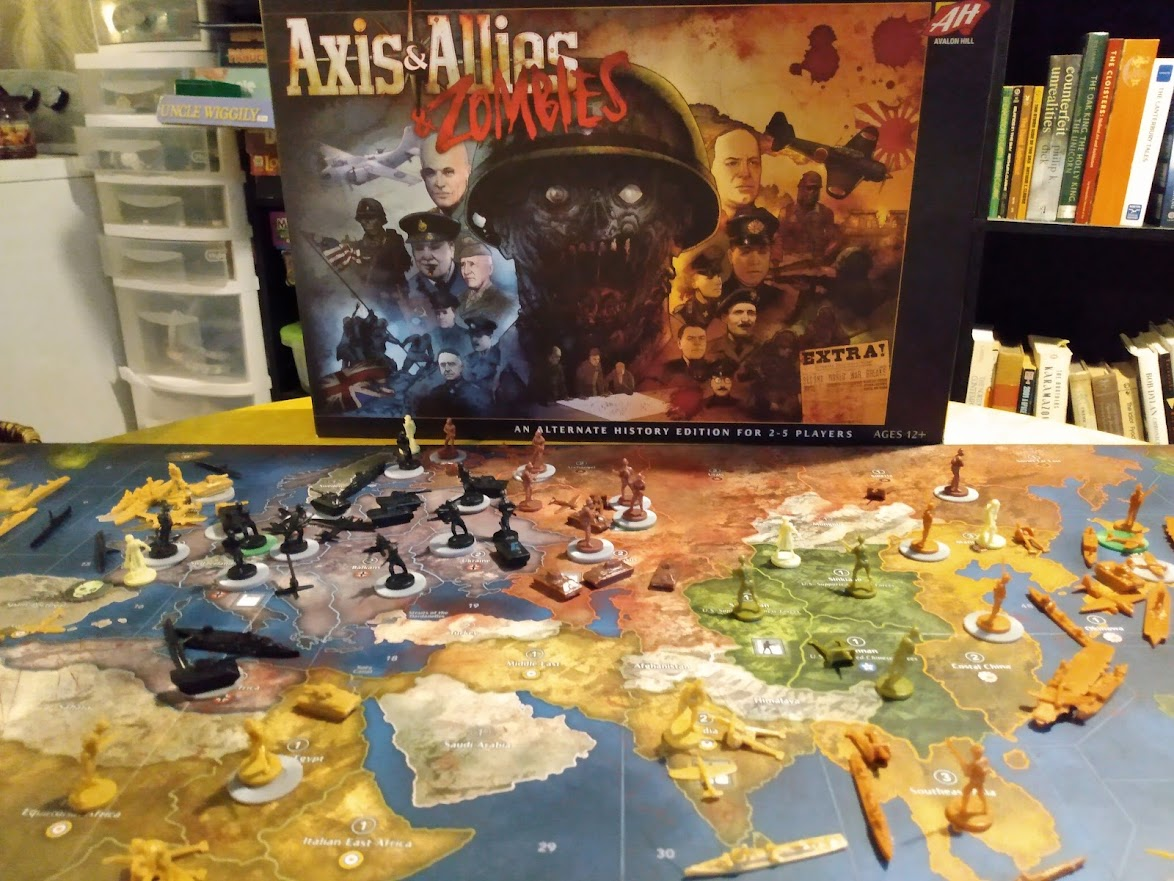
As if World War II needed some extra violence and mayhem, Avalon Hill added zombies to their classic game. It’s for two to five players, controlling one of the same powers as the original game, with the wild card of zombies for good measure.

I’ve been playing the original version of this game for many years; I find it a fun, lengthy wargame and my 10 year old son enjoys it very much. He could see after a few games, and after playing some more recent kinds of wargames, that the combat mechanics, while involved, are fairly standard, and when he saw this version with monsters in it he wanted it badly.

We’ve played it a number of times now, and it is always fun. The story is that some sort of noxious smoke, unleashed by a Nazi archaeological dig, circulates around the globe creating zombies. The zombies can end up overtaking you before your opponent, which can be funny. You draw a zombie card before your turn, and add a zombie to a territory. You also have a chance to drive them out of your territories, but beware! If you lose, your soldiers end up zombified, which can be disastrous for your chances to win, even while being quite hilarious. You also have a chance to roll for tech advances that will help you fight the zombies, similar to your ability to advance your technology in the original game. Who doesn’t want a chainsaw tank or zombie mind control ray in their arsenal? No one, that’s who.

The pieces are high quality, and in line with what you would expect from an Axis & Allies game. It’s a worthy addition to this series. I have been thinking of picking up one of the other versions of the game, as there are now editions focused on WWI, the Pacific theater, and so on. But two games of this sort are enough for now. One of the fun things about these enormous wargames is the epic feel of them. It can sometimes take numerous sessions over several days to finish. We have a number of these types of big games in our collection, and adding to that seems unwise. The most disastrous thing that has happened while playing one of these occurred when our cat, in her nocturnal roamings, destroyed a game of War of the Ring after two solid days of play. We tried to soldier on, but the feline monster won the day.

If you like Axis and Allies, I’d rate this one 4.5 out of 5 stars. Highly recommended!

One Roll Quest!

In our family travels this summer, I brought along some quick, portable games to play with my eight and ten year old. A couple of them were real hits with the kids that we will continue to play.

One Roll Quest plays just like it sounds. There’s a big clear die with 5 tiny colored die inside. You roll it, and that roll immediately determines whether you live or die, gain fame and fortune or experience points. The inner, colored dice determine some more specific consequences for your character–i.e. Everyone gains fame and fortune, except you–you die! It’s a very fast paced and funny game that my kids and I played numerous times. We also played One Roll Chronicles, which is a book with a brief story, in which you start out drinking in a tavern (like all good adventurers) and wind up, of course, looking for fame and glory. I’d rate this one 10 out of five stars for the number of laughs we had over it. It even includes some one off jokes like ‘One roll pizza,’ in which the die roll determines what pie you’ll order and which toppings. (we ended up with pepperoni and cheese, but my daughter cheated). 🙂

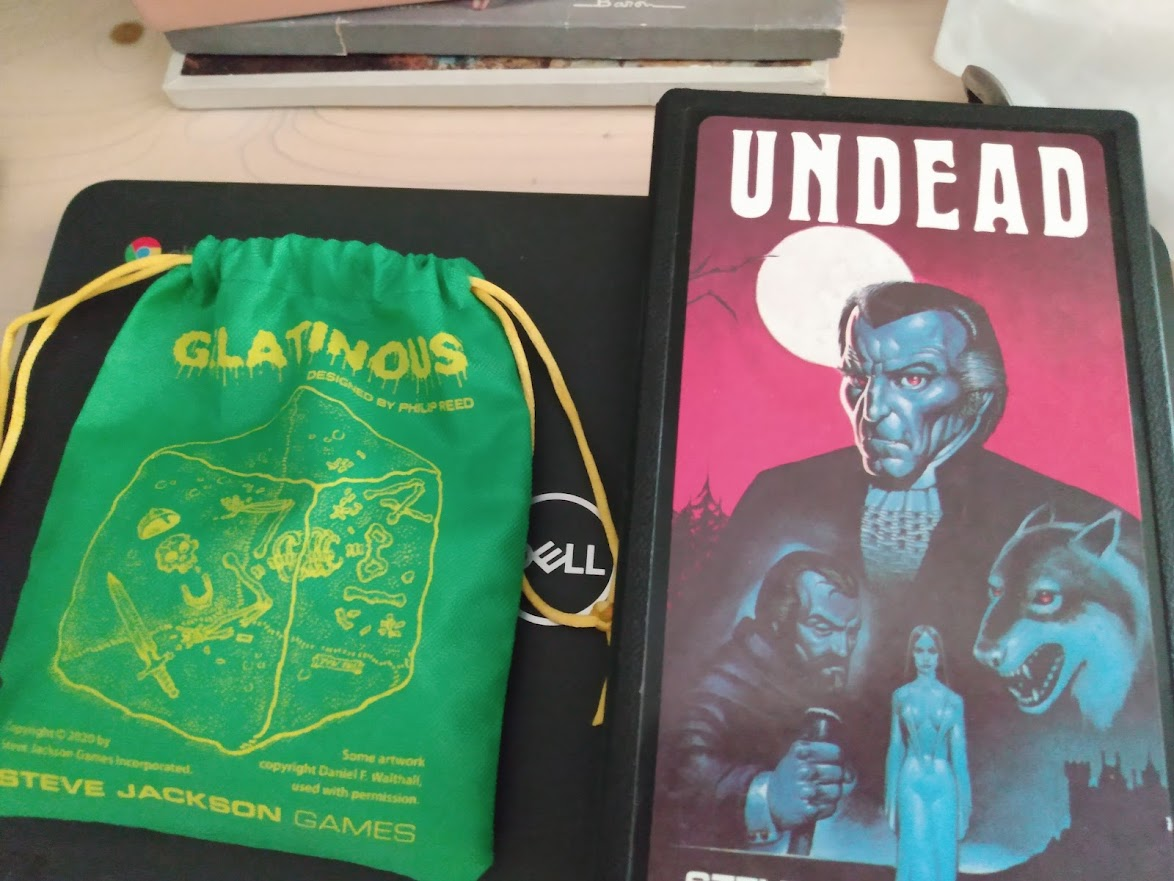
“Gelatinous” is another humorous dice game from Steve Jackson, in which each player gets 7 dice and tries to roll enough threes to create a gelatinous cube to win. Everyone can also lose and get eaten by a cube, which is a very amusing way to end this game. My kids found this one fun, as well.

We also played Catan dice, a shortened version of the game, in which all the dice have different resources on them, and you roll to create towns, cities, and roads. This was another fun and fast paced game, though it was less funny that the first two.

Finally, on a rainy day during our vacation, we played ‘Undead,’ a pocket box from Steve Jackson Games. This is a fun one, a bit more complicated than the others that will take an hour or two to complete. One player controls vampire hunters, the other is Dracula, and there is an option for a GM. It takes place in London in 1890, and is a hidden movement game that we found fun and thematically pleasing.

You can’t go wrong with any of these games. Steve Jackson Games has always done a great job with affordable, light games like these, and they keep creating great new ones all the time. I highly recommend supporting their kickstarters, or just checking out one of their many pocket or travel games if you’re looking for something to take with you on your vacation. They also make great diversions on game night with your friends.

Our trip was fun, as well. But games make everything better.