In the opening of my new story, we met the denizens of Dogwood Street, a suburban neighborhood, including:
Billy Joe, a drunken reprobate
Simon, a professor
Rex, a strange newcomer who has moved into an abandoned house
Rex has arrived in the midst of Billy Joe’s noisy, drunken stupor, and put an end to it. In the next part of the story, the conflict is ramped up…read on!
Here’s the start of something I’ve been working on for awhile. It was supposed to be out this fall, but my plans fell through, and I’ve been looking for a new publisher.
This one is a dark fantasy/comedy about a neighborhood gone bad. Think ‘The ‘Burbs’ meets Haunting of Hill House, with a touch of Something Wicked This Way Comes. I’ll be sharing chapters of it here in the coming weeks.
If you enjoyed what you read, please comment and let me know, and share it.
If you’d told me when I was twelve that we’d have endless new sci fi/superhero/fantasy movies and shows every single week, I would’ve been ecstatic. But alas, since I’m fifty and no longer twelve, I’m totally disinterested in most of it. Partly this is because I’m no longer a child, but it’s also because I enjoy new and different stories, and none of these gigantic intellectual properties do that. They just make the same exact stories over and over.
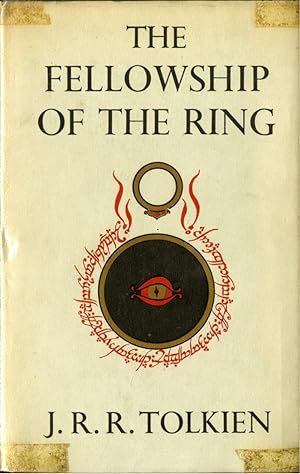
A long time ago, in a galaxy far, far away, George Lucas created something special that felt fresh. Comic books did that also, and some still do. Tolkien created a genre that has been well mined for generations. Other writers have done and continue to do this, and some films do as well. But most of the large properties simply make the same thing with slightly different characters or timelines. It obviously sells and many people love it. It doesn’t interest me, though– new and interesting stories do. But these famous, valuable names are like real estate snatched up by greedy developers.
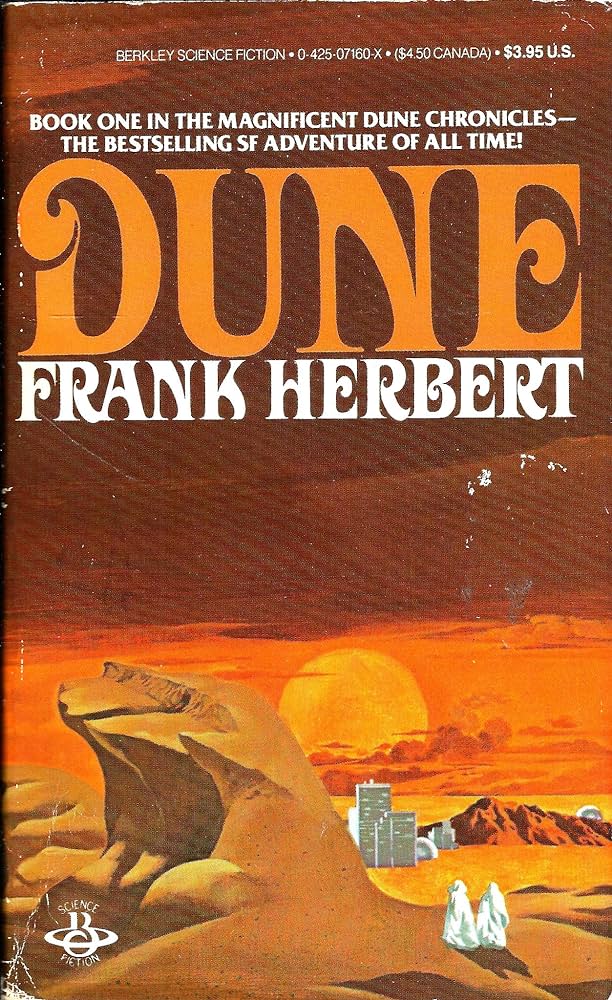
At times, older fans can get prickly about newer things. I’ve felt that way as well, mainly because the experience of reading an amazing novel can never be matched by any movie, no matter how well done. As George RR Martin recently commented, very rarely does a great book get a truly worthy interpretation, but when it happens it’s quite amazing. Dune managed it, in my opinion, and Jackson’s Lord of the Rings did, as well. But more often they just leave you cold.
Don’t adapt this, son. Don’t even try.
Most of these newer films are not made for middle aged guys, so I just accept that it isn’t for me, and go back to the books. But I admit, and as Martin said, I find the arrogance of some of these adaptations hard to believe. Luckily I will always have my bookshelves.
“Once men turned their thinking over to machines in the hope that this would set them free. But that only permitted other men with machines to enslave them.” –Frank Herbert, DUNE
The new Dune film is amazing, far better than anything that fans of the book had any right to expect. I loved it. I started rereading the book as soon as I got home; I read the above quote and had to put the book down for a moment. Frank Herbert wrote that in 1965–probably quite a bit earlier, as ’65 is the publication date. What a visionary.
The film changed a few things, but that’s to be expected in a work of this size and scope; it would be impossible to adhere to everything Herbert wrote. At some point I may write up some further thoughts. But suffice to say it was great and left me speechless. Once I finish the first book, I’ll probably continue with the others, too. I loved the first three books in the cycle and enjoyed the next three as well, though I felt they weren’t at the same level of quality as the first two or three.
A good friend of mine also recommended the many sequels written by Brian Herbert and Kevin Anderson, so I may go down that Golden Path, as well.
I’m really in awe of Denis Villenueve and the whole cast of this movie, particularly Javier Bardem, who I felt carried much of the film as Stilgar. We’re lucky that a director as good as Villenueve was able to make this. In my opinion, this achievement is as great as Peter Jackson and Lord of the Rings, and will be remembered for a long time.
“The Wheel of Time turns, and ages come and pass, leaving memories that become legend. Legend fades to myth, and even myth is long forgotten when the Age that gave it birth comes again. In one Age, called the Third Age by some, an Age yet to come, an Age long past, a wind rose in the Mountains of Mist. The wind was not the beginning. There are neither beginnings nor endings to the turning of the Wheel of time. But it was a beginning.” ― Robert Jordan, The Eye of the World
So begins Robert Jordan’s fourteen-book, 4.4 million word saga, The Wheel of Time, a tale which has sold over ninety million copies since the first novel in the series was published in 1990.
Some three decades ago, or an age ago, in Wheel terms, when I was in high school and college, I happily devoured the first four books in Robert Jordan’s high fantasy series. It hit me at exactly the right time; I had recently read The Lord of the Rings and was constantly on the lookout for more epic fantasy. Jordan’s story fit the bill, and I enjoyed every minute I spent in his world.
As the series went on, I became disappointed with the next two or three books and eventually gave up on them. For me, what started out as an excellent fantasy adventure tale that was heading in a satisfying, if not entirely original direction became bogged down with an unwieldy plot and too many characters. Each new installment of the series introduced more plot elements, settings and people until I stopped seeing the heroes like Rand, Moiraine, Perrin, Egwene, Matt and the rest of the cast of characters that had started out on such a promising adventure in The Eye of the World.
My friends who were fantasy aficionados felt the same way. By the time the later installments of the books came out, I had moved on and lost interest. There were always plenty of other books to read, and other fantasy worlds to explore by writers like Tad Williams, Ursula LeGuin, and many others I was busy discovering. When new Jordan books arrived, I was interested in them but not tempted enough to buy and read them. I’d already spent thousands of pages with The Wheel of Time, and it seemed there was no end in sight.
When I saw that amazon was adapting the Wheel of Time, I thought it might be a good chance for them to tighten up this story a bit, maybe streamline things and tell a rousing tale. I watched season one with great hope but did not really enjoy it. However, I did go back to read The Eye of the World and The Great Hunt, books one and two of the series.
I’m happy to say that after thirty years, these first two installments hold up well. I had forgotten most of the plot over three decades, but I very much enjoyed Jordan’s setup in the Shire-like Two Rivers, the flight from the Myrddraal and the Trollocs, and the slow unveiling of the truth of Rand’s destiny. The magic system is well developed: female wizards wield a magical force called The One Power and must train for years to do it. The philosophical underpinnings of the Wheel, where the world is in a continuous cycle of history, were a fun innovation for the fantasy genre that gave the setting plenty of depth, to my mind.
For me, some of this story aged less well, specifically the adolescent romantic longings of the main characters. I guess I was ok with this kind of thing when I was a teen and in my early twenties, but such doe-eyed yearning was not exactly to my taste this time around. But I let it go, because the story is fun and engaging enough to keep me interested.
What I also found striking in my re-read was the all-female wizardry of the Aes Sedai. They are a powerful order, akin to the Bene Gesserit of Dune. The political maneuverings of their different classes allow for plenty of intrigue and some great plot twists. The idea that men have tainted the One Power is also reminiscent of LeGuin’s Earthsea books.
I could do with less of Jordan’s at times florid descriptions of how gorgeous and powerful some of these women are, though–he lays it on thick at times. In The Great Hunt there is a sequence where some evil women of the Seanchan, an invading army, have leashed and enslaved Aes Sedai and other women who can wield the One Power. I’m not sure the story needed this sadistic plot point, but I guess Jordan had his reasons.
Clearly, plenty of readers disagree with my criticisms, and loved the entire cycle, including the final three books, finished posthumously by the amazingly prolific Brandon Sanderson. It’s sad that Jordan didn’t live to finish the series, but it seems he had a good steward to bring to to its conclusion.
I enjoyed re-reading these two books very much, partly for nostalgia’s sake, but also because they’re a lot of fun. The Great Hunt has a particularly stirring climax, where Rand and his friends face impossible odds as they pursue an ancient, magical horn that will call back legendary heroes of a past age. There are some engaging action sequences with high stakes for everyone involved. Rand, who now knows he is The Dragon Reborn, the great hero on which the hope of the world rests, must fight a demonic being to save his friends. The different creatures and races in the book are also quite well described and evocative. Some of the nightmarish dream sequences, in which Rand and his friends face their darkest fears, brought on by the evil beings that are hunting them down, are well told and gripping. Like Herbert and Tolkien, Jordan took a lot of care in creating these alien societies, and they’re quite detailed and consistent. Jordan had a lot of panache in telling these stories, and it’s easy to see why so many fans stuck with him. Maybe I’ll make it all the way through to the end, this time.
It does seem clear by the end of book two, though, the direction in which this story is moving, so I’m unsure why this series could not have reached a perfectly satisfying conclusion in three or four books. That’s just one reader’s opinion, and others have felt differently, but with so many other good books to read, I can’t say with certainty that I’ll read the other twelve books in this series. Maybe this summer I’ll dive back in for The Dragon Reborn.
I started playing Talisman in the late 1980s, when the second edition was widely available at gaming shops across the land. My friend had a copy of it, as well as all the expansions, and between sessions of Paranoia, Dungeons and Dragons, Car Wars, or Tales From the Floating Vagabond, we played Talisman. It’s quicker than an RPG campaign, but has a great fantasy theme to it, and an epic feel that always kept us entertained for hours of play.
As teens, my friends and I had a hard time getting together every week to play RPGs, but the great thing about Talisman was that you could choose a ready made character and get adventuring right away—there’s no lengthy campaign and if some of us couldn’t make it, we could play anyway, without a well thought out campaign getting messed up.
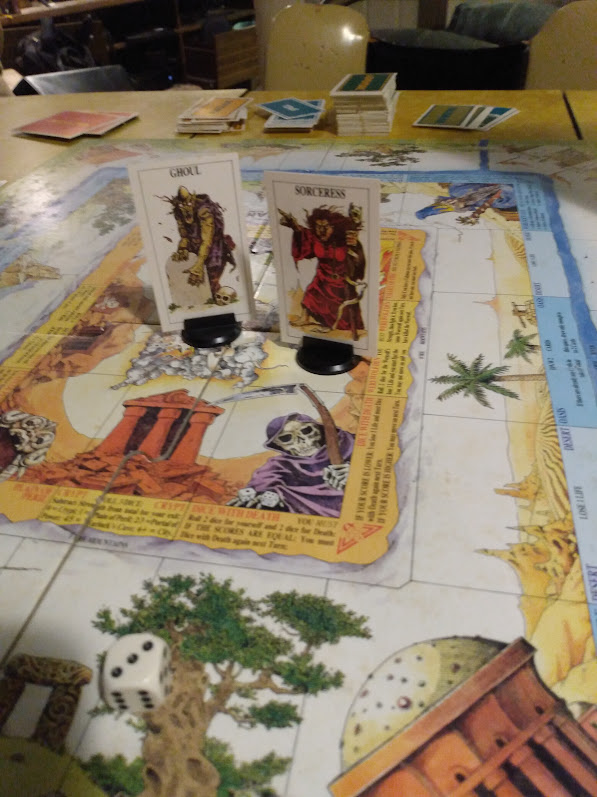
In Talisman, you draw cards, attempt to level up, and move across the land until you are powerful enough to challenge the center region of the board. If you try this too soon, you’re liable to be quickly destroyed, so a lot of the game tends to be adventuring and trying to kill monsters and increase your strength or magical ability. The title of the game refers to the magical object you need to enter the final space on the board, ‘The Crown of Command,’ where you can cast the command spell and kill everyone else on the board.
The game encourages you to backstab and attack your friends, which is part of the fun, as long as everyone has a sense of humor about it. (I learned through experience that not everyone does.) Most of the fun was messing around, joking about whatever werewolf or dragon or ghoul you had to fight, losing your gold, losing lives, and generally just roaming the board, trying to improve your stats. Some people find this boring, but my group of friends loved it. It was perfect for us, and would always become a lengthy game of improv, with the knight making dramatic pronouncements as he attempted to banish an evil spirit, or a troll grunting his way through combat with a giant spider. We’d feign outrage and hurt feelings as our friends attacked us, stole our gold, or assassinated us. As soon as we could we’d try to even the score and level up. Some of our friends only played once, as they took it more seriously and didn’t enjoy the verbal sparring, but I could never understand why. If you’re an adventuring warrior, you must expect some chicanery now and then.
I absolutely loved this game, and had a million laughs in many, many hours of play with my friends. We continued playing it in college, but as time went on and friends moved away, our group stopped gathering, and that, as they say, was that. After college we all had jobs and too much to do to spend an entire Saturday goofing around in taverns and trying to fight monsters. Some years later, I asked my friend what happened to his game, but it was long gone, likely cleaned out of the attic by his mom.
I always found time to play other games, and have had copies of Catan, and others hanging around for years. Occasionally I’d play a one off rpg with friends. When I saw that Fantasy Flight had done a 4th edition of Talisman, I immediately got it, and played it often with friends and family. Some of my old group enjoyed it for nostalgia’s sake, and it still has a wonderful fantasy theme to it. To be honest, the 4th edition is a fantastic game, probably more involved and better than the one I played in the 80s.
Even so, there was something I missed about that Games Workshop edition. I wanted to have it, loved the art, and it had imprinted on me at such a young age that I was overcome with nostalgia whenever I saw an image of it. Alas, copies of it went for hundreds of dollars.
Today, we live in a golden age of boardgames. There are a great many good ones, award winning wargames and eurogames and cooperative ones and everything in between. I’ve become something of a collector of games and play them as often as possible with my children. I’m particularly fond of Tolkien themed boardgames; there were only a few of these back in the day, and now they are everywhere, and they’re all great.
Yet even as I acknowledge that these newer games are more sophisticated, I miss the simpler games of my youth, the ones that have a short rulebook, some evocative fantasy art, some simple mechanics, that allow a lot of free reign to just mess around with your friends. I really enjoy plenty of current games, but I truly love the ones I played as a boy.
There’s something to be said for a simple hack and slash fantasy experience, a real meat grinder of a game that encourages reckless aggression and where a bad roll of the dice can kill your character off forever. It’s funnier this way, more chaotic but just as enjoyable to me, or more so, than a game that rewards careful, smart strategic play.
Let’s say you’ve played a conservative game and outmaneuvered your friends. Guess what, Einstein? You just rolled a one. You’re dead, and you have only two lives left. Next turn, you roll a one again. Now you lose all your possessions and become a toad for three turns. On his next turn, your best friend comes and steals everything you worked for and then squashes you. Back to the drawing board, genius. You’re done. It’s hilarious. I love it.
You may also find yourself in the lead for the entire game, only to have some bad rolls in the end and lose to your friend who had been running so far behind the entire game you forgot she was even playing.
As board games go, Talisman is chaotic neutral, the funniest and greatest alignment you could possibly have. It’s unreliable, irritating sometimes, kind and generous one moment and brutally vicious the next. Kind of like life.
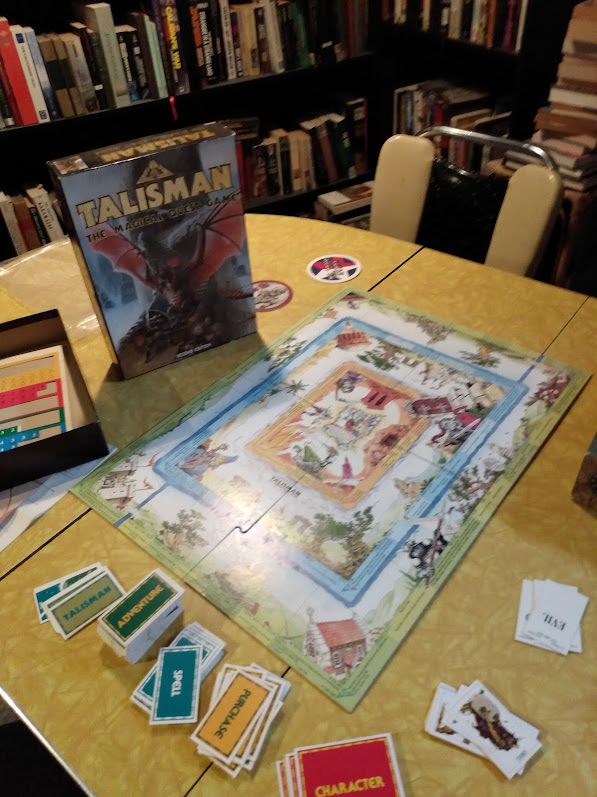
And so, of course, in my middle age, I could not resist getting a copy of the second edition. Some poor soul out on ebay parted with this beauty for a reasonable price and made me very happy. I can’t wait to get the old gang together so we can share some laughs and maybe a dagger in the back.
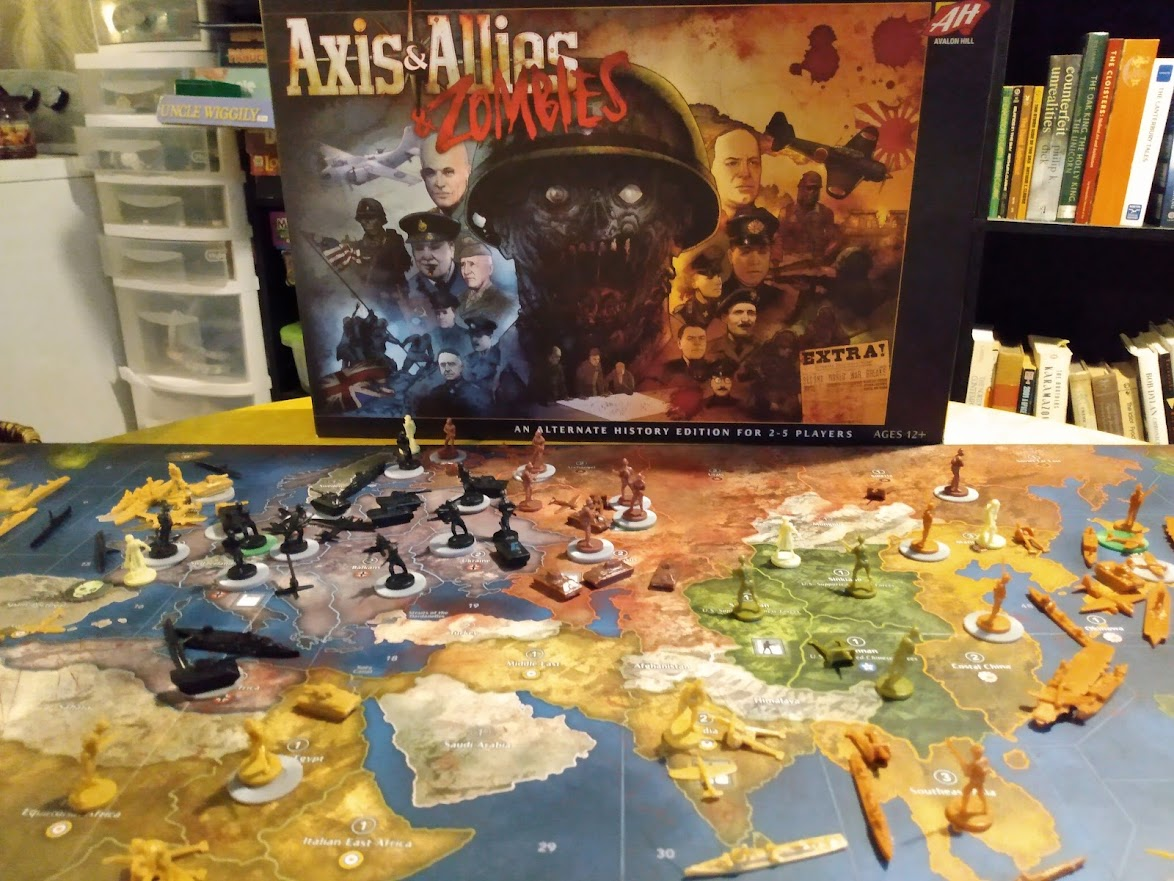
As if World War II needed some extra violence and mayhem, Avalon Hill added zombies to their classic game. It’s for two to five players, controlling one of the same powers as the original game, with the wild card of zombies for good measure.
I’ve been playing the original version of this game for many years; I find it a fun, lengthy wargame and my 10 year old son enjoys it very much. He could see after a few games, and after playing some more recent kinds of wargames, that the combat mechanics, while involved, are fairly standard, and when he saw this version with monsters in it he wanted it badly.
We’ve played it a number of times now, and it is always fun. The story is that some sort of noxious smoke, unleashed by a Nazi archaeological dig, circulates around the globe creating zombies. The zombies can end up overtaking you before your opponent, which can be funny. You draw a zombie card before your turn, and add a zombie to a territory. You also have a chance to drive them out of your territories, but beware! If you lose, your soldiers end up zombified, which can be disastrous for your chances to win, even while being quite hilarious. You also have a chance to roll for tech advances that will help you fight the zombies, similar to your ability to advance your technology in the original game. Who doesn’t want a chainsaw tank or zombie mind control ray in their arsenal? No one, that’s who.
The pieces are high quality, and in line with what you would expect from an Axis & Allies game. It’s a worthy addition to this series. I have been thinking of picking up one of the other versions of the game, as there are now editions focused on WWI, the Pacific theater, and so on. But two games of this sort are enough for now. One of the fun things about these enormous wargames is the epic feel of them. It can sometimes take numerous sessions over several days to finish. We have a number of these types of big games in our collection, and adding to that seems unwise. The most disastrous thing that has happened while playing one of these occurred when our cat, in her nocturnal roamings, destroyed a game of War of the Ring after two solid days of play. We tried to soldier on, but the feline monster won the day.
If you like Axis and Allies, I’d rate this one 4.5 out of 5 stars. Highly recommended!
I’ve been busy preparing a manuscript for release next year; don’t want to give away too much about it, but it will appeal to those who like comedy and spooky stories. It’ll be a great seasonal read for Halloween, and I hope to have the release coincide with that, perhaps late summer.
Think The ‘Burbs meets The Haunting of Hill House. It’s a tale as old as time: Good, Evil, and Home Improvement.
I’ve also been working on a new book, about which I will say even less, since I’m still on draft #1. But it’s humor and fantasy, mixed with some more serious elements.
My hope is that these novels will build on the audience for my first book, The Osprey Man, and appeal to an even wider audience. I learned a lot through the release of my first book, and I hope the rollouts for these forthcoming books will be even better.
By the way, if you’re reading this, but haven’t read The Osprey Man, check out the pinned post on this blog for some reviews. Readers have loved this tale of two youths creating a comic book together, and memorializing their friend. It’s just $15 through my website–contact me for a signed copy. You can also purchase through the publisher for the same price, or get the ebook for just $5.99. It’s great for general readers, or for a young person in your life who loves to read. You can also ask your local library to purchase it; that is a great way to support writers.
I found Kindred to be such an amazing achievement; wonderfully written, creating such a believable, harrowing world. I plan to read the rest of Butler’s novels in due course, but had to let my thoughts on this one simmer for awhile. This isn’t light beach reading or something you pick up to be distracted. It’s considered one of the monumental works of 20th century science fiction, deservedly so.
Dana, an African American writer, is transported back to the antebellum south, and this is where the horror begins. It is hard to do this book justice, but the day to day life of a slave in the American south is described in great and horrifying detail. Dana becomes the protector of young Rufus Weylin, the heir to a plantation, and she later learns that he is one of her ancestors. Dana travels back and forth between the 1820s and 1976, finding that while she has been in the past for several hours, days, or months, she has usually only been gone for comparatively short periods of time in the present.
Slaves on the Weylin plantation are brutalized, raped, and tortured, and yet Weylin’s father, Tom, their master, is considered by the slaves to be mild in comparison to other slave owners. Families are casually torn apart to pay debts, or in some cases just to prove a point. Dana’s account of these atrocities gives the reader an idea of what slave life was like, and the unimaginable horror of just surviving and enduring.
The book is set during the bicentennial, which is when it was written, and this setting is significant, given how much America was celebrating at that time. But this book is a clear reminder of our brutal, racist, genocidal past. It’s something we must reckon with, if we want to make this country more just and fair.
Kindred is a book everyone should read. It’s a landmark of American literature, a brilliantly written and researched novel and a powerful work of literature. The characters are very nuanced and have so much depth to them. The depiction of the slave community, and the brutality they were subjected to, are so moving and heartbreaking. They are faced with unthinkable choices for their survival, and Dana’s struggle to help them and eventually be liberated has echoes of historical slave narratives, as many critics have pointed out. Butler has said in interviews that she wanted “to make people feel history,“ and she succeeded brilliantly.
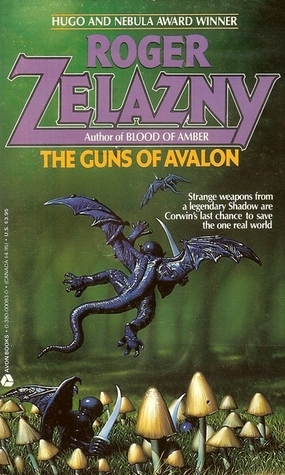
I had said that I’d take a break from Amber after reading the first book in this series, but I couldn’t resist and read The Guns of Avalon next. In this second installment, Corwin’s story gets stranger and his road into the shadow realm more circuitous. There’s plenty of action and intrigue and plot twists to keep readers engaged and guessing until the end.
The way Zelazny imbues the princes of Amber with both godlike and very petty, human characteristics is particularly interesting and satisfying for me. I’ve read plenty of epic fantasy where the heroes are noble and their cause righteous, so it’s fun to read an antihero whose motives are less pure. In this way, Corwin reminds me a bit of that other antihero, Elric. I guess by the 70s there was enough going on in science fiction and fantasy that we got some revolutionary kinds of stories like this that turned the heroic story on its head. Though, it should also be said that the selfish and sometimes cruel behavior of Corwin and his family is very much in line with plenty of Greek, Norse and other mythologies, where gods behave at their own whims, to the detriment of almost everyone around them.
You want Corwin to succeed in his return to Amber–mostly, anyway. Zelazny sets him up in circumstances so dire that it’s hard not to wish him success in his attempted revenge against his brother. But the cost of this revenge is disastrous indeed; the curse he utters threatens to destroy the world he claims to love above everything, so Corwin’s account of his exploits is more than a bit self-serving, in my view. But his story is engaging and worth the journey.
Of course, there are plenty of neat creatures in this book, monsters and concealed demons, treacherous family members and a land itself that is intent on destroying everyone. Zelazny’s use of trump cards that enable the royal family to communicate and teleport, as well as the idea of the pattern itself, that road on which those with royal blood may enhance their power and enter myriad worlds–are what really make this series unique, I think. These concepts, combined with Zelazny’s use of mythology, make the whole story feel like it has some psychic weight to it. I also continue to find his mix of the mythological and the everyday and modern a lot of fun.
This time I think I really may take a break before continuing the saga. There are so many great things to read, and so little time.








 Christopher Tuthill