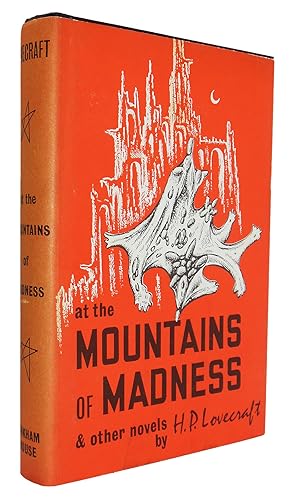
At the Mountains of Madness by H.P. Lovecraft (1936)

“It is absolutely necessary, for the peace and safety of mankind, that some of earth’s dark, dead corners and unplumbed depths be let alone; lest sleeping abnormalities wake to resurgent life, and blasphemously surviving nightmares squirm and splash out of their black lairs to newer and wider conquests.”

Lovecraft is another of those giants of horror who could fill this list all on his own, but I had to pick just one story, and this is one I really enjoy. A group of ill-fated scientists from Miskatonic University make the terrible mistake of going to Antarctica where they find evidence of a race of beings far older than anything known to humans before, beyond a range of mountains larger than any that have ever been recorded. They explore buildings left behind by this civilization, which have been devised through ‘non-Euclidean geometry,’ and find hieroglyphs that help them learn about Elder-things and shoggoths, monsters that populated the place and whom they have foolishly awakened. They escape, but not before losing several members of the party. The novella serves as a warning to others who might want to return to study the antarctic.

Lovecraft has of course been highly influential and much has been written about him and his work. “Who Goes There?”, John Campbell’s horror tale set in the arctic with a group of explorers, immediately comes to mind, as do the films based upon it, including the 1951 version “The Thing From Another World,” as well as John Carpenter’s excellent “The Thing” from 1982.

I think it’s best to learn about Lovecraft straight from the source. There are many entry points for his mythos, but I think this is a great place to start. You could also read the Call of Cthulhu, The Case of Charles Dexter Ward, Dagon, or any number of others. The Library of America has a wonderful collection of his tales that I highly recommend.

So there you have it. Thirty-one tales of gothic terror and wonder over the month of October. I think it’s a pretty good list of some of the gems I’ve read over the years; I chose them in no particular order as the month went by, but I stand by each of them as tales that are either unique, or influential, or just plain scary enough to keep you up at night. Perhaps I’ll choose another 31 next October. For now, I hope you’ve enjoyed perusing this list, and that you’ve been inspired to read something you haven’t before. If you have your own favorites, or if you like what you’ve read, be sure to let me know in the comments.

Happy Halloween!

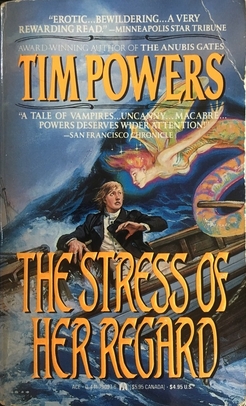
The Stress of Her Regard by Tim Powers (1989)

“Crawford felt drops of sweat run down his ribs under his shirt as he slowly forced the muscles of his neck to tilt his head up; he saw the upper slope, bristling with trees that obstructed a view of the road, and then he saw the outer branches of the tree he was braced against, and finally he gathered his tattered courage and looked straight up.

And it took all of his self-control not to recoil or scream, and he was distantly resentful that he couldn’t just die in this instant.”

Tim Powers has had a long and illustrious career writing historical fantasy, and he ought to be a household name. You can read any of his books and be transported to a different world, but for this time of year I think Stress of Her Regard is a great place to begin. It’s a wonderful tale about Michael Crawford, who accidentally finds himself the object of a nephilim, a sort of succubi that he has unwittingly courted. His bride to be is found dead, and he’s the main suspect. He travels around Europe trying to rid himself of the creature, and meets up with Shelley, Byron, Keats, Dr. Polidori, and others, all of whom are trying to avoid these strange, dangerous creatures. It’s great fun to read and gets my highest recommendation-for those who love literary history and fantasy, it doesn’t get much better than this. I’d also recommend Powers’ other books, which are all terrific. I particularly enjoyed On Stranger Tides, a pirate story, and his Last Call series. He’s one of the best fantasy writers we have, and he’s still going, with his latest book due out this fall.

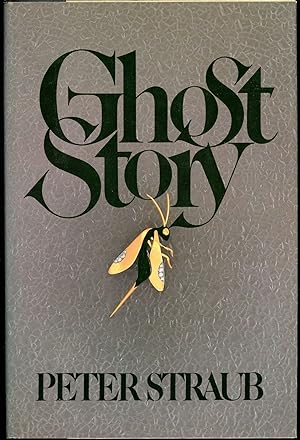
Ghost Story by Peter Straub (1979)

Ghost Story was a great success for Peter Straub when it was published in 1979, and it’s easy to see why. The novel has all kinds of unsettling stories within, enough to keep any reader up late at night. It’s written in the form of ghost stories told by four old men who suffer from terrible nightmares. Their stories from their own youth seem frighteningly believable and really captured my interest as I read. Since the men are elderly, we are reaching back in time many years, learning of strange happenings in rural upstate New York. I happen to live up here, and I felt Straub did a great job in that vein, carrying on the tradition of Washington Irving. The ghost tales become increasingly elaborate, with supernatural events in the present time overwhelming the characters.

I really enjoyed reading this book, which received high praise from Stephen King and others. (King would also collaborate with Straub on two different novels, The Talisman and Black House.) Straub wrote many successful novels and in addition to editing the Library of America’s Fantastic Tales set, which I’ve raved about a few times, he also edited their excellent H.P. Lovecraft volume. He was one of the greats of horror fiction, and this is a perfect starting point for his work.

The Phantom Coach, by Amelia Edwards (1864)

In the grand tradition of Victorian Christmas ghost stories, Amelia Edward’s The Phantom Coach first appeared in The December, 1864 issue of Charles Dickens’ literary journal, All the Year Round. Amazingly, the preceding link is to that full issue (the cover image is below), which I intend to read. Much of the run of this journal is freely available online, thanks to the Hathi Trust, the Internet Archive, and other sources.

The narrator of this tale of the damned is a man named Murray who is traveling across the Scottish moors when a snowstorm hits; afraid he won’t make it back home, he hails a passing stranger and asks for shelter. The man, Jacob, is the servant at a nearby house, but warns Murray that his master will not want him to stay. Jacob reluctantly allows Murray to follow him back to the residence.

The master of the house is at first irritated by Murray’s presence and tells him he has lived in this secluded place for twenty-three years, with no visitors at all for the past four. But the man is eager for news of the outside world—they have a fireside chat during which the old man tells him:

“The world grows hourly more and more sceptical of all that lies beyond its own narrow radius; and our men of science foster the fatal tendency. They condemn as fable all that resists experiment. They reject as false all that cannot be brought to the test of the laboratory or the dissecting-room. Against what superstition have they waged so long and obstinate a war, as against the belief in apparitions? And yet what superstition has maintained its hold upon the minds of men so long and so firmly?”

The man further says that he himself believed in the supernatural, and as a man of science, his career was ruined for it. He speaks with eloquence about various philosophers and scientists, leaving Murray in awe at the breadth of his knowledge; Murray says that he “wandered from topic to topic, from speculation to speculation, like an inspired dreamer.”

When the storm ends, Murray wishes to make his way home, though it is late at night—it’s decided he’ll join the mail coach, which will be passing through a few miles away. Jacob leads him to the stop, and now the story gets macabre. He mentions that a mail coach had crashed over an embankment, killing all aboard, nine years before.

It’s at times like this in most ghost stories when I, and most readers, want to tell the protagonist to find some other way home. Of course, Murray doesn’t. He gets on the coach when it arrives, at first relieved to be out of the cold, until he realizes the awful truth of the matter.

This is a very fun, atmospheric horror tale, and I can see why it has been anthologized so often. You are set up beautifully by the desolate moor, the irritable servant, finally the old man telling tales of the supernatural in a parlor teeming with hundreds of books and scholarly apparatus of every conceivable kind. Incidentally, I want a room just like this, complete with a fireplace and ghost stories and a glass of sherry. If anyone out there reading this wants to help me achieve this, I’d be grateful.

 I came across my copy of this tale in a Dover thrift edition of ghost stories. I’ve loved those Dover editions since I was a young man—for just a few dollars you get some first-rate stories. My college instructors used to kindly assign these editions to their poor students, and I’ve kept with the tradition.  

Amelia Edwards was a woman of many talents: in addition to writing many novels and short stories, she was also a journalist, illustrator, and Egyptologist. Like most of the authors on this list, you can learn more about her life in her Dictionary of Literary Biography entry, though you will need a login to access it.

A Night in the Lonesome October, by Roger Zelazny (1993)

This novel is a wonderful seasonal treat by the legendary Zelazny. Each of the chapters is a night in October, told from the point of view of Snuff, a dog who is the companion of Jack the Ripper. Sherlock Holmes, Dracula, Dr. Frankenstein, the Wolfman, and various other spooky characters haunt the pages of this book, each with an animal familiar, all playing a game that will determine the fate of humanity. I found this book to be a tremendously appealing conceit, such a fun read and so well told. If this kind of story sounds appealing to you, do not delay: sit back, relax, pour yourself a cup of tea and enjoy it by the fire–you won’t be disappointed. If it doesn’t sound appealing to you, that makes me sad and I’d encourage you to try it anyway.

Ozzy

I discovered Ozzy at the height of the Satanic Panic, when I was in the eighth grade. A friend gave me a copy of Blizzard of Ozz and I admit when I first heard it, I found it frightening. The news said this man was Satanic and a kid had killed himself to the music. I was used to the milder stuff and didn’t get it at first. Only on repeated listenings did I start to understand this was Ozzy’s act,  an awfully fun one that upset parents and made kids love him all the more.

No Rest for the Wicked, Bark at the Moon, Diary of a Madman, one after another left their mark. I learned he’d fronted a band in the early mists of time, before I was born, called Black Sabbath. Mind blowing stuff. War Pigs is still enough to give you chills. There’s no better music than this for kids who love Dungeons and Dragons, pulp fantasy novels, and sci fi and horror movies.

He was funny and had a humanity and warmth that made me enjoy his music even more. The Spinal Tap moments on his reality show were priceless, and he took it all in good fun, part of his madcap act. I never saw him, but always knew I could trust a fellow who told me he was heading to Ozzfest. They were always kind souls. I’m so sad to hear he passed away; I feel like I’ve lost a part of my childhood.

What a ride he took us all on. God bless you, saintly Prince of Darkness. Rock on forever.

Hand of God has struck the hour
Day of Judgment, God is calling
On their knees the war pigs crawling
Begging mercy for their sins

Chapter 1, Part 2

In the opening of my new story, we met the denizens of Dogwood Street, a suburban neighborhood, including:

Billy Joe, a drunken reprobate

Simon, a professor

Rex, a strange newcomer who has moved into an abandoned house

Rex has arrived in the midst of Billy Joe’s noisy, drunken stupor, and put an end to it. In the next part of the story, the conflict is ramped up…read on!

If you missed part one, here is the link.

New Project

Here’s the start of something I’ve been working on for awhile. It was supposed to be out this fall, but my plans fell through, and I’ve been looking for a new publisher.

This one is a dark fantasy/comedy about a neighborhood gone bad. Think ‘The ‘Burbs’ meets Haunting of Hill House, with a touch of Something Wicked This Way Comes. I’ll be sharing chapters of it here in the coming weeks.

If you enjoyed what you read, please comment and let me know, and share it.

And Happy Solstice!

Adaptations

If you’d told me when I was twelve that we’d have endless new sci fi/superhero/fantasy movies and shows every single week, I would’ve been ecstatic. But alas, since I’m fifty and no longer twelve, I’m totally disinterested in most of it. Partly this is because I’m no longer a child, but it’s also because I enjoy new and different stories, and none of these gigantic intellectual properties do that. They just make the same exact stories over and over.

A long time ago, in a galaxy far, far away, George Lucas created something special that felt fresh. Comic books did that also, and some still do. Tolkien created a genre that has been well mined for generations. Other writers have done and continue to do this, and some films do as well. But most of the large properties simply make the same thing with slightly different characters or timelines. It obviously sells and many people love it. It doesn’t interest me, though– new and interesting stories do. But these famous, valuable names are like real estate snatched up by greedy developers.

At times, older fans can get prickly about newer things. I’ve felt that way as well, mainly because the experience of reading an amazing novel can never be matched by any movie, no matter how well done. As George RR Martin recently commented, very rarely does a great book get a truly worthy interpretation, but when it happens it’s quite amazing. Dune managed it, in my opinion, and Jackson’s Lord of the Rings did, as well. But more often they just leave you cold.

Don’t adapt this, son. Don’t even try.

Most of these newer films are not made for middle aged guys, so I just accept that it isn’t for me, and go back to the books. But I admit, and as Martin said, I find the arrogance of some of these adaptations hard to believe. Luckily I will always have my bookshelves.

DUNE

“Once men turned their thinking over to machines in the hope that this would set them free. But that only permitted other men with machines to enslave them.” –Frank Herbert, DUNE

The new Dune film is amazing, far better than anything that fans of the book had any right to expect. I loved it. I started rereading the book as soon as I got home; I read the above quote and had to put the book down for a moment. Frank Herbert wrote that in 1965–probably quite a bit earlier, as ’65 is the publication date. What a visionary.

The film changed a few things, but that’s to be expected in a work of this size and scope; it would be impossible to adhere to everything Herbert wrote. At some point I may write up some further thoughts. But suffice to say it was great and left me speechless. Once I finish the first book, I’ll probably continue with the others, too. I loved the first three books in the cycle and enjoyed the next three as well, though I felt they weren’t at the same level of quality as the first two or three.

A good friend of mine also recommended the many sequels written by Brian Herbert and Kevin Anderson, so I may go down that Golden Path, as well.

I’m really in awe of Denis Villenueve and the whole cast of this movie, particularly Javier Bardem, who I felt carried much of the film as Stilgar. We’re lucky that a director as good as Villenueve was able to make this. In my opinion, this achievement is as great as Peter Jackson and Lord of the Rings, and will be remembered for a long time.