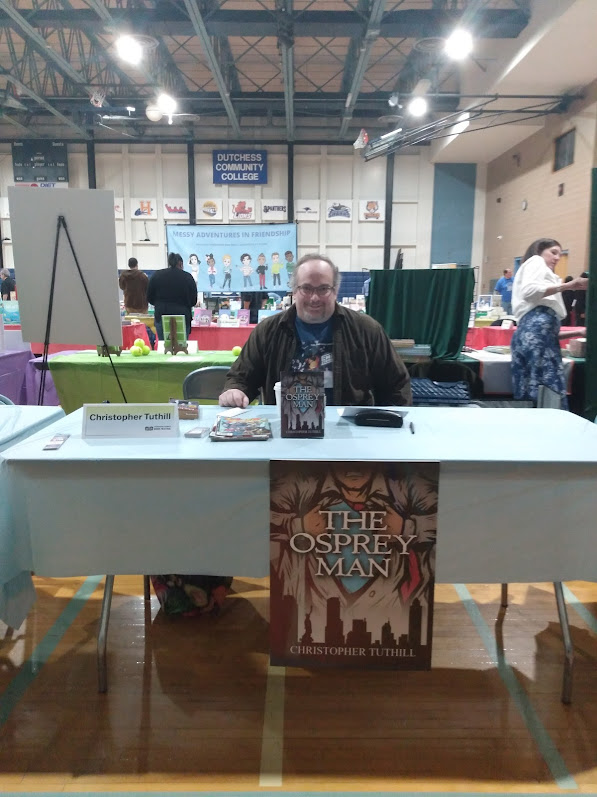
The 2025 Poughkeepsie Children’s Book Festival was a huge success. Many thanks to both the Merritt Bookstore and the Poughkeepsie Public Library, who worked tirelessly to put on a great event. It was really heartening to see so many enthusiastic children and young adults. They’re the next generation of readers and the future of our world, and they need our support.
Many thanks to all the people I met, and to those who bought books from me and the more than 100 authors who were there. My children had a great time, met some authors, and came home with lots of great stuff to read. I hope by next year’s event I’ll have another book to bring with me.
“We are what we pretend to be, so we must be careful about what we pretend to be.”
–Kurt Vonnegut, Mother Night
Today I saw a wild-eyed fellow with a t-shirt that said “Russian Asset” and I immediately looked away from him, since in my experience the sort of nutbag who would wear such a shirt usually wants more than anything to get some kind of reaction from you. I saw him again a few minutes later and he had a hat on that looked just like Elon Musk’s MAGA hats, but instead read “Make America Get Apartheid.”
I was enraged and wanted to knock it from his head. How could someone walk around with this kind of message? What is going on in this country when someone can proudly wear this? In the most generous reading of it, is it possible he was, I don’t know, being ironic? Was this his idea of satire? It really doesn’t matter what his intent was, because YOU CANNOT IRONICALLY WEAR A NAZI SYMBOL. It’s hard to believe this even needs to be said.
Yesterday, the vice president of the United States went to Greenland and said “We must have it” and that “We can’t ignore the president’s desires.” Most Trump supporters I know would probably say he is exaggerating, that it’s all a joke. We have heard this refrain over and over, every time the administration, or Trump, does something outrageous or cruel or warmongering. But they mean everything they say. JD Vance definitely looks on Trump as some kind of God-Emperor, like we’re in DUNE, which is why he speaks of his ‘desires’ as if they’re the immutable will of some divine presence. And all Trump’s followers know this isn’t a joke, even if they say it is. We’re teetering on the abyss, and there’s nothing funny about it.
Over the past few years, there’s been no shortage of folks breathlessly telling us that AI is our new tech to be worshiped, that it is a wonderful and amazing tool that we all must rush to use. It will make life better, and everything will be easier and more effortless. Besides, there is the whole inevitability thing, an argument which tech bros love to shove down our throats, the same way they do with every other technology on which their fortunes depend.
I’d like to offer a different view. AI is a soulless source of junk information, bad writing, and bad ideas. On a personal note, the creators of Meta’s AI program stole my novel, without asking, to ‘train’ their stupid tool. They’ve illegally done this with millions of works, but when called out on this lawless behavior, the companies merely shrug and inform us that there would be no way to train their tools if they had to deal with pesky copyright laws. Authors are powerless in the face of these tech forces, it seems. It’s all inevitable: the bright, shiny future.
Forgive me for a moment if I seem emotional here. My humble novel, The Osprey Man, was a labor of love. I spent years writing it, and years beyond that marketing it, and it finally found a home at a tiny, independent publisher. I made very little money from it, but of course, as any decent writer will tell you, that was never the point. I had a story I wanted and needed to get out there. It may not have sold many copies, but I didn’t care.
My story of publication isn’t unique. There are plenty of writers out there who have done and continue to do the same, despite the odds. Zuckerberg and his lackeys, no matter how rich and powerful, have no right to churn up our work like it’s fertilizer. Yet that’s exactly how Meta and every other purveyor of AI treat the copyrighted works of millions of writers. It’s revolting, undemocratic, downright vile behavior, yet it’s exactly the sort of thing we’ve come to expect from our tech overlords, and no one even bats an eye. In fact, the story barely seemed to make news and disappeared rather quickly.
Aside from the outrageous way Meta has treated authors, there is a much larger issue with AI, and how it’s bound to affect us all. In 1985, Neil Postman, in his seminal work Amusing Ourselves to Death, argued convincingly about the death of our reading culture, and how television had dumbed us down so much that it had reduced our once coherent public debate to mere sound-byte and spectacle. In Postman’s view, things had gotten so bad that Americans elected a nincompoop in Ronald Reagan. I’m sure he’d not be the least bit surprised by America in 2025, where, after a generation of hyper-connectivity and bad information, there seem to be few who believe in facts at all anymore, and we elected a far more ignorant, dangerous man than Reagan as president.
Give AI some time, and we will no doubt have an even dumber public life, one in which no one is able to read or understand anything more complicated than a meme. Where no one knows what reality is, and no one really cares anyway, since it’s AI’s job to figure out the issues and tell us what to think.
I’ll be at the Poughkeepsie Book Festival this Saturday, 3/29 at Dutchess Community College with copies of my YA novel, The Osprey Man. Hope to see you there! #poughkeepsiebookfest #poughkeepsiepubliclibrary #bookfestival
On the occasion of my birthday, my four year old son brought me a package he’d wrapped himself, and proudly announced: “You got books, dad. They’re your favorite thing.” He dutifully unwrapped them, commenting on how nice they were, and handed them to me one by one. Even better, he gave me a card he’d written himself, his eyes shining with pride, grinning from ear to ear. He wants to read them with me and play the boardgame I got, too. He’s a keeper.
Each day is a chance for a new start. Today I wish to reflect on all the amazing things I’ve been blessed with: firstly and most important, I have a beautiful, amazing family that brings me no end of joy and laughter. We have everything we need. I get to work as an educator and try to help others. I have so many lifelong friends that are like an extended family to me. Every day is a blessing and I’m so lucky to live the life I do, which is so full of outstanding people.
As I get older, I think that perhaps we need to start each day recounting such blessings and being grateful for them. Times may be difficult, but many have lived through such times, and a shift in perspective may help us weather this and one day come out for the better. So I wish anyone reading this, no matter what your road, all the best, and may your days be full of happiness and joy.
“i thank You God for most this amazing day”
e.e. cummings, 1950
i thank You God for most this amazing day: for the leaping greenly spirits of trees and a blue true dream of sky; and for everything which is natural which is infinite which is yes
(i who have died am alive again today, and this is the sun’s birthday; this is the birth day of life and of love and wings: and of the gay great happening illimitably earth)
how should tasting touching hearing seeing breathing any—lifted from the no of all nothing—human merely being doubt unimaginable You?
(now the ears of my ears awake and now the eyes of my eyes are opened)
My opinion of the new Jethro Tull album doesn’t make much difference, but here it is anyway: it’s a total joy to even have one. Since I was a teenager, this has been my favorite band, and there will come a day that I won’t get any more new ones, so I’m enjoying the hell out of it.
We’ve been lucky enough to have three new Jethro Tull albums since 2022, and all of them have been fantastic. The Zealot Gene was a tour-de-force of biblical proportions, mingling sacred text and modern life, while 2023’s RokFlote was an epic exploration of Norse myths. Curious Ruminant is perhaps more down to earth, more contemplative, but no less searching–it’s a truly impressive artistic journey that gets better with repeated listenings.
The album should be listened to straight through, in one sitting, if you can manage it. As with all of Ian Anderson’s best records, this one ebbs and flows and gives the listener the feeling they’re looking at a giant canvas, revealed bit by bit, or reading a complex book and learning more in each chapter.
The opening song is the high-energy ‘Puppet and Puppet-Master,’ a reflection on the songster and his audience. We know we’re in capable hands as the band shows its chops with some fine electric guitar, organ and flute solos as Anderson delivers his tongue in cheek dramatization of what it’s like to get up there every night and play. “Holding court on a black box stage, dangling from the strings, I twirl and face the music,” he sings; the subject matter reminds me of ‘A Raft of Penguins,’ from his excellent 2003 album, Rupi’s Dance, which was a song about his nervousness in playing with an orchestra.
“Dunsinane Hill” is a real treat if you’re a Tull fanatic who also loves Shakespeare, like me. Having grown up in Scotland, one can only imagine how much MacBeth must have inspired Ian over the years. I absolutely love this song and it’s conceit: intrigue between two politicians discussing betrayal. Here the flute plays a merry folk tune even as the narrator says “I look over my shoulder/To see my brother warrior, damned spot to wash away.” I give this reimagining of the bard ten out of ten stars.
“Stygian Hand” is a sort of companion to Dunsinane thematically. Have you ever been nervous walking down a dark street alone? Here’s a song to help you. Bring a symbol of faith to ward off the devil and hope for the best. The accordian features prominently on this one. It’s a fun song and gives bit of levity to the otherwise fairly serious proceedings on this album.
“The Tipu House” is another up-tempo number, and here Anderson is singing of ‘All God’s children’; the subject is a tenement Anderson saw in Barcelona, and the residents, including young kids playing in less than ideal conditions. The flute is as manic as on any Tull track, the melody will leave you humming. It’s neat trick, to get an audience feeling empathy for their fellow man even while tapping their feet and singing along.
Other songs in this collection continue to encourage us to recognize our shared humanity, including the nearly 17 minute “Drink from the Same Well,” a fantastic piece of music that’s a meditation on differences that drive people apart. It seems a plea to remember that we’re all human and are worthy of respect, much as Aqualung was. The music is eastern-influenced, and Anderson said the bulk of the instrumental work dates from 2007, which explains why it would not sound out of place on his albums of that era.
“Over Jerusalem” is a song of lament for Israel that sounds like it could have been the twin of ‘Swing it Far’ from Thick as a Brick 2. You get the sense that Anderson, who has played in Israel many times over the years, donating all the money to charity, is as deeply saddened by the current situation as anyone.
“Savannah of Paddington Green” is a song about ecology, a subject Anderson has written of before, most famously in “Skating Away,” way back in 1973. “Threatening species, we turned on ourselves, like others before us, now left on the shelves,” he sings, wondering what the future may hold for our planet.
The final track on this one is a sort of goodbye, called “Interim Sleep,” a meditation on one’s final act. Most of us don’t want to think of the end, but I suppose Mr. A feels the weight of time.
“When interim sleep takes me
I want you close beside
No tears, no sad goodbye
I am calm and still as a fallen autumn leaf”
This is really quite sweet, and moving, as well as very unlike most Jethro Tull songs in that it’s personal and straightforward. Anderson has always preferred things that are more abstract, but that isn’t to say he lacks emotion. After all, his most famous song is a searing heavy rock number about a homeless vagrant, featuring a face melting guitar solo that Jimmy Page himself approved of as it was played. The best Tull songs are like this, melding high and low, profane and holy, mundane and beautiful.
The title track has the classic sound of this band–heavy guitar, flute, coupled with philosophical lyrics. Anderson is pondering life, ‘asking why am I here, answering, why am I anywhere,’ and ending with ‘cogito ergo sum.’ At 77, he’s as much a seeker as he ever was. I’m glad he’s taken us all along for the ride, and I sure hope it doesn’t end anytime soon.



 Christopher Tuthill