Regarding publishing woes and other writerly problems, I’m reminded of the sage words of Tommy Lasorda: “Eighty percent of the people who hear your troubles don’t care and the other 20% are glad you’re having them.”
The less said about it, the better. I learned some things, and it’s time to move on.
Hello all! Thanks to those of you who have purchased a copy of The Osprey Man. As I wrote here last August, the publisher of the novel, Daniel Willis, passed away. There was talk of his company, DX Varos, being sold to a new publisher, but that hasn’t yet materialized. I have not received any statements or royalties since Daniel’s passing, and so I want to ask that if you are thinking of buying a copy, PLEASE DON’T USE THE PUBLISHER SITE, as I’ll get nothing from it and will have no way of knowing it sold. I don’t even think the publisher is still fulfilling orders. If you want it, please write me directly–I have some copies left that I can sign and sell.
I am working on getting my rights back to the book, as it seems the publisher is no longer functioning. Thanks again for your support of the book.
I have other things in the works that I hope to share soon.
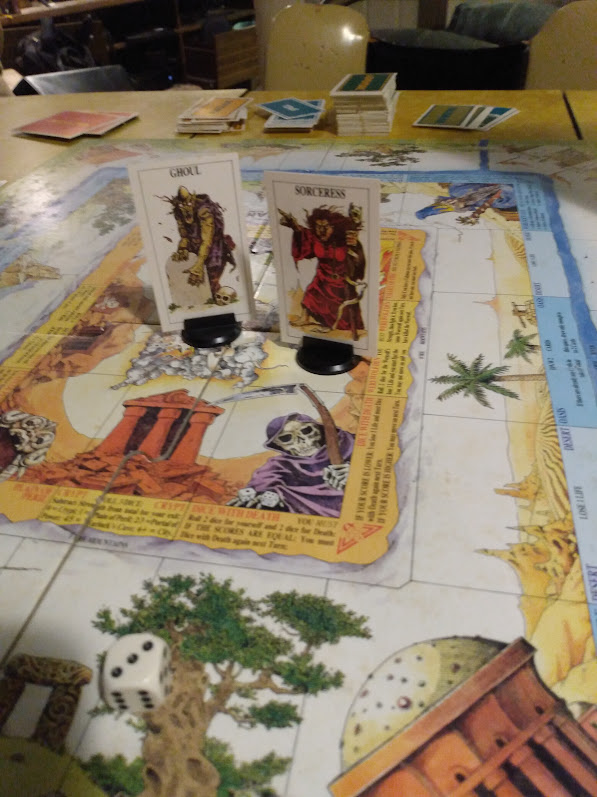
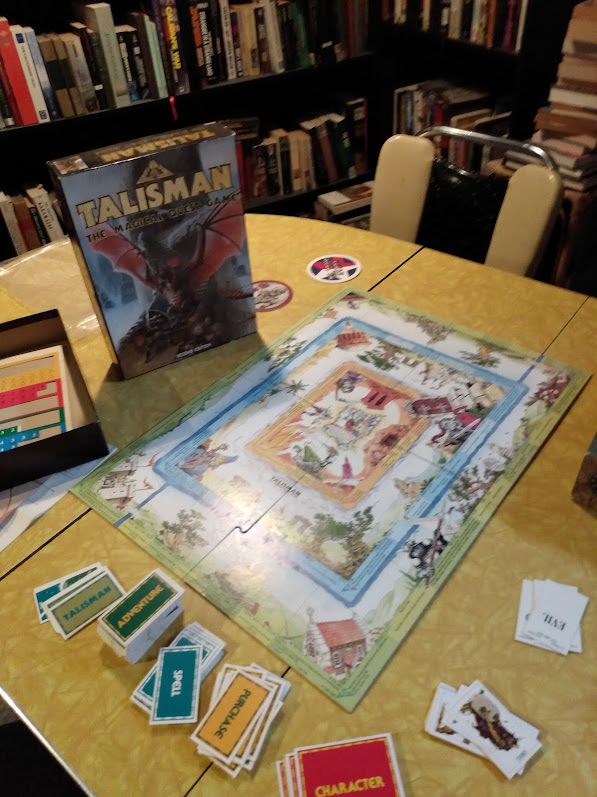
I started playing Talisman in the late 1980s, when the second edition was widely available at gaming shops across the land. My friend had a copy of it, as well as all the expansions, and between sessions of Paranoia, Dungeons and Dragons, Car Wars, or Tales From the Floating Vagabond, we played Talisman. It’s quicker than an RPG campaign, but has a great fantasy theme to it, and an epic feel that always kept us entertained for hours of play.
As teens, my friends and I had a hard time getting together every week to play RPGs, but the great thing about Talisman was that you could choose a ready made character and get adventuring right away—there’s no lengthy campaign and if some of us couldn’t make it, we could play anyway, without a well thought out campaign getting messed up.
In Talisman, you draw cards, attempt to level up, and move across the land until you are powerful enough to challenge the center region of the board. If you try this too soon, you’re liable to be quickly destroyed, so a lot of the game tends to be adventuring and trying to kill monsters and increase your strength or magical ability. The title of the game refers to the magical object you need to enter the final space on the board, ‘The Crown of Command,’ where you can cast the command spell and kill everyone else on the board.
The game encourages you to backstab and attack your friends, which is part of the fun, as long as everyone has a sense of humor about it. (I learned through experience that not everyone does.) Most of the fun was messing around, joking about whatever werewolf or dragon or ghoul you had to fight, losing your gold, losing lives, and generally just roaming the board, trying to improve your stats. Some people find this boring, but my group of friends loved it. It was perfect for us, and would always become a lengthy game of improv, with the knight making dramatic pronouncements as he attempted to banish an evil spirit, or a troll grunting his way through combat with a giant spider. We’d feign outrage and hurt feelings as our friends attacked us, stole our gold, or assassinated us. As soon as we could we’d try to even the score and level up. Some of our friends only played once, as they took it more seriously and didn’t enjoy the verbal sparring, but I could never understand why. If you’re an adventuring warrior, you must expect some chicanery now and then.
I absolutely loved this game, and had a million laughs in many, many hours of play with my friends. We continued playing it in college, but as time went on and friends moved away, our group stopped gathering, and that, as they say, was that. After college we all had jobs and too much to do to spend an entire Saturday goofing around in taverns and trying to fight monsters. Some years later, I asked my friend what happened to his game, but it was long gone, likely cleaned out of the attic by his mom.
I always found time to play other games, and have had copies of Catan, and others hanging around for years. Occasionally I’d play a one off rpg with friends. When I saw that Fantasy Flight had done a 4th edition of Talisman, I immediately got it, and played it often with friends and family. Some of my old group enjoyed it for nostalgia’s sake, and it still has a wonderful fantasy theme to it. To be honest, the 4th edition is a fantastic game, probably more involved and better than the one I played in the 80s.
Even so, there was something I missed about that Games Workshop edition. I wanted to have it, loved the art, and it had imprinted on me at such a young age that I was overcome with nostalgia whenever I saw an image of it. Alas, copies of it went for hundreds of dollars.
Today, we live in a golden age of boardgames. There are a great many good ones, award winning wargames and eurogames and cooperative ones and everything in between. I’ve become something of a collector of games and play them as often as possible with my children. I’m particularly fond of Tolkien themed boardgames; there were only a few of these back in the day, and now they are everywhere, and they’re all great.
Yet even as I acknowledge that these newer games are more sophisticated, I miss the simpler games of my youth, the ones that have a short rulebook, some evocative fantasy art, some simple mechanics, that allow a lot of free reign to just mess around with your friends. I really enjoy plenty of current games, but I truly love the ones I played as a boy.
There’s something to be said for a simple hack and slash fantasy experience, a real meat grinder of a game that encourages reckless aggression and where a bad roll of the dice can kill your character off forever. It’s funnier this way, more chaotic but just as enjoyable to me, or more so, than a game that rewards careful, smart strategic play.
Let’s say you’ve played a conservative game and outmaneuvered your friends. Guess what, Einstein? You just rolled a one. You’re dead, and you have only two lives left. Next turn, you roll a one again. Now you lose all your possessions and become a toad for three turns. On his next turn, your best friend comes and steals everything you worked for and then squashes you. Back to the drawing board, genius. You’re done. It’s hilarious. I love it.
You may also find yourself in the lead for the entire game, only to have some bad rolls in the end and lose to your friend who had been running so far behind the entire game you forgot she was even playing.
As board games go, Talisman is chaotic neutral, the funniest and greatest alignment you could possibly have. It’s unreliable, irritating sometimes, kind and generous one moment and brutally vicious the next. Kind of like life.
And so, of course, in my middle age, I could not resist getting a copy of the second edition. Some poor soul out on ebay parted with this beauty for a reasonable price and made me very happy. I can’t wait to get the old gang together so we can share some laughs and maybe a dagger in the back.
The library newsletter has a nice picture of my book, along with several others, in an ad for The Poughkeepsie Book Festival. It’s going to be on Saturday, March 30 at Dutchess Community College–I’ll be there with copies of THE OSPREY MAN. Hope to see you there!
I don’t like to write up rants about gigantic companies–such screeds are pointless and only serve to make me angrier. But I just wanted to spread the word about how rude and awful optimum was when I tried to cancel service, and to urge anyone reading this to stay away. I’ve had their internet and phone service for close to a decade, but the service has gotten pretty spotty as my bill crept higher each month. They offer much cheaper options for new customers, but if you’ve been with them for years they tack on new fees every month, until I was paying over $100 for service that started out at around $50 8 years ago.
In the past, I never switched because I knew it would take a lot of hassle and time on the phone. This is why no one bothers to change providers–it is a maddening experience. But I finally saw a much better offer from verizon, offering hundreds of dollars in credits, a 5 year price guarantee, and to really sweeten the deal, a new xbox. So, I decided to switch, against my better judgment.
I knew it would be a pain in the neck, but it was much worse than I envisioned to quit optimum. I’ve never experienced this kind of thing in the past; if I was trying to switch phone or internet or tv providers, maybe a salesperson encouraged me not to quit, but then they just processed my request and it was done.
This time, it took me two+ hours on the phone, multiple callbacks, intentional disconnections from their call center, lengthy waits, constant belittling pressure and badgering to stay with optimum, followed by a bunch of lies and extremely rude and petty behavior from their staff before I could successfully quit. To make matters worse, they charged me for an entire month of service, when I was 2 days into my latest billing cycle. A hundred bucks for two days of service. I told them that if there was ever a chance I’d stay, or come back, it’s gone now. Companies used to pro-rate these things for you, but it seems those days are over.
Then, bizarrely, they called me a couple of times the day after I returned all the equipment, promising lower rates, a reduced final bill, better service for less money, 3 months credit, and a $200 dollar gift card. I couldn’t stop laughing at this. I asked why they didn’t offer this in the first place, as I would have probably stayed with them and avoided the whole ugly ordeal.
Stay far away from optimum, a terrible company that uses pressure tactics and gets very nasty when you try to quit. I’m sure my new company is probably just as heartless but for now I’m happy with the new service.
I imagined for a moment that I was trying to describe today’s entertainments to an alien from another planet:
“There are two teams of exceedingly manly men. They will fight over a ball. A large crowd of people pay thousands of dollars each to witness the spectacle. Many, many millions more will waste an evening at home to witness it, broadcast on large screens. A very great many males wish they were just like these gladiators. They watch their every move and speak of them endlessly, ignoring everything else around them.”
“Are these gladiators playing for money? For their lives?”
“For money, and fame.”
“They’re trying to lift themselves out of poverty?”
“No, most of them are fabulously wealthy already. But forget about that for a moment. There is something else at work here. A world-famous, glamorous singer is at the event. Her mate is a celebrated player. She is very happy when he does well. It brings her joy.”
“OK.”
“This makes many men watching the spectacle at home insane with rage.”
“Why?”
“No one knows why. But these middle-aged, portly, lonely men are so, so angry. And these same men also wish for a dictator to take over their land.”
“What does a dictator have to do with the famous entertainer?”
“No one knows. But they say it is an enormous conspiracy.”
“To what end?”
“No one knows. ‘Tis a mystery, traveler.”
“What happens when the game is over?”
“The side that wins is very happy and they gain fame and riches. Everyone else must go back to work.”
“What about the singer?”
“No matter what happens, she remains rich and famous and enrages the lonely old men.”
This World War I game from GMT is probably the most involved, epic wargame I have ever played. Like other games from GMT, this is big on strategy and history, and rewards thoughtful, careful gameplay. Pick your side: The Allies, or the Central Powers.
The game begins in August 1914, and each turn takes one season. Each side receives six turns in this season, in which they can use one of seven cards in their hands to move troops, reinforce, attack, or play other historical events that help their cause. Each side is trying to raise their Victory Point threshold high enough to end the game, before either time runs out in 1918, or an armistice is reached, giving victory with the side who has a better VP total.
I won’t lie–the rule book for this game is a bit daunting when you open the box. It’s thick, with lots of detail. But my eleven year old son read it and was conversant with the rules and eager to play. So it’s not too complicated for someone who plays a lot of Axis and Allies, for example, but it will require some effort, time, and a love of history to enjoy.
I found this game to be a really engaging way to learn some things about the first World War. As my son said, “I feel like I am re-living history, with alternate outcomes for a lot of these battles.” Granted, my son is a history buff who loves to read, but to me that is a high compliment indeed for any game.
After around 12 rounds, or three years, we found ourselves in almost exactly the same VP totals as when the war started. It’s not easy to pull ahead in this–armies get entrenched and are hard to defeat. We fought for years on the European front, with neither side scoring a decisive victory until we neared the game’s final act, when the US entered the war and the allies defeated the Germans. It was quite a mirror of the actual war, with many lives lost even while there was almost no movement in the trenches.
I give this game my highest recommendation. It was clearly made with a lot of care and attention to detail. It takes some time to learn how to play–we had it set up over multiple weekends, and only finished our first full game after probably 8-10 hours of play–but it’s worth it. The board is beautifully produced, the rules are clear, and the sense of history is quite strong as you play. If you’re a history buff or a wargamer, this is a great game, well worth buying and playing. It isn’t cheap; you can find a copy for around $80. GMT sometimes runs sales on their site, which is a good way to pick this one up.





 Christopher Tuthill