The Dying of the Light

I recently finished George RR Martin’s 1977 Science fiction novel, The Dying of the Light; I saw him speak last October and among other things, he was talking about his earlier career, so I was eager to track this one down. In the 70s, Martin wrote this novel and other stories in his “Thousand Worlds” science fiction setting. Since I’ve enjoyed so many of his other books, I wanted to give this one a try.

The novel is set on “Worlorn,” a dying planet that has recently hosted a worldwide festival. Dirk T’Larien, the hero of this tale, journeys to Worlorn after receiving a ‘whisperjewel,’ a token of love, from his former girlfriend Gwen, for whom he’s been lovesick. He arrives hoping to be reconciled, but instead is met with a strange set of circumstances and a love quadrangle that goes south very quickly.

Martin did a credible job in this novel of creating some alien cultures that are difficult to wrap one’s mind around. Gwen is now involved with a man named Jaan Vikary, who is from a brutal culture called Kavalar, in which women are treated as property. Another Kavalar man shares her in this revolting arrangement, and there is a lot of discussion of the harsh conditions that caused the Kavalar to become so regressive. They are descended from humans, but have taken human culture in a strange direction after centuries of living through plagues and nearly dying out. As a Star Trek fan, they reminded me a bit of Klingons, holding honor above all else and demanding combat when insulted.

Dirk is puzzled that Gwen, who seems surprised to see him, has no interest in rekindling their relationship; Dirk had figured that the whisperjewel was a cry for help from her desperate situation. Eventually, he learns that someone else sent it to him, to lure him to Worlorn. He is drawn into a conflict between Gwen’s lover and other Kavalar on the planet who want them dead. There are some fun action scenes throughout, and I think that fans of Martin’s other work will be pleased with this novel from earlier in his career.

For me, the setting of this book was really interesting. A dying world that hosts an armageddon-type festival and is then abandoned as it dies is a neat idea. Martin has a lot of interesting history of the Kavalar through the book, and at times it feels like this could be a sourcebook for a science fiction RPG. There are plenty of twists and turns in the plot, as in Martin’s more famous works. He would later masterfully develop these kinds of plot elements in A Song of Ice and Fire, and it’s really fascinating to see this early career effort from him. It’s got a lot of DNA that would turn up in Game of Thrones and is an enjoyable science fiction adventure, provided you don’t mind some grimness. If you’re a Martin fan, that is probably not an issue for you.

This was a fun book. I really enjoyed Martin’s other early works too. Armageddon Rag is a great read about a cursed rock band, and his vampire book, Fevre Dream, is another one that any Martin fan will enjoy. I’m working my way through his collection of short stories, and also have his novel with Lisa Tuttle, Windhaven, in my to be read pile.
One Bite at a Time

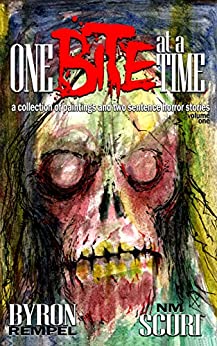
I very much enjoyed ‘One Bite at a Time,’ a book with the subtitle “a collection of paintings and two sentence horrors,” by N.M. Scuri, and illustrations by Byron Rempel. This book was enormous fun to look at and pore over, with some really chilling and darkly funny tales that I had a great time reading.

“Hell is a Library” was one tale that cracked me up. As a librarian and twilight zone aficianado, I loved this, which said simply “I’m the last man on Earth, and I can read all I want. Now where are my glasses?” The accompanying illustration is a man with his back to us, in a seemingly apocalyptic landscape. “A Dainty Dish” was another memorable entry, with a painting of a tentacled monstrosity beside the ominous words: “The Old One Cthulhu, baked in a pie.” And there are plenty of zombies here, too, of the human and animal variety, as in “Red Rover,” in which a canine pal keeps on killing even after he’s been dead a month.

Many of these stories sound like they could be the opening of a great short story or novel, the seeds are here for some fun stuff. Scuri has some precise, tightly controlled language to set the atmosphere for the really wonderful paintings, which reminded me of Ralph Steadman’s illustrations of Hunter Thompson’s books.

I highly recommend this engaging collection for fans of horror, comics, and poetic writing. It’s a unique book that is loads of fun. This was listed as “Volume One,” so hopefully there will be more installations to come.

In “Thirteen Stories and Paintings,” Scuri and Rempel take the idea a bit further. Here we have similar kinds of haunting illustrations, with flash fiction horror tales. “Hooked” is one such memorable story, about a night of scary storytelling that goes horribly wrong. “The Sad End of Perry Belmon” is a Joker-like tale of a lost soul, trying forever to win friends, yet always failing miserably. This is another fine, ghoulish collection of stories and art that I think would please horror fans, folks who like The Walking Dead, who enjoy Lovecraft and Poe and Stephen King and all the better things in life that make us uneasy.

Check these books out! They’re fun and engaging and I think you’ll like them as much as I did. You can find them on amazon.

Happy New Year

“It’s common in Old English to count time by ‘winters’ – to speak, for instance, of someone having lived a certain number of ‘winters in the world’ – and we’ll see that winter is a season which looms large in Anglo-Saxon poetry.” –Winters in the World, by Eleanor Parker

I’ve been reading a wonderful book, “Winters in the World,” by Eleanor Parker, in which she takes readers through the medieval Anglo-Saxon calendar. A really enjoyable read, and she is so adept at making Old English, and some pretty arcane subjects, accessible to non specialists, which is a rare gift in academic writing.

Winter for us is a time that might be rather irritating or difficult, especially if you live in an area that gets lots of snow and cold weather. To ancient peoples, it could mean death. In a modern context, George RR Martin did a wonderful job of using winter as an oppressive force to be feared. Parker takes the reader through Anglo Saxon poetry that spoke of winter and its hardships–it’s a journey well worth taking. I highly recommend this book.

I’m just up to the section on Candlemas, which was celebrated February 2, when the Christmas season came to an end. I propose we go back to having the entire month of January off and starting up work again after Candlemas. It’s the right thing to do!